

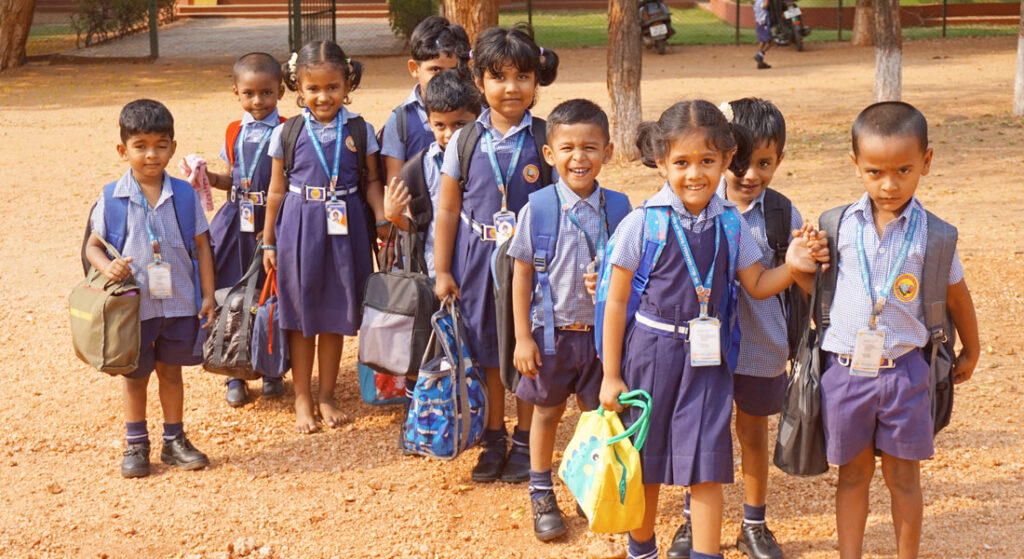
The school bus sways gently as it navigates narrow, uneven roads cutting through the countryside of Theni in Tamil Nadu. Outside, green paddy fields stretch towards the horizon. Recent rains have left stretches of mud and potholes, while thorny bushes edge the roadside. However, inside the bus, the mood is entirely different.
Children chatter excitedly as they make their way home after school. Packets of groundnut chikki and murukku are passed between seats. Students from Classes 1 to 5 share the ride home, laughing and exchanging stories from their day. Some gaze out of the window at the passing fields, while a little boy, exhausted after a long day at school, sleeps peacefully on his teacher’s lap.
Just a few years ago, many of these children would have walked five kilometres to school. Some would have traversed through 8–10km on the same difficult roads that the bus now navigates with ease.
The school draws students from neighbouring villages, where most parents work in the fields, weaving units and small-scale industries.
The new buses are taking the students of Srivalli Varadaraj Matriculation Higher Secondary School, near Andipatti in Theni, back home. While the yellow vehicles may seem like a simple addition to the school campus, they represent something much larger. “Access to education; for children growing up in rural communities, opportunities are often limited by distance and circumstance. These buses help bridge that gap,” says the school principal V Rajendra Prasad.
Built on a spot surrounded by sugarcane farms and coconut groves, away from noise and pollution, is the Srivalli Varadaraj Matriculation School in a village close to the Vaigai Dam in Tamil Nadu. The township, Varadaraj Nagar, is named after the Coimbatore-based industrialist, educationist and PDG of then RID 3201 G Varadaraj, from the PSG family. GV, as he was affectionately known, was also a Rajya Sabha MP.
The genesis
When GV requested former TN chief minister M G Ramachandran, a close friend, to approve the setting up of a medical college in Coimbatore, MGR suggested that he build a sugar factory near his constituency, Andipatti, a sugarcane belt. Thus was born Rajshree Sugars and Chemicals in what was otherwise a barren land with little employment opportunities. Today the factory is a source of income for several thousand villagers and sugarcane farmers. Rajshree Pathy, GV’s daughter, is its managing director, and charter president of RC Coimbatore Texcity, RID 3206.
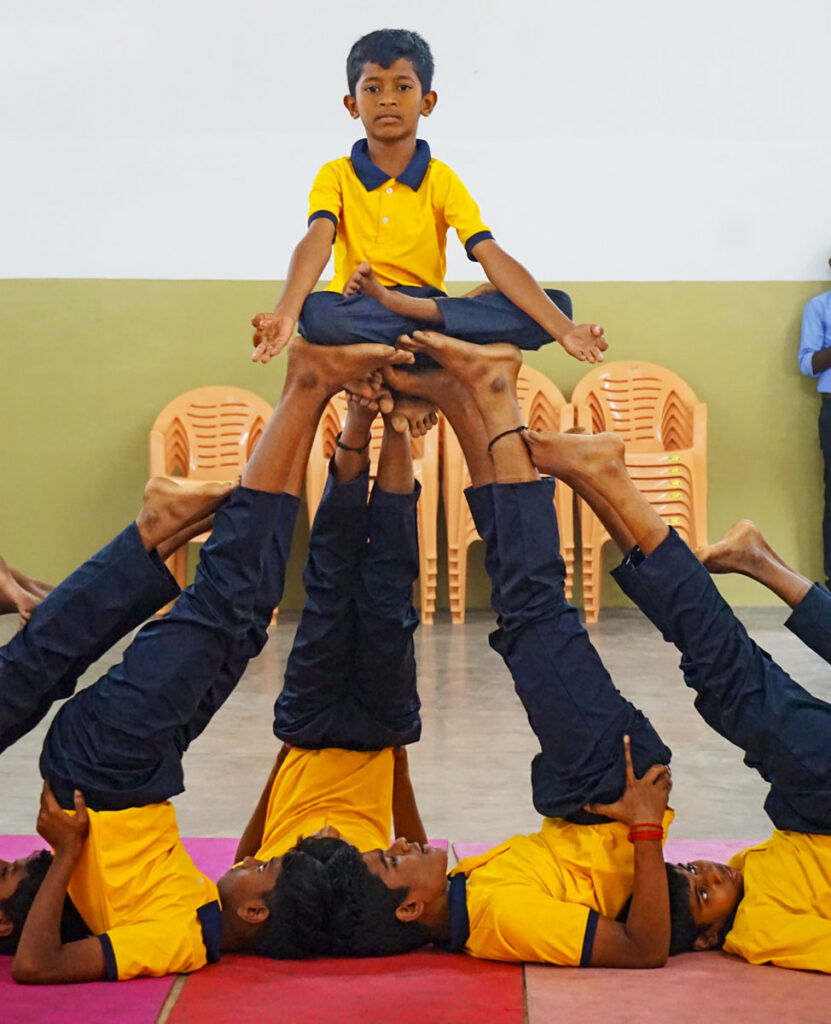
Having ushered in substantial economic development around the area, GV wanted to construct a school for the children in the region, but passed away before this could be done. Rajshree turned her father’s dream into a reality in 2007 by setting up the school on an 18-acre plot near the factory.
The present
The school draws students from neighbouring villages, where most parents work in the fields, weaving units and small-scale industries. “Among our parents, the most financially secure is a bus conductor,” smiles Prasad.
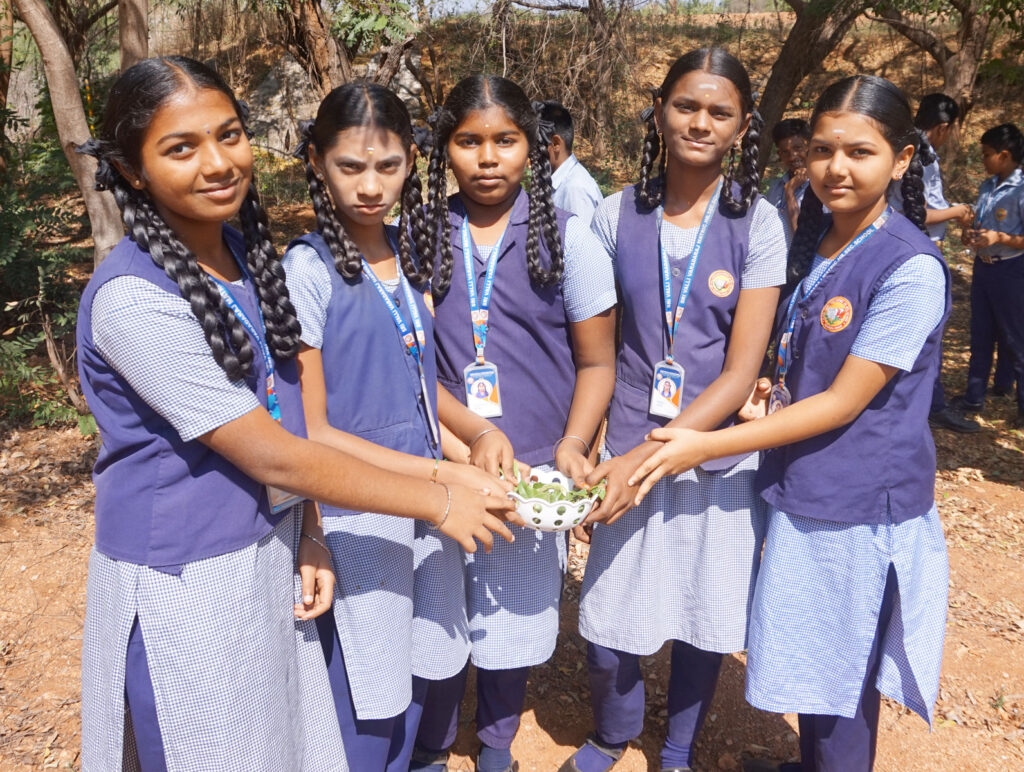
Most of the students are first generation learners. “The parents are keen to give them the school experience with the hope of building a better future for them. We want to give them a good education, help them believe in themselves and make sure that no child misses out on learning because his family cannot afford the fees.”
The Rotary connection
Rajshree chose PDG S Krishnaswami, a member of RC Madras, RID 3234, who was a trusted friend of her father, as mentor and advisor to the institution. He continues to play with dedication. Over the years, he has mobilised support from fellow Rotarians and friends. He rarely speaks about the children’s hardships. Instead, he talks about their talent, potential and determination to succeed. “When I meet friends and fellow Rotarians, I tell them about our students and how bright they are. I invite them to visit the school and see for themselves,” says Krishnaswami, Many do just this.
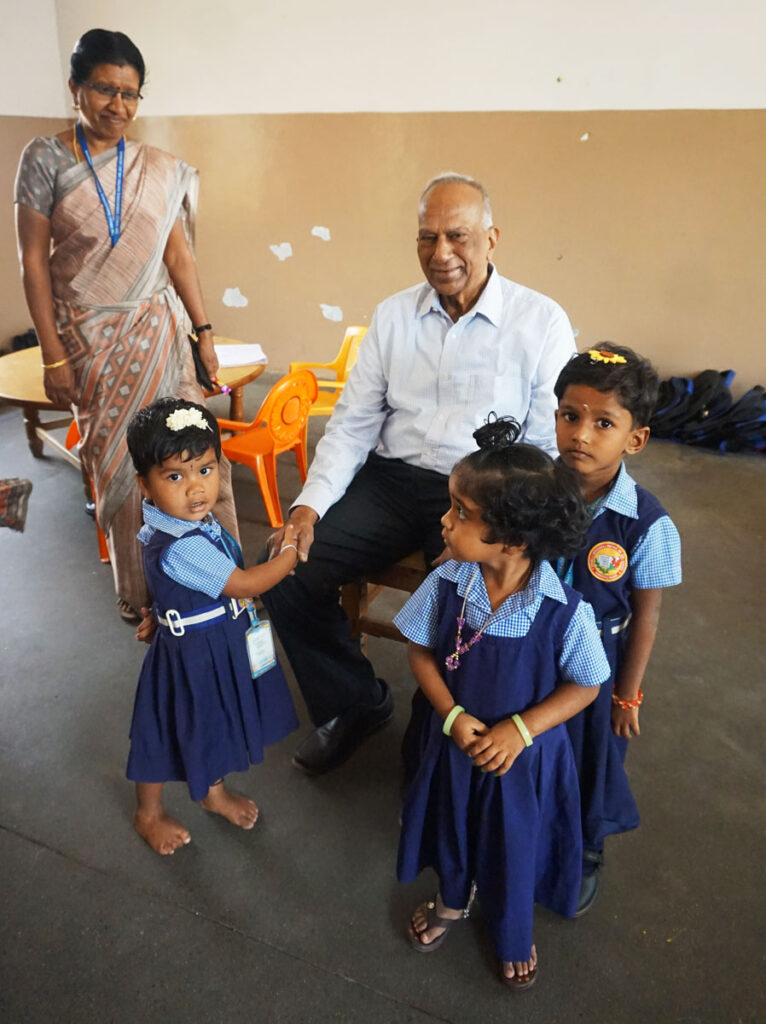
“What begins as a casual visit often turns into a lasting connection. Visitors meet our confident young students, dedicated teachers and families who place immense value on education despite limited means. They leave inspired not by a sense of pity, but by a belief that these children deserve the same opportunity as anyone else,” says Prasad. Over time, those visits have grown into a network of Rotary partnerships that have helped the school improve transportation, infrastructure, technology, teacher training and access to opportunities for these students.
Under a global grant of $59,388, RC Coimbatore, RID 3206, along with RC Wynnum and Manly, RID 9260, Australia, has provided two school buses and classroom furniture.
A second GG valued at $71,500, brought together RCs Madras Coromandel, RID 3234, and Cataraqui-Kingston, RID 7040, Canada, to provide two more buses and support for teacher training.
Over the years, Rotary clubs, individual Rotarians and well-wishers helped the school secure computers worth around ₹20 lakh, RO drinking water systems worth about ₹3 lakh; build compound walls and establish scholarships. Recently an HPV vaccination drive was organised by RCs Theni Stars and Dindigul Queencity, RID 3000, with sponsorship from RC Madras, RID 3234. Nearly 70 students received the vaccine.
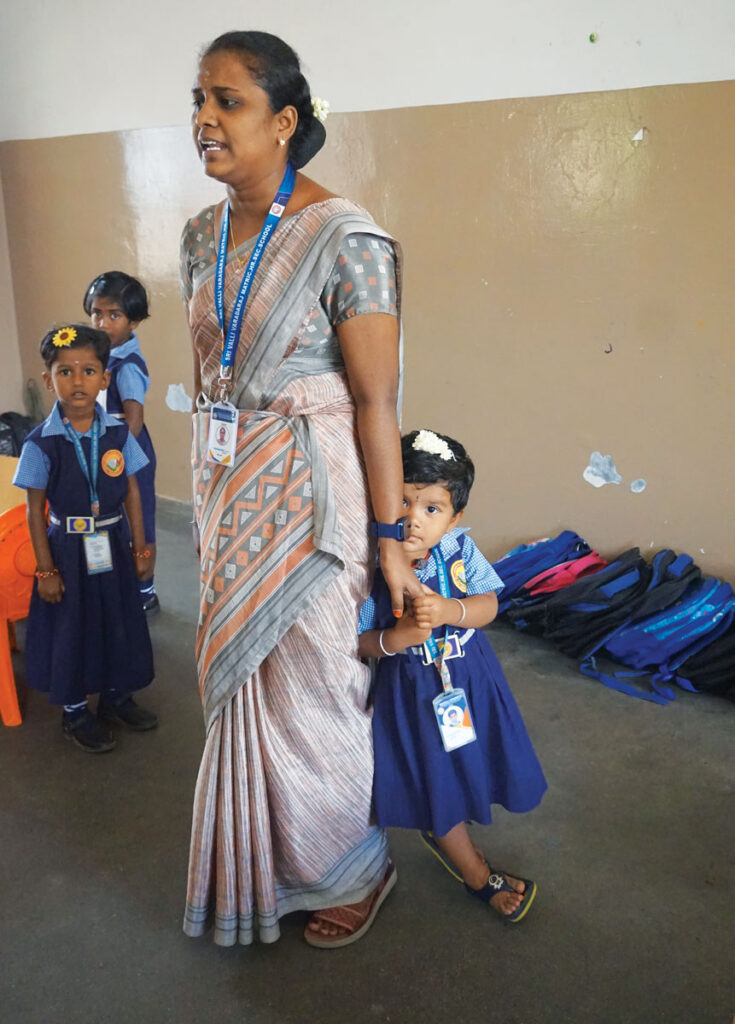
Krishnaswami recalls a recent visit by a group of Freemasons who, impressed by the school and its students, volunteered to pay the fees of three students. “When visitors come here, they don’t see a problem to be solved. They see children with potential. They want to help them continue their education,” he says.
Inside the classroom
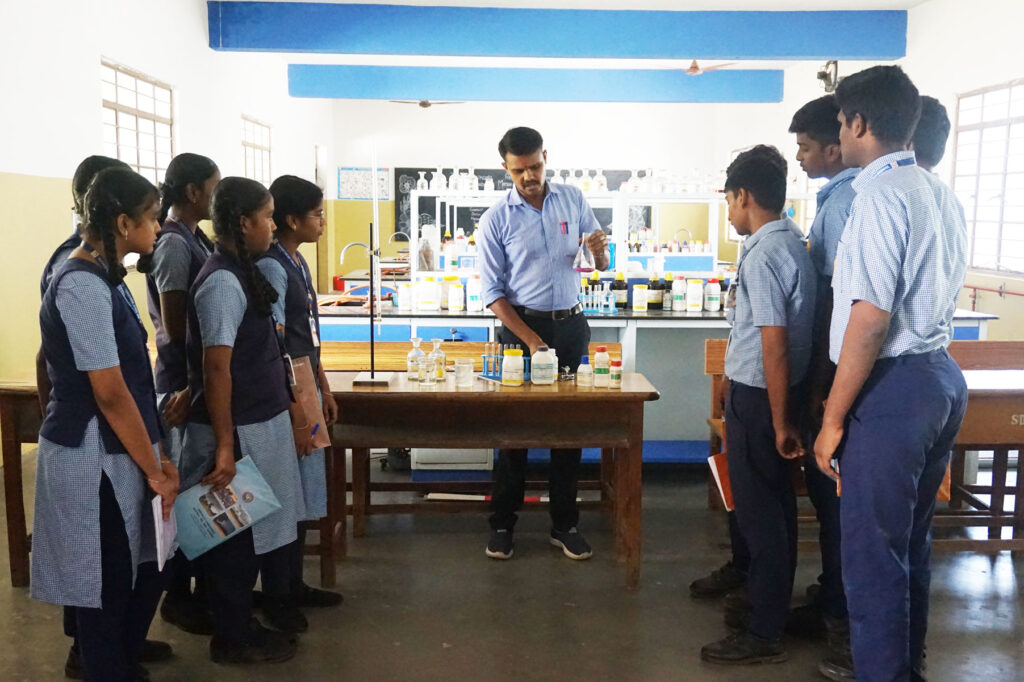
Most students converse confidently in English. “This is a remarkable achievement considering many are the first in their families to receive formal education,” points out Prasad. They regularly take part in debates, elocution contests and other inter-school events. In the STEM lab, students proudly walk visitors through their projects, explaining concepts and experiments with surprising ease.
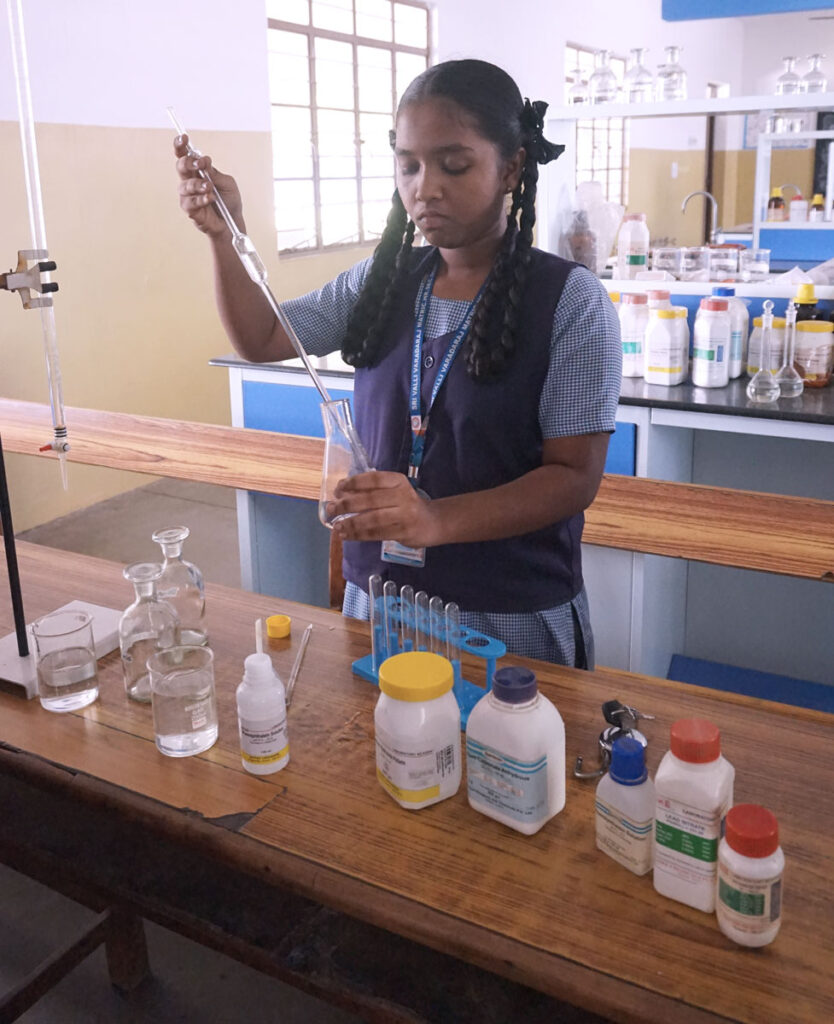
Well-equipped laboratories and well-maintained toilet blocks and wash stations for boys and girls complete the picture. Three medical examinations — skin, eye and dental — and education on menstrual hygiene for the adolescent girl students and career guidance seminars are conducted every year.
“Students from neighbouring schools regularly visit our lab facilities for practical classes,” says Prasad.
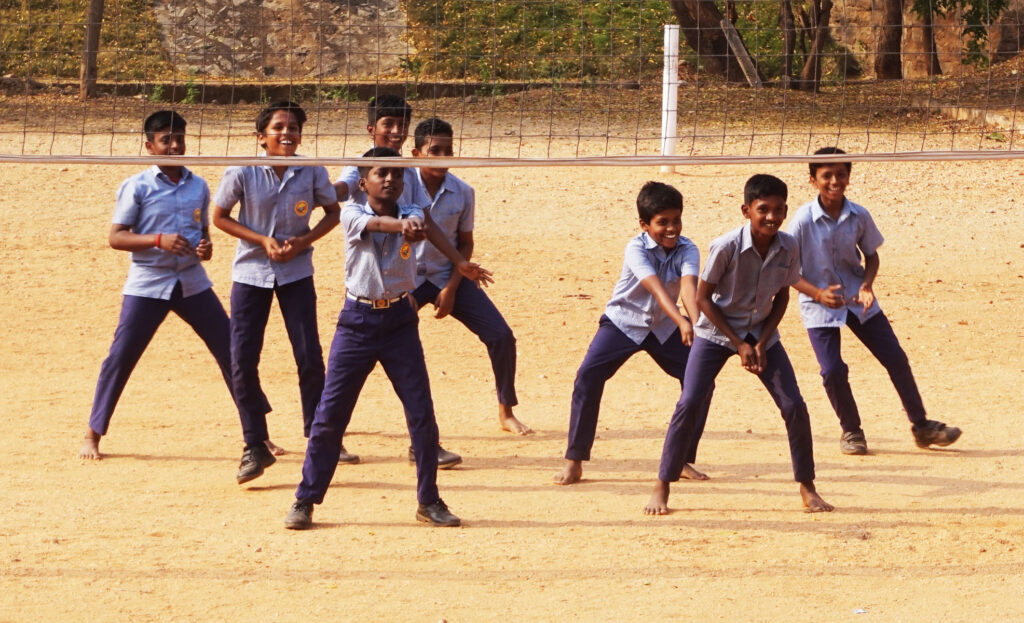
The school boasts of a kitchen garden maintained by the students, two volleyball courts and a large playground, a play area for the kindergarten section and a library.
But unpaid fees have accumulated over the years, amounting to nearly ₹2 crore. “Even so, the school continues to keep its doors open to children whose families are struggling financially, choosing kindness over exclusion,” Krishnaswami says with pride. He also gives scholarships for achievers in the name of his family members.
Despite the financial challenges faced by the school, the students continue to shine. For the past several years, the school has been achieving 100 per cent results in Class 10 and Class 12 board examinations. This year 33 students scored above 400 marks in the Class 12 boards.
Pictures by Kiran Zehra