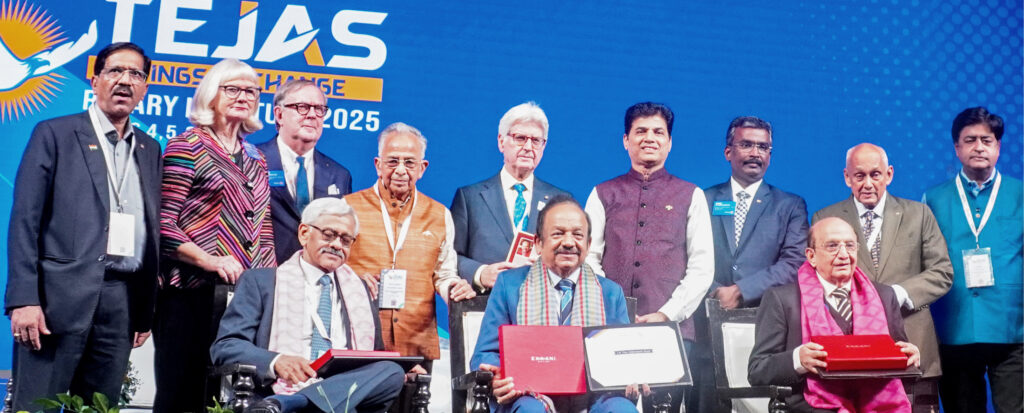
Tejas, the Rotary Zone Institute, devoted a session to celebrate three stalwarts — PRID Ashok Mahajan, PDG Deepak Kapur and former Union Health minister Dr Harsh Vardhan — whose dedication ensured India’s hard-won victory over polio. They were honoured with Lifetime Achievement Awards. The segment was moderated by PRID A S Venkatesh and anchored by institute secretary PDG Manjoo Phadke.
An emotional PRID Mahajan, whose leadership and advocacy were pivotal to Rotary’s polio story in India, said, “For me the campaign was never an assignment. It was a calling, ever since I got associated with the Rotary Polioplus programme in 1996.” One defining moment was his meeting with nearly 100 Ulemas (Muslim religious leaders) in New Delhi, a breakthrough that softened years of hesitation in Uttar Pradesh. Recalling that day in April 2006 (when he had just been elected RI director), Mahajan said, “As I entered the room, I had no paper in my hand. But Goddess Saraswati was on my tongue that day. I began the meeting reciting: Bismillah-ur-Rahman-ur-Rahim; La ilaha ill-illah-ul-Azim-ul-Haleem; La ilaha ill-illah-ur-Rahman-ur-Rahim.” His recitation from the Holy Quran instantly won the trust of the clerics. What followed reshaped polio work across the state. “If you want our support, form a committee in every district in the state,” one of them suggested. Mahajan and his team acted immediately, setting in motion one of the most effective community-driven collaborations in the history of the programme.
“We were able to form the core group in Lucknow and other parts of UP. When the sub-NID was announced, we saw to it that on camera, all the Ulemas administered polio drops to their children, grandchildren or relatives’ children. This was telecast all over the state and we started receiving support from the community,” he recalled.
But the joy was short-lived; within the next 10 days, four polio cases were reported from Malegaon, Maharashtra, and the state health secretary said the government was helpless. “But PRIP Rajendra Saboo raised his hand and quietly said that if the government of Maharashtra can’t do it, Rotary will do it,” and introduced Mahajan to the officials.
“In Malegaon, it was more difficult to break through than in UP; apart from the community, here even the medical fraternity and media were against polio drops,” he said. Facing suspicion, misinformation and hostility, he, along with PDG Rajiv Pradhan (RID 3132), spent five days in the town, meeting families and speaking at public gatherings. “We even had a meeting in a crematorium where they made us sit on the floor to listen to us,” he recalled. Finally, they won back the community’s confidence step-by-step, and “for that I thank the India National PolioPlus Committee and its chair PDG Deepak Kapur, who were very supportive.”
Mahajan also credited Ajay Saxena, a past president from RID 3120, and Ulema Maulana Rashid, for bringing the Muslim clerics to the table. “We were scared, but we knew we were doing the right thing.” The turnaround that followed marked one of Rotary’s most significant grassroots victories. “I am very happy that the work we have put in is being recognised today,” he said, thanking institute convener RI director K P Nagesh.
He dedicated his award to PRID O P Vaish, who initially invited him to work on the PolioPlus Committee in 1996, and Rajashree Birla, chairperson of the Aditya Birla Centre for Community Initiatives and Rural Development. “She has contributed over $19 million to Rotary’s polio eradication initiatives. When PRIP Kalyan Banerjee invited me to be a coordinator to raise funds from the private sector, he set a goal of ₹1 crore. I contacted her and she immediately accepted my request just over a cup of tea. She gave me much more than I expected. Whenever I ask her money for the polio eradication programme, she readily gives.” Mahajan dedicated his award next to Maulana Rashid who guided him through the numerous meetings with the Ulema committee.
“Now that I have received the award, I will not take a back seat. I will keep on fighting till the world is polio-free and Rotary will be remembered for long for the feat. Many times, I had heard experts say that India would be the last country to get rid of polio. At that time it appeared so because of the kind of resistance we faced,” he said.
INPPC chair Kapur was recognised for his meticulous planning and personal commitment on the field. “His ability to mobilise teams made Rotary’s polio strategy more coordinated and impactful,” said Manjoo. Kapur too dedicated the award to PRIPs Saboo and Banerjee, and PRIDs Sushil Gupta, Sudarshan Agarwal and Vaish.
“It is because of their strong shoulders that Rotary managed to work with the GoI and our partners WHO, UNICEF and CDC to get rid of the wild virus,” he said. To reach the last mile, “we need to have the best surveillance; we have to immunise every child and we still need mega bucks to complete the job,” he said.
Receiving the award, Dr Harsh Vardhan recalled how a chance conversation with paediatricians in December 1993 introduced him to the possibility of eradicating polio, not merely controlling it. His subsequent deep study of global efforts convinced him that if Brazil and Cuba could eliminate polio, “why not India?”
He further emphasised Rotary’s pivotal partnership, calling it “one of the greatest treasures of my public life.” He also acknowledged the fragility of global gains. Referring to recent data which showed that there are 39 polio cases (30 in Pakistan, 9 in Afghanistan) and 169 cases of vaccine-derived polio virus in 13 countries, he said, “If we fail to end the virus in Pakistan and Afghanistan, and the other countries, the world may face two lakh polio cases a year within a decade, which will definitely be a number larger than what we used to have in 1988,” he warned. “My last desire is to stand with all of you on the day the world is declared polio-free.”
RID 3182 PDG Dr P Narayana from Shimoga was honoured in absentia. PRID Venkatesh closed the session by reminding delegates that while India celebrates more than a decade of being polio-free, “the last mile is global, and Rotary still has a crucial role.”
Earlier during the day, a Rotary Golf Tournament held on the sidelines of the institute helped raise $250,000 for TRF’s Polio Fund.