





Let me appraise you on what’s in store for you and the colony, office space, or society you live in, from April this year. Now, don’t get me wrong. I will not indulge in any crystal ball gazing and make some alarming predictions. In fact, I will only be familiarising you with some green rules that may have escaped your notice, but which demand your attention.
Well, here goes. To work towards making the country greener and garbage free, the Union government has very recently announced new and stricter rules for waste management. These set of rules notified as the Solid Waste Management (SWM) Rules, 2026, set to be implemented from April 1, should put less load on urban local bodies and promote waste management right at the source, with the onus on every bulk generator.
You may wonder who is a bulk generator? Simply put, the government has included in its definition our colony, our society, workplace, university, schools, institutions, any government-run building, private office or our panchayat.
The onus will be on us — on each and every individual who contributes to the garbage of the ‘bulk generator’. So, if you are callous enough not to throw your chips packet or pet water bottle in your office dustbin, or you don’t bother to segregate the garbage at home, your office administration or your housing society could be responsible for your behaviour. They in turn might have to take you to task for your “un-green” attitude and keep a closer watch on residents who are careless enough not to follow the rules.
Henceforth bulk generators will be responsible for collecting waste, transporting it and ensuring that it is recycled or processed in a sustainable, environment-friendly manner.
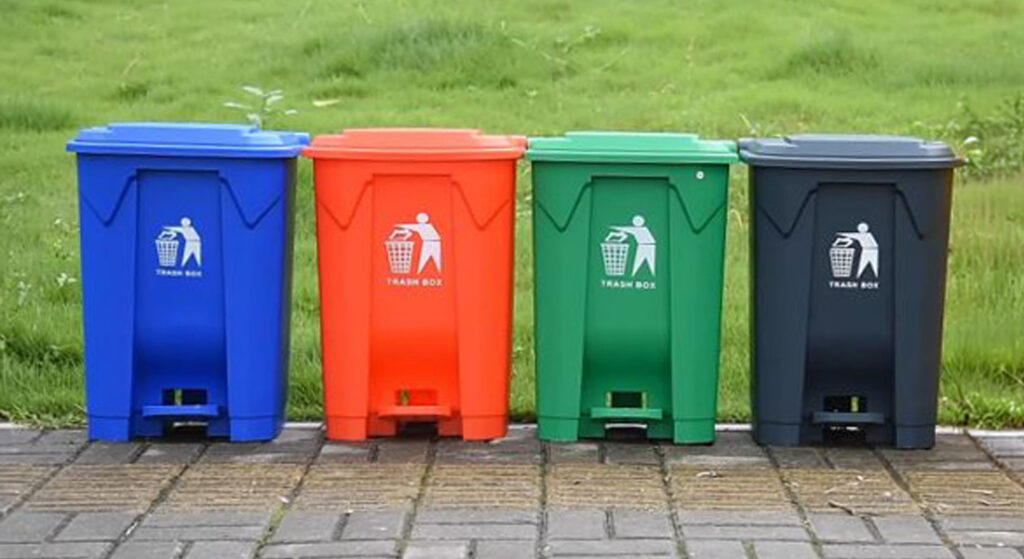
However, the good news is that following the guidelines is not as daunting as it sounds. It is quite simple to follow and just needs a disciplined outlook. Remember, from now on there will be four mandatory streams of segregation at source instead of the existing two. So, please be ready to add another two waste bins to the green and red ones you already have at home. And, also, be prepared to educate your family members and household staff about what goes where.
The four streams of segregation have now been defined as follows:
Wet waste: This is the familiar green coloured bin and is typically used for waste that is biodegradable. This includes all kinds of kitchen waste — vegetable and fruit peels, spent tea leaves and coffee ground, food scraps and garden waste.
Dry waste: This consists of waste paper, plastic, metal, glass, wood, rubber and all things recyclable, to be put in a blue coloured bin.
Sanitary waste: This is a red coloured bin for sanitary waste such as diapers, sanitary pads and condoms.
Special care waste: This is a black coloured bin for all domestic waste that is hazardous. This includes paint cans, bulbs, tube lights, wires, medicines and used batteries.
When the new rules come into effect in April, bulk generators will have a massive responsibility, which they are, in all likelihood, going to pass on to individual citizens to streamline the procedure.
Henceforth bulk generators will be responsible for collecting waste, transporting it and ensuring that it is recycled or processed in a sustainable, environment-friendly manner. They will be required to process their wet waste at the site of the collection or get a bulk waste generator responsibility certificate when onsite processing is not possible. If violations take place environment compensation in the form of fines will be levied using the ‘polluter pays’ principle.
With rules becoming stringent, you may have to bear an extra cost while vacationing. If you go for a holiday to a hill station or an island, both environmentally fragile geographies, you could end up paying a levy to the local authorities for handling and management of solid waste. They can also restrict the number of visitors per day during peak tourist season to check overcrowding and to ensure that tourists do not spoil the environment by leaving litter behind.
Given that our hills and beaches are full of single-use plastic and polythene bags, I believe this law needs to be enforced with utmost seriousness.
By and large, the focus of the new rules is on prevention and reduction of waste followed by reuse, recycling, recovery and disposal.
The hope is that in the future, landfills will only have to take in non- recyclable, non-energy recoverable waste. Here is what may compel bulk generators into submission — they will be charged an exorbitant fee for sending unsegregated waste to the landfill.
The fee for unsegregated waste will be higher than the cost of segregation, transportation and processing. Hence, the outflow of funds for a Residents’ Welfare Association, for instance, will be extremely steep if it does not follow the rules, and this in turn will increase the maintenance bill for each one of us residents.
There may additionally be strict regulations to see that green is the future of our garbage. A new, centralised portal for real-time tracking with provisions to ensure robust data generation and tracking is to be set up. However, if we just follow the rules and bulk generators take their responsibility seriously, we can mitigate the problem.
The enormity of the issue that we face cannot be overstated. Official estimates indicate that India generates about 170,000 tonnes of municipal solid waste per day. This translates to nearly 62 million tonnes annually. And roughly only half of it is treated scientifically. Projections suggest that urban India alone may generate around 165 million tonnes of waste annually by 2030, and 436 million tonnes by 2050.
To provide a binding statutory framework for the segregation, recycling, treatment, energy recovery, and environmentally sound disposal of municipal solid waste was long due. So, please do your bit to make the world a greener and cleaner place!
The writer is a senior journalist who writes on environmental issues