




May we celebrate the 100th article for Wordsworld — strange but true! — with one of my all-time favourite authors?
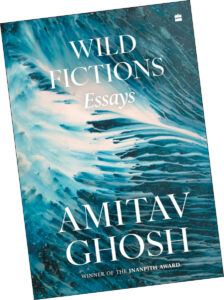
I haven’t read all of Amitav Ghosh’s books but what I have, I have loved. In order of personal preference, of course, but his approach, building fiction on fact, is awesome, awe-inspiring. His 2025 collection of essays, Wild Fictions, had been sitting on my desk from the moment it came to bookshops but it was when I reached out for Gun Island, published in 2019 and gifted recently, that I started reading the nonfiction simultaneously. What an amazing pairing that’s turned out to be! The very things he talks about in Gun Island are corroborated and substantiated across articles published over the years and featured in Wild Fictions, clearly underlining the author’s commitment to social, political and environmental concerns.
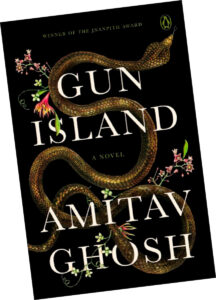
You could call Gun Island a kind of sequel to The Hungry Tide (2004); both are connected to the Sundarban and legends emanating from the region. Sundarban (more often referred to as Sundarbans) is a massive mangrove forest, richly biodiverse, covering over 10,000 sqkm across West Bengal and Bangladesh. It is located in the delta formed where the Bay of Bengal meets the Ganga, Brahmaputra and Meghna rivers. The islands and mudflats are criss-crossed by several streams that experience high tide by night and low tide by day following the ebb and flow of the sea. Consequently, all the water is saline. This is where the Royal Bengal Tigers roam — and swim — but we don’t know how much longer they will rule, along with a whole lot of other endangered species. Then, there’s the danger and devastation from cyclones.
In Gun Island, we meet a couple of characters from The Hungry Tide; while the latter story is spun around the legend of Bon Bibi and Shah Jongoli intrinsic to the Sundarban, Gun Island follows the story path of Bonduki Sadagar, the Gun Merchant, and draws upon the legend of Manasa Devi, goddess of snakes. We are treated to vintage Amitav Ghosh as he weaves together folklore, faith, contemporary realities, climate change, migration patterns, local and global concerns, fisherfolk and philosophers, academics and activists… It’s a wide and varied world that Gun Island paints, a world in which the forces of nature impact similarly across time and space.
Our protagonist, Dinanath ‘Deen’ Datta is an antique books dealer based in the US. He finds himself researching the legend of the Gun Merchant through a series of serendipitous meetings and references. This prompts him to visit the shrine of Manasa Devi in the Sundarban, accompanied by a technologically savvy and ambitious young man, Tipu, the son of a fisherman. Deen is intrigued by some symbols etched on the walls of the shrine and while he is pondering over them, he is saved from misadventure with a snake, thanks to the sudden appearance of Rafi, a boy who tends the shrine. When he returns to the US, Deen reconnects with an old friend and mentor, Professoressa Giacinta ‘Cinta’ Schiavon, a scholar in the history of Venice. It is she who finally helps him understand and unravel the legend of Bonduki Sadagar after a visit to Venice where they have a series of strange experiences. Cinta too finds closure to the sorrow she carries within, and Deen discovers how and why Venice is home to so many Bengali-speaking, mostly Bangladeshi, refugees. This latter fact is confirmed in an article in Wild Fictions titled ‘The Great Uprooting: Migration and Displacement in an Age of Planetary Crisis’ first published in The Massachussetts Review, 2021. In the essay, Ghosh makes the observation that “…many of them (migrants) say that the worst part of their journeys consists not of their time on the road or the sea, but rather of the months and years they spend languishing in European migrant camps. In those camps there is nothing to do but wait and sleep: it is little consolation that you are fed and housed and given allowances; it is the waiting and the idleness that break the spirit.”
Ghost-Eye stands as a reminder that literature can still function as a space for listening, for hesitation and for learning to see again.
It’s hard to synopsize the story of Gun Island. In this connection, it is interesting to recall a conversation that Deen has with Cinta. When he refers to the legend as being “only a story,” she raps him on the knuckles and says: “In the seventeenth century no one would ever have said of something that it was ‘just a story’ as we moderns do. At that time people recognized that stories could tap into dimensions that were beyond the ordinary, beyond the human even. They knew that only through stories was it possible to enter the most inward mysteries of our existence…” She goes on to argue: “What if the faculty of storytelling were not specifically human but rather the last remnant of our animal selves? A vestige left over from a time before language, when we communicated as other living beings do?” This is a time and space in the realm of the evocative.
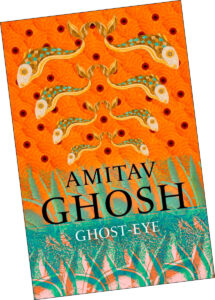
This feels like classic Amitav Ghosh in my view. He tells you a story, his style tends to be formal, and in the process, he makes you conscious of the world around. The reality. The reality of worlds that exist and seemingly others that don’t. Going by the reviews, his latest book, Ghost-Eye, also appears to be exploring something along those lines. But as far as the world as we know it goes, it is one that he has researched, examined and experienced for himself. Take, for example, the essay ‘The Town by the Sea’ in Wild Fictions. He is at the Nirmala School Camp in Port Blair on January 1, 2005, just days after the December 24 tsunami that ravaged this part of the world. In an echo of the migrants’ waiting in European refugee camps quoted a couple of paragraphs earlier, he writes: “The refugees had spent the last three days waiting anxiously in the camp, and in that time no one had asked them where they wanted to go or when; none of them had any idea of what was to become of them. The sense of being adrift had brought them to the end of their tether. The issue was neither deprivation nor hardship … it was the uncertainty that was intolerable.”
In their own ways, both books reiterate one overarching theme, that natural phenomena “are the byproducts of historical processes that have hugely benefited a small minority of human beings at the expense of the great majority of the world’s population.” When we look around and see what is consuming our minds today, this does appear to make sense. You could even claim that reading Amitav Ghosh is reading the world. Ghost-Eye has received mixed reviews. However, what Ashutosh Kumar Thakur says on the Down To Earth site may help clarify the phrase ‘reading the world’. Concluding that the novel is about coexistence, Thakur writes: “Ghosh does not offer solutions. He offers attention. In its calm, deliberate prose and its refusal to hurry meaning into place, Ghost-Eye stands as a reminder that literature can still function as a space for listening, for hesitation and for learning to see again.” That’s the place of literature, good literature. This is why we need books and writers and thinkers and observers and ponderers. This is why we must read with refinement… so we may be able to listen, to hesitate, to learn to see again.
The columnist is a children’s writer and senior journalist