





Looking beyond ‘correct’ and ‘incorrect’, particularly with regards to written texts. Where’s it coming from? What is it saying?
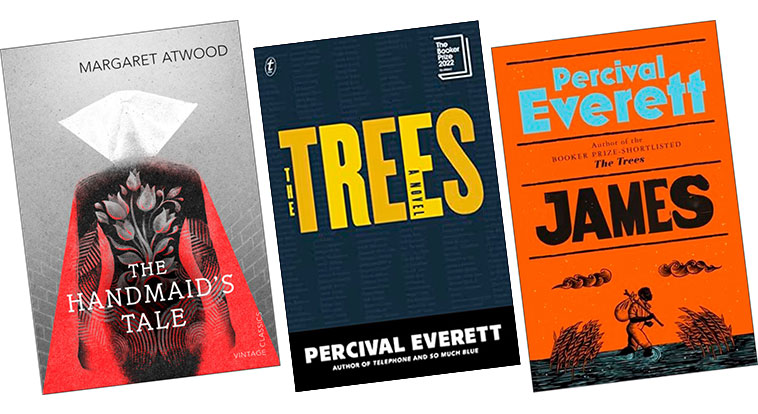
Before we step into the world of words, an aside about dystopian literature. Dystopian, as in a world that’s dehumanised, where people are oppressed and controlled by totalitarian forces, where life is nightmarish. Does this sound familiar? You will find this world in books such as Aldous Huxley’s Brave New World, George Orwell’s Animal Farm and 1984, Suzanne Collins’ The Hunger Games. Despite not having a taste for such literature, I had read all of these way back, but held back from reading Margaret Atwood’s The Handmaid’s Tale (published 1985) until now.
I had barely read two or three pages when our magazine-man dropped off Outlook magazine featuring Iran. The cover carried Shirin Neshat’s 1994 art-work, Rebellious Silence, and the introduction to the issue began with a quote from The Handmaid’s Tale: “‘There is more than one kind of freedom,’ said Aunt Lydia. ‘Freedom to and freedom from. In the days of anarchy, it was freedom to. Now you are being given freedom from. Don’t underrate it.’ ” The writer of this piece, Chiki Sarkar, calls this book the Bible of our times, especially for women. It is a complex work of speculative fiction that could well presage which way our world is headed, given the autocratic, dictatorial, misogynistic, aggressive, trigger-happy, oppressive, insular regimes ensconced worldwide, the conquering mindset captive to the killing mindset.
The ‘handmaid’ referred to in the title is a category of women ‘preserved’ or ‘tolerated’ for the purpose of reproduction — in the novel. Human machines, in other words, forbidden from any kind of engagement with the material and emotional world. Many other categories exist in this dystopian scenario, but in all of them, women are enslaved, beholden, trod upon. Of course, there’s a hierarchy and the wives of the powerful wield the kind of power influential people generally do. I read in an interview that Margaret Atwood, who is Canadian, based her characters on Canadian politicians and their shenanigans. Her razor-sharp writing is a sardonic reflection of her attitude towards sanctimonious religiosity.
There is more than one kind of freedom,’ said Aunt Lydia. ‘Freedom to and freedom from. In the days of anarchy, it was freedom to. Now you are being given freedom from. Don’t underrate it.’
– A quote from The Handmaid’s Tale
Percival Everett’s writing is equally razor-sharp and sardonic to boot, laced with political irony and laugh-out-loud humour. His characters emerge from the soil and climate of the milieu represented in the novel. Thus, in The Trees, which can be mistaken for detective fiction but solidly establishes itself as something else altogether, the world that is recreated is of the deep south of the US. Yes, the hotbed of slavery at one time. The novel is set in the present day, in this case, Money, Mississippi, entrenched in racism and black politics and local gossip. There’s been a series of grisly murders of white people at various places. However, at every crime site is found also the body of a black man holding a severed body part in his hand. By the time discovery leads to action, the black body disappears, only to appear again at another murder in another location. As the story builds, the mystery grows into the mysterious; there’s even a hint of voodoo. Meanwhile it seems as though the novel is a litany of lynching of black people growing into a protesting rebellion. At the end of the novel, the reader is left with more questions than answers though it is clear that discrimination is rampant and victims will not be silent.
The Trees was our book club read and while some enjoyed the writing for its powerful storytelling and individualistic style, others were thrown, particularly by the language. One person went so far as to say she hated it, mainly because she felt the English was all strange, all wrong. Which brings us to the question of what’s right and what’s wrong and why voice matters in the language of the written word. Is it that our worldview and experience are limited only to what we know — which is very little — and hence our inability or unwillingness to ‘understand’ (acceptance comes later) something, anything different? Aren’t words and the arrangement of words just a means, the building blocks, to learn to make meaning? Isn’t language the process of constructing meaning? Isn’t the finished product an expression of a vision, a way of communicating, a voice? Ultimately, isn’t language a marker of identity? Deny language, deny identity.
The Trees is a marvellous read and so, when I discovered another Percival Everett — James — on my friend’s bookshelf in Bangalore I grabbed it and finished it in two days flat. It’s the story of enslaved Jim, transported into this novel from Mark Twain’s The Adventures of Huckleberry Finn in which he is the moral compass, the father figure to Huck. He continues to be Huck’s role model and protector in James; the suggestion is that this is where Huck was and what he was experiencing every time he disappeared from Twain’s narrative. Some people see James as a retelling of Huckleberry Finn, told from Jim’s standpoint. Apparently, Everett read Huckleberry Finn some 15 times “in order to blur it” until he was thoroughly sick of it and came to the conclusion that he didn’t think “there’s a flaw in it that I haven’t found, but the world remained”! It’s the world, or worlds, we discover when we read Percival Everett.
Jim, his wife and his little daughter, are all bonded to a white ‘massa’. When Jim hears that he, and only he, is about to be sold to another ‘massa’ in New Orleans, he has no choice but to escape, vowing to come back for his wife and child at a later date. Huck accompanies Jim out of affection and loyalty to him. Along the journey, they encounter many experiences; Jim often comes close to being lynched, the normal punishment at the time for being a ‘runaway’. He is caught a couple of times but he manages to get away; eventually he manages to shed his ‘nigger’ name, and christens himself James. ‘Just James.’ He manages to motivate many other slaves to make a bid for freedom, unmindful of the dangers that surely lie ahead even as a fire rages behind them. An old white man carrying a shotgun accosts them: “Niggers, where do ya’ll think you’re goin’?!” I stepped in front of him. “Who the hell are you?” he asked. He pointed his gun at me. I pointed my pistol at him. “I am the angel of death, come to offer sweet justice in the night,” I said. “I am a sign. I am your future. I am James.”
Everett references the narrative with details of the period (during the civil war), the social fabric, the master-slave dynamic, among other things, without compromising on the lightness of the storytelling. Here too, language plays an important role in the storytelling. As a slave and in the company of white masters, Jim goes “What dere be in dem woods? Dat be a ghost? You stays away from me, you ol’ shade” when in fact, he is well-read and well-spoken. In a telling scene, Jim teaches a group of children how to use ‘slave language’ as a protective shield against white masters who consider the enslaved illiterate, brutish, dull-witted, created only to serve them. It’s a sequence that is at once empowering and heartbreaking. At the conclusion of the novel, Jim’s words come together to become the voice of James, the voice readers hear.
The columnist is a children’s writer and senior journalist