
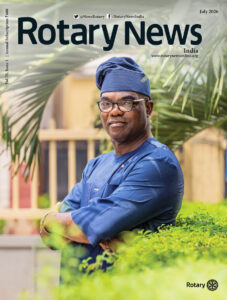


Incoming RI President Olayinka Hakeem Babalola’s charm offensive begins with the easy familiarity with which he speaks to us as he strides into the Rotary News Trust office for this interview. There is neither protocol nor formality that you’d expect from the seniormost leader in any organisation.
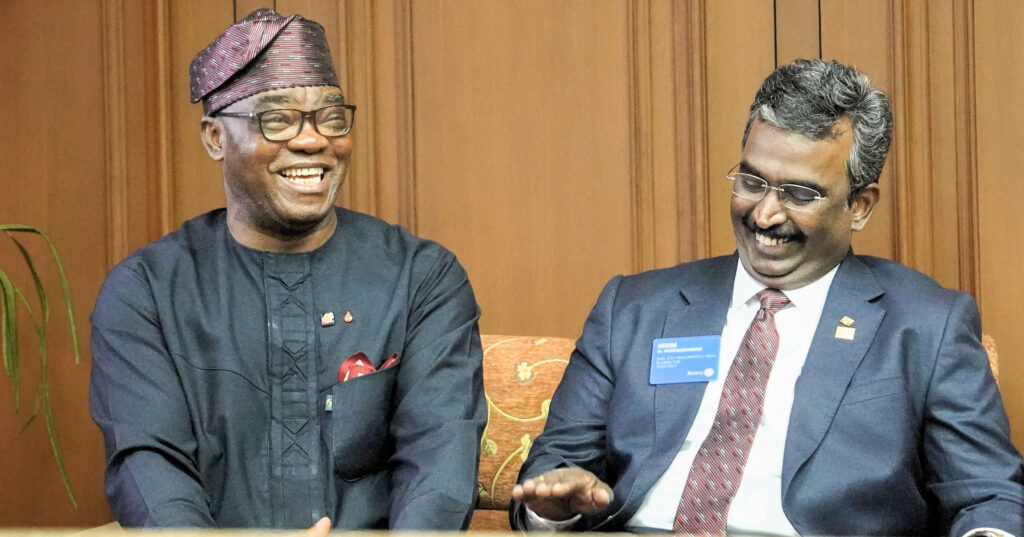
After surprising me with his comment “we missed you at the Editors’ conference in Evanston,” he wonders why I didn’t attend it (March 25 and 26). I explain that I was booked on Qatar Airways “and with missiles flying all over that region my family wouldn’t allow me to take that route. I did check out the alternative routes through Europe but they were too expensive.”
To his raised eyebrow and unasked question, I laugh and say, “Oh, I decided that. I felt spending ₹4 lakh on the airfare was not worth it.” Babalola chuckles and says: “Ok, ‘it was not worth it’ are the operative words!”
My VP being a former Rotaractor is not a coincidence, it’s a deliberate move. It’s the first time in Rotary’s history; I hope the Rotaractors are excited and recognise the opportunity this gives them.
— Yinka Babalola
RI President Elect
Continuing the banter, I respond: “My boss MMM (RI director and RNT chair M Muruganandam) is not stingy. He would have cleared the travel, but I decided not to go!”
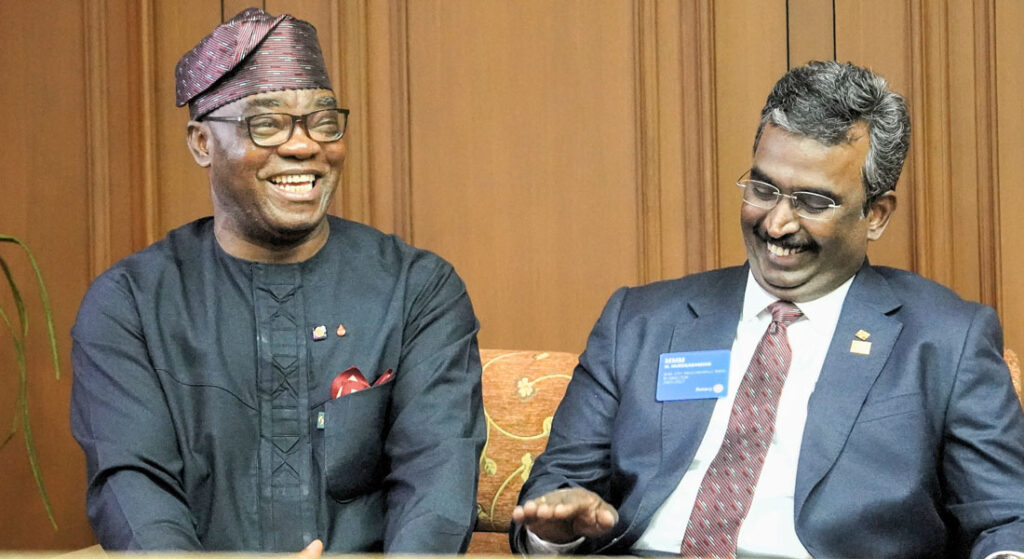
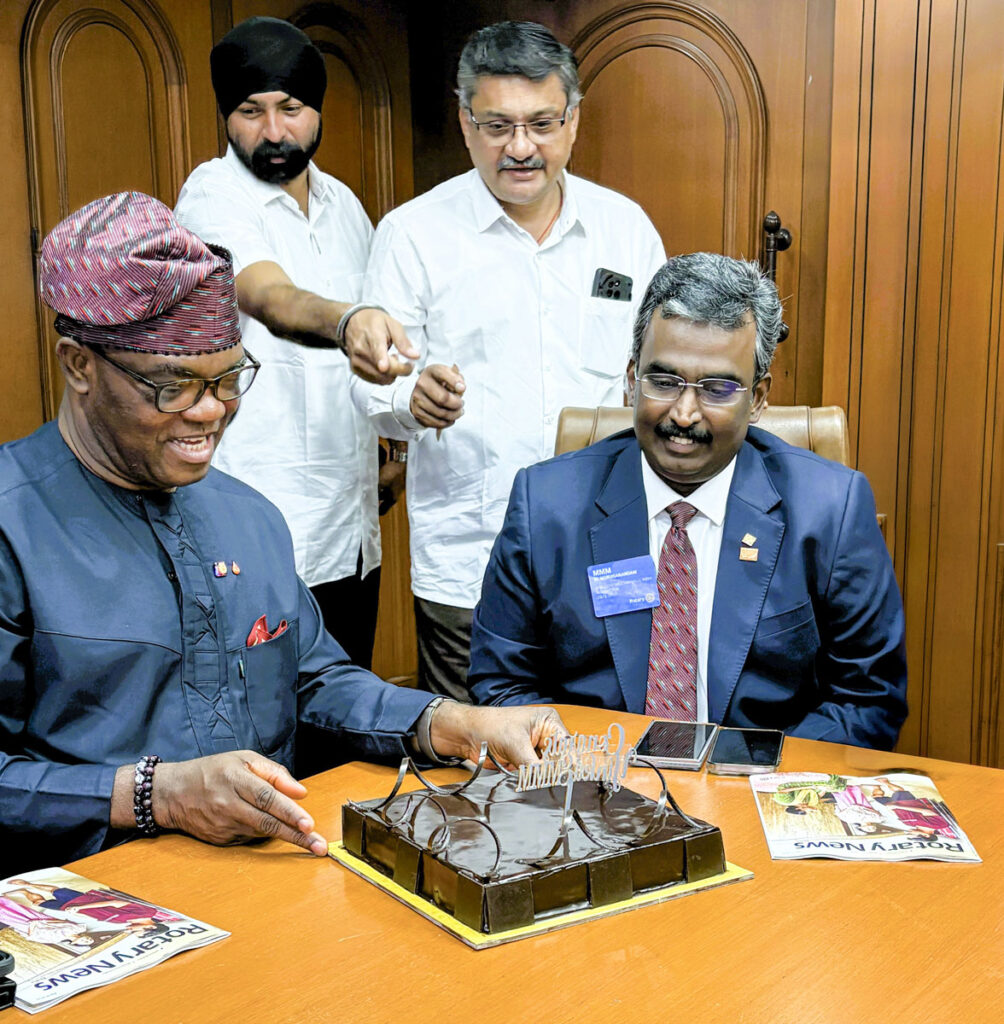
After a bouquet is given, a celebratory cake cut, and pleasantries exchanged with a few senior RI officers who’ve come to meet Babalola, as we are on a strict timeline, I politely but firmly ask everybody except MMM, his vice-president for the coming year, to leave the room. Later, during the joint interview with the two, Babalola chuckles, and tells Muruganandam: “She’s a strong woman, I can see!”
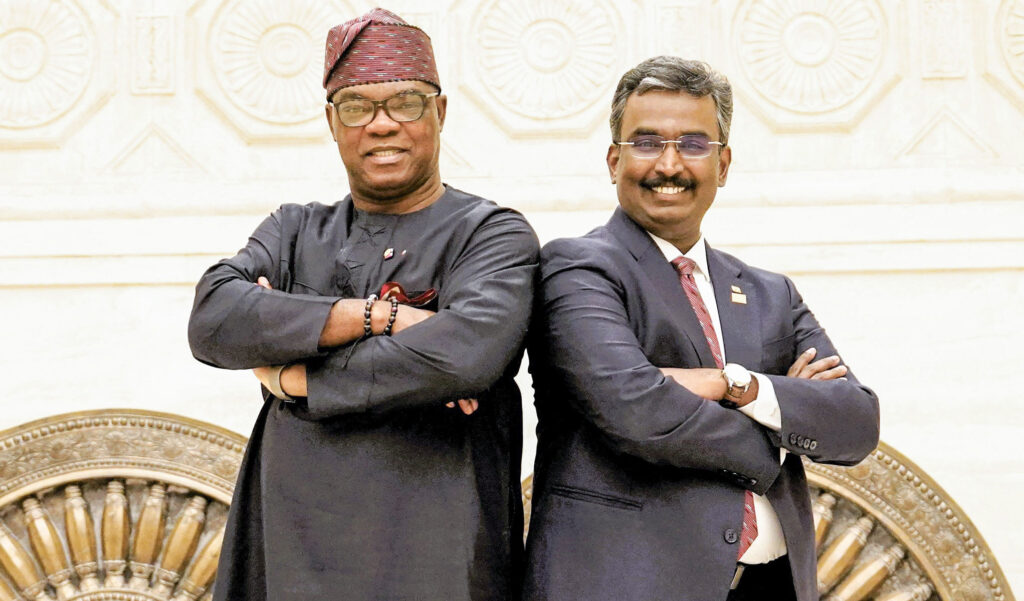
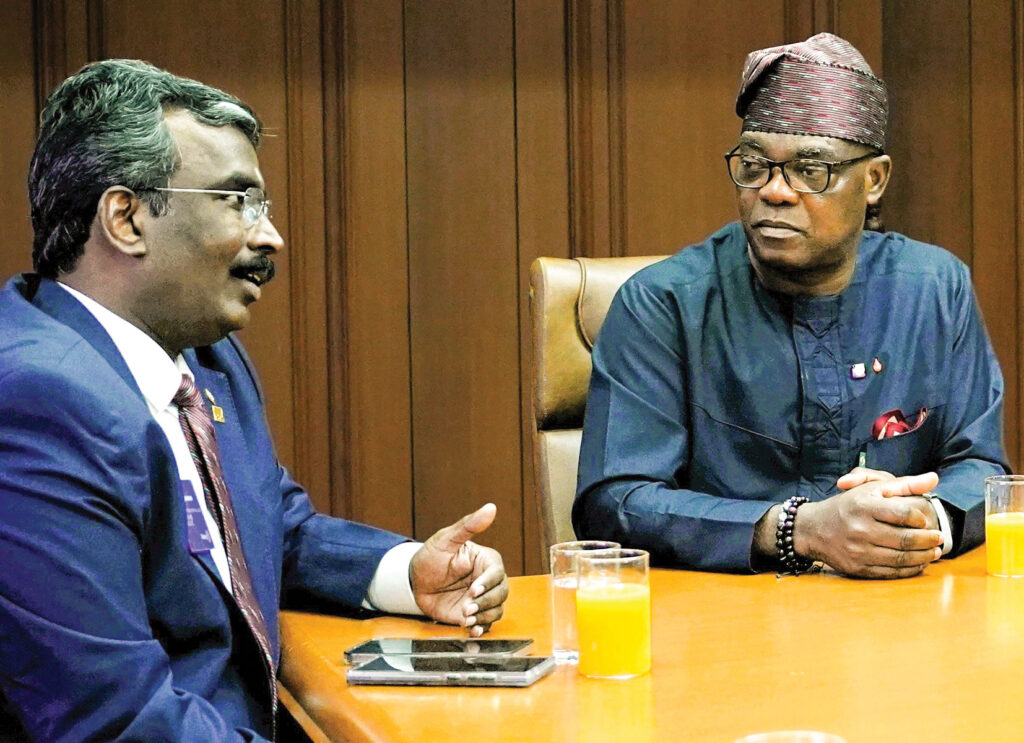
As both the incoming Prez, a member of the Rotary Club of Trans Amadi, RID 9141, Nigeria, and his VP, from the Rotary Club of Bhel City Tiruchirapalli, RID 3000, are former Rotaractors, the main question is about how they plan to rope in more Rotaractors and Interactors into Rotary to boost its membership.
“We need to be more welcoming of Rotaractors. I am the first Rotaractor to become RI President. And we are also going to have a past Rotaractor as vice-president. That was not an accident,” says Babalola.
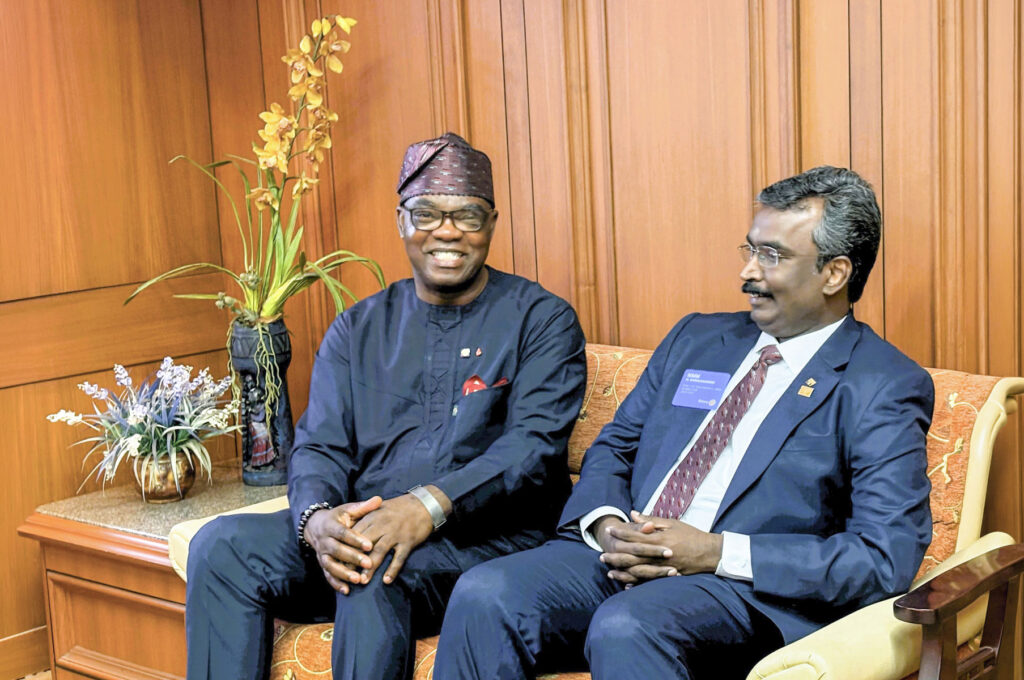
A rare coincidence, I comment. “No, it’s not a coincidence, it’s a deliberate move. It’s the first time in Rotary’s history, and I hope the Rotaractors are excited and recognise the opportunity this gives them.” Also, getting youngsters into Rotary should be viewed through not only Rotaract but the entire gamut of “our youth offerings — Interact, RYLA, Youth Exchange and Rotaract. Each of these programmes delivers different experiences to young people. Rotaract is that point where career and professional development should happen. Currently we do not have an intentional bridge between each of those programmes; in places where Interact is thriving, Rotaract is not, so when these people leave secondary school, they don’t have somewhere to go, and hence we lose them. We have not made a deliberate effort to connect our RYLA programme with the Interact programme, our Youth Exchange with the RYLA or the Rotaract programme.”
It’s a misconception that young people don’t want to do good. I believe they want to serve and are seeking opportunities, which Rotary provides.
— Yinka Babalola
For instance, many Rotary Youth Exchange students go out and spend a full year or more with Rotary families, attending Rotary events. “Naturally, they expect that once they get back home, Rotary is waiting for them. But when that doesn’t happen, it’s a huge opportunity lost. We are working on it, and will do something about it; we have what we call a ‘Grow Rotaract plan,’ which was never there before.
Adds Muruganandam, “Both of us have a clear plan on getting more youngsters into Rotary. Interactors are the prospective Rotaractors, and Rotaractors are the prospective Rotarians. We know the huge, huge potential across the world, especially this part of the world, and I am going to address this opportunity. We have a plan, and coupled with Yinka’s vision, we are talking about having over 125,000 Rotaractors by 2030.”
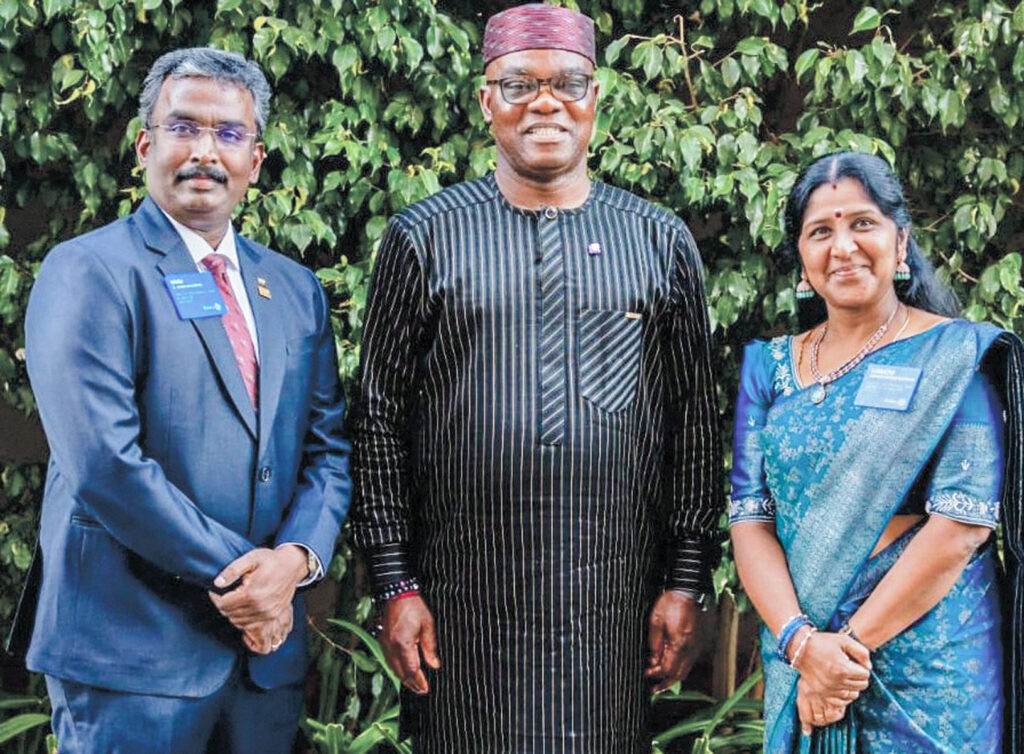
While that is the corporate goal for Rotaractors; “in this part of the world, we will work on the formula 1:2:3, which we have given to all the clubs. For every Rotarian, let us think about two Rotaractors and three Interactors. Since we have huge youth potential, we don’t want to miss it. Certainly, the future of Rotary lies in the hands of youth.”
Whenever we give opportunities to our women members, they outshine… they do an amazing job. They are committed, focused, hardworking.
— M Muruganandam
Also, adds the incoming VP, “Yinka telling you that my being a Rotaractor and becoming the VP is no coincidence, but a deliberate tactic, is by itself a strong message to the entire Rotary world. It’s a strong message he wants to give to youngsters, that being a Rotaractor can take you to the position of Rotary’s highest echelon of leadership. That is another big push for Rotaract.”
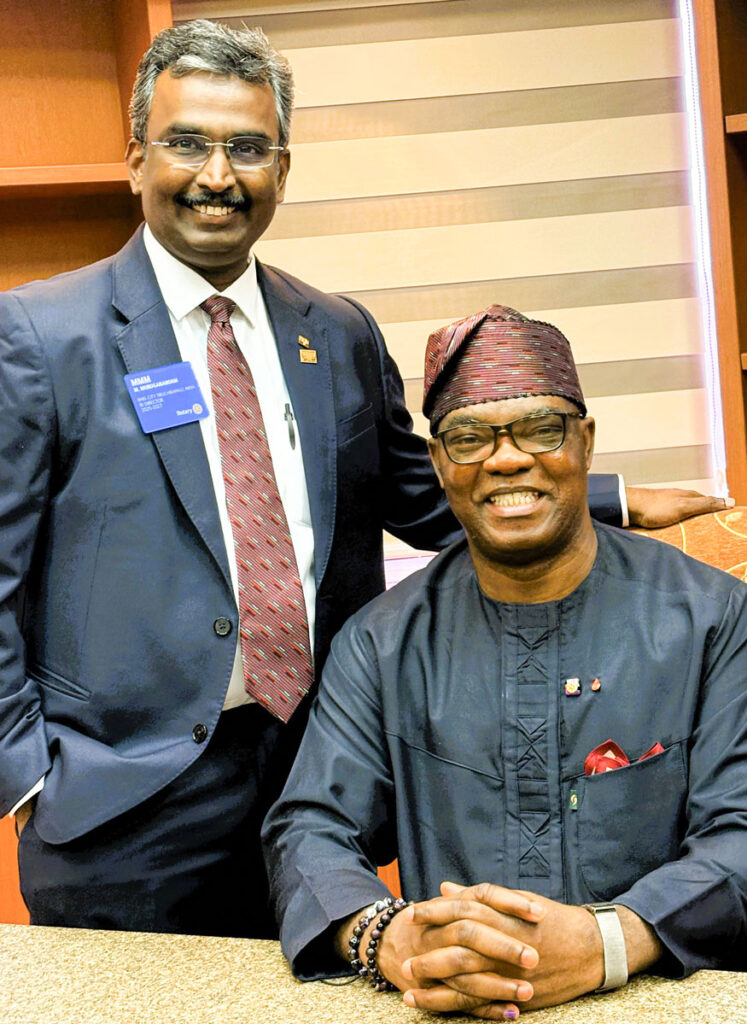
Incidentally, apart from being former Rotaractors, both are engineers; while Babalola has over 25 years’ experience in the oil and gas sector, Muruganandam has businesses in diverse sectors such as maritime logistics, energy and HR.
On how to engage the youth and make them focus, a difficult feat, Babalola says, “I think there are misconceptions there, the first being that young people don’t want to do good. I believe they want to serve and are seeking opportunities to do so. And Rotary provides those opportunities; only we have yet to communicate the value proposition clearly and have not connected with them properly. I am aware that Rotaractors are doing a lot of good stuff in many parts of our world. In fact, where Rotary is thriving, Rotaract is also thriving. Where Rotaract is not thriving, Rotary is not thriving. I have said that 1,001 times.”
So, “we have to provide that opportunity for them to flourish and thrive. Internationally, with the Elevate Rotaract enactment, “we are saying a few things; we ask our regional coordinators to appoint Rotaractors into their various committees. We are beginning to have Rotaractors as assistant coordinators and currently have a Rotaractor as an assistant public image coordinator in Zone 5. This has to be replicated everywhere, at the district and club levels. We need district governors to do this and engage Rotaractors in a meaningful way and one that recognises their specific skills. It’s not inviting Rotaractors to come and arrange the room. That’s not what young professionals should be doing. We have to find and leverage their skills.”
Rotarians should be visible to Rotaractors, and tell the huge story of Rotary to them in a way they can hear it, and know we have on offer a network, leadership and service.
— M Muruganandam
Vice President-elect
Muruganandam adds another dimension when he says, “What is more important for Rotarians to know is how visible are we to the Rotaractors. We have a huge story to tell but we have to tell it to them in a proper way, so that they can hear it. We have to tell that story better and let them know that here we have on offer a network, leadership and service, which is open to them. Then they will certainly get it… the kind of opportunities that are open to them in our organisation.”
Nodding in agreement Babalola reiterates the importance of creating a welcoming atmosphere for Rotaractors to join Rotary. He says that after 10 years in Rotaract, all the Rotarians in his city knew him. “When I was going to join Rotary as a Rotaractor, I walked into my Rotary club meeting. And the club president looked at me and said, ‘Rotaractor, what are you doing here today?’ And I said: ‘Mr President, I have come to join Rotary.’ The whole room turned and looked at me. ‘What? What audacity? What is wrong with this young man? Is that how you join Rotary? Look at that. Don’t you know Rotary is by invitation?’ I’ve told that story many times.”
The young man stood his ground and said calmly: “I never knew that a child needed an invitation to come into his parents’ home. But a Rotarian spoke up that day for me, and that’s how I became a Rotarian. We need to be open and demonstrate to the young people that Rotary is a place where they belong and are valued.”
This incident happened in 1993; have things changed now, I quiz both the leaders. While Muraganandam says, “Yes, drastically,” the incoming president says, “No. MMM is talking about what he is seeing here (in our region). Yes, I agree that Rotary has changed a lot since then. But are all Rotary clubs very open and welcoming? The answer is no.”
Imagine our Peace Fellows or Rotarians working in the White House. And in Iran and Israel, or Qatar and other places involved in negotiation. Even when governments don’t trust each other, the Rotarians will.
— Yinka Babalola
Did he mean places in Europe or the US? “Not anywhere. Not even in all Rotary clubs in India. Not in Nigeria. But not all Rotary clubs are like that. There are Rotary clubs that have accepted Rotaractors. Take for example MMM! He was a Rotaractor and is now a Rotarian; there is no way he would have come so far if his Rotary club would not have wanted Rotaractors. The same thing is true of my club, and a few clubs like that. But there are still Rotary clubs which are not as open, and not just for Rotaractors, for young people entirely.”
We next come to the question of how closely the President and the VP work, and the need for a good rapport. “Very closely,” Babalola smiles. “Absolutely… we need to have a good rapport. The body chemistry is important, and that is why it is the President who proposes who the VP should be. The bylaws state simply that the VP will do the duties as assigned by the President or when the President is not available. In case that the President becomes incapacitated, the VP goes in as President.” He then chuckles and adds: “But I can tell you this VP will have a lot of work to do.”
On the qualities that led Babalola to choose Muruganandam as his VP, and the latter’s strengths, he says, “Courage. Tenacity. Also, we both share something else; a passion to grow Rotary. I have a record of growing Rotary in my part of the world. He has a record of supporting the growth of Rotary in his part of the world. And in 2026–27, we have a very ambitious goal of growing Rotary across the world. My desire, my aspiration, my goal is that for the first time in many years, Rotary’s membership should grow. So, he has a lot of work to do!”
When I comment that at 52, his VP certainly has the energy to achieve this goal, Babalola says, “More than energy, he has the passion. Because you may have energy and not have passion. Both are required. He has the energy, he has the passion, and I don’t know if he realises it himself… I see him as somebody who is driven. When I say this is what we need to do, he understands and I don’t need to talk too much about it!”
When I apologise and tell him that despite time running out, I had to ask him one last question on the possibility of Rotary emerging as a peacebuilder in our fractured world, particularly in the background of the US-Israel attacks on Iran, Babalola smiles and says, “Oh, don’t mind him (MMM, who has signalled to me the time is over and they have to leave!), after all, you are talking to his President!”
Coming to the question, he says many people have asked him “whether Rotary could play the role of mediator. But as an organisation, I don’t think we are built for that. But as a people, we can do much more, because at every side of a conflict, there are Rotarians. And if our Rotarians have the capacity to build peace, which is what Rotary as an organisation is doing, then perhaps things may not go as bad. We can fix things before they get to the point of escalation and become a war.”
Giving the example of what is happening in the Middle East, he says, “Just imagine that you have our Peace Fellows, or Rotarians, working in the White House. Imagine you have them on the Iranian side, or in Israel, or Qatar and others who are involved in the negotiation. Then, even when the governments don’t trust each other, we will have people who trust one another because of their membership in Rotary, and they can come to an agreement more easily.”
The incoming President believes that in conflict situations Rotary needs to do two things; “leverage our Peace Fellows, and I’m happy that we have our Peace Centers and many of our Peace Fellows are undertaking social change initiatives. They are doing a lot of work, and all of it is related to peace. I hope that as Rotarians we think about the pillars of positive peace and ask ourselves what can we do to engender peace and create lasting impact. Can we influence our governments to take policy decisions that enhance or strengthen the pillars of peace? These are the ways in which we can influence the emergence of a more peaceful world.”
He feels much more can be done; “I believe we are not doing enough; we need to do more. And, I must say that Rotary must never take sides in any conflict, because we will always have Rotarians on both sides.”
Pictures by Rasheeda Bhagat and special arrangement
Looking for competent women
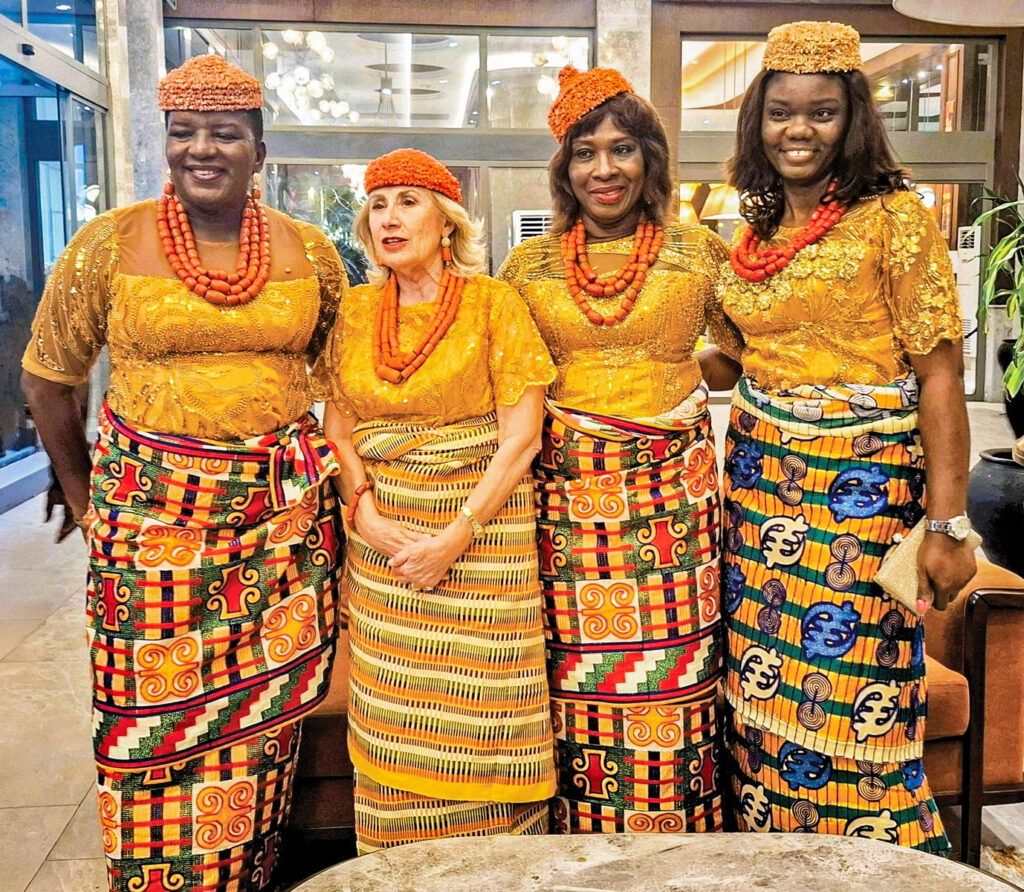
We have to make our environment more inclusive for women.
An important focus area of RIPE Yinka Babalola at RI during his year will be increasing women’s membership and enhancing their leadership positions. RI has around 27 per cent women as members, though some countries like Egypt have close to 50 per cent. “The Egyptians tell me that they are looking for men,” he chuckles.
On a serious note, he adds, “To get more women into Rotary we have to make our environment more inclusive. A male-only environment and a mixed environment are two different things. First, we need to support women and give them opportunities to thrive. I was on the RI Board, when for the first time in 2018 it took the decision that about 30 per cent of our leadership has to be female. And every director is supposed to make that happen; as President-elect, I’m also trying to make that happen. For appointments I have to make, I’m looking for competent women. And when I see them, I give them the opportunity so that they can demonstrate what they are capable of doing.”
We are seeking more women in leadership positions where only past district governors are eligible. “Governors are elected by the districts, and if districts don’t select women as governors, they are shooting themselves in the foot, because when that opportunity comes, we will leave their men and choose women from other places.”
Muruganandam intervenes to say that this is already happening where Babalola has to make the appointments. “For your information, he has appointed a woman — RI director Harriette Verwey from the Netherlands as the chair of RI’s executive committee for 2026–27, and his admin chair is another woman… RI director Wyn Spiller from the US.”
Babalola reiterates that “this is a very conscious choice. Not only for committee chairs, but also committee members, I always say: I want to see the gender balance. Not only I, but Rotary as an organisation, has been making a special effort to put women in leadership positions at different levels since we took that decision on the Board.”
But, he warns, “that’s not going to be enough. This same thing needs to be done at the district, and more so, at the club levels. Because the Rotary club is where everything happens.
If our clubs are not supportive of women, particularly women of child-bearing age, nothing much can change.”
To my puzzled look, he says, “Yes, young women, women of child-bearing age because at that point they are dealing with many things. I love telling stories and please allow me to tell this one.”
He then relates a gripping story about a club meeting that he had attended. “I just went to a random club meeting and a lady walked in with two children. One of them was about 5, and the other was 18-month-old. The younger one was sleeping in the stroller… sleeping beautifully. The 5-year-old was simply running about the meeting room.”
He was quietly observing the Rotarians’ response to this; “they did not react badly. But I’ve seen situations where Rotarians have said in such cases: ‘Can you take this child out? This is not a play place. This is serious business. Can’t you keep this child somewhere else when you come to a meeting?’”
With such an attitude, Babalola continues, women would certainly keep far away from Rotary. “Even if they join Rotary, and then get pregnant, they leave Rotary. And if the club is unlucky, they may not come back, unless they are really passionate about Rotary.”
The questions which this experience raised in his mind included what if there was a speaker that day. That particular day, the club didn’t have a speaker. What if the 18-month-old had got up from his sleep and started crying? How would the members have responded? The most interesting part of the story is that “after that day’s meeting, the members took a good decision. They asked the hotel to give them access to the small room adjacent to the meeting hall, requested the men to bring some toys for the children, and the women decided that during every meeting, one of them will serve as a nanny to all the children. And they told the women to bring their children to the club meetings. Thus, more women started coming to the meetings.”
The happy ending to this particular story is that “after a while, the men started enrolling for the nanny service, as they wanted to play with children, not just provide their toys. Because some of the older men who no longer have children at home, love the opportunity to play. That is the kind of club women would like to join… where you know that your family will not suffer and you will not be overstressed. In fact, such clubs might be a motivation for women to come to Rotary, thinking: ‘At least today I will have somebody looking after my children and I can have some peace!’”
Muruganandam endorses the push for more leadership roles for women, and says, “I’ve found that whenever we give opportunities to our women members, they outshine… they do an amazing job. They are committed, focused, hardworking.”
His President nods in agreement, and says, “Somebody said if you want a job done, give it to a woman. I say this cautiously, but they show very little distraction compared to men!”
At a glance
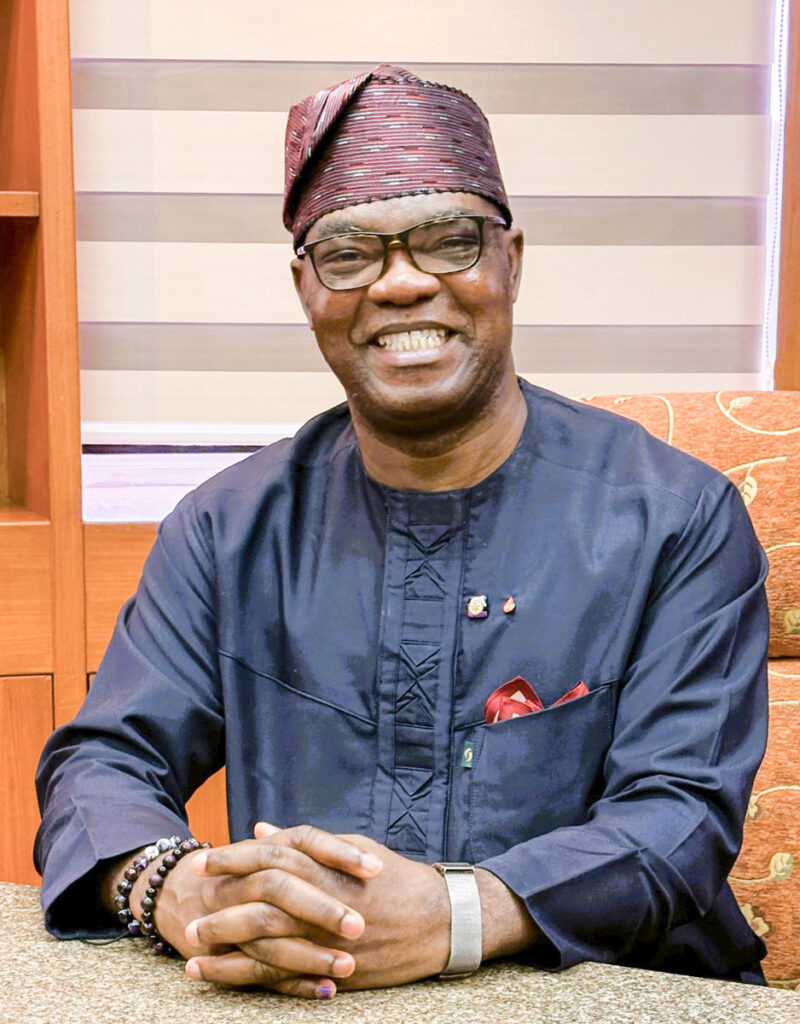
RIPE Babalola’s response to a rapid round of questions:
Music: Afrobeat, Afropop. I love those.
Religion: I am a man of faith. I’m not very, very religious, but I believe in powers that are beyond me.
Favourite food: Beans and plantains. I can eat plantains three times a day because there are ten different ways of making plantain in our region.
Do you cook: I cook very well… to the annoyance of my wife!
Reading: Books on Philosophy. I like serious things like that… sometimes esoteric stuff that looks deeper than just what you see around you.
Favourite book: I’ve been reading Mindstuck, written by Michael McQueen, a Rotarian from Australia, where he talks about changing mindsets. It’s fascinating.
Relax; movies or music: No, I don’t watch movies, I don’t have time! When I need to relax, when I’m tense, I burn incense. I like fragrance, as fragrance calms me. I get lots of incense from Arabia. I burn incense if I’m indoor, to calm me down. If I’m outdoor, I walk… forest walk for the fragrance from the plants.
Fitness: For fitness, I play golf, I swim when I have the opportunity. But because of my recent travels, all this is becoming a challenge so I sometimes just walk.
Travel, favourite holiday destination: I don’t have any, the reason being that there are places I go and I tell myself: I’m going to come back here, but never find time to do so. But there are places where I felt at peace. For example, when I was in Nepal, somewhere close to Mount Everest, I was at peace. Dubrovnik in Croatia is beautiful; here I was sitting on a chair at one of the sea areas or the bays. And I slept off; it was so peaceful.
Dream for Rotary: Next year, I want to restore the emotional connection of Rotarians to Rotary. I’ve been asking Rotarians to connect to why they need to be in this organisation. If it’s only transactional — you give something and you get back something… Take for eg a nanny, whose job is to take care of children; if in that group one is her own child, will you notice? Sure, you will. So the emotional connection makes a difference and I want to restore that. To many of us in Rotary, people ask: What is it about Rotary that you devote so much time, money, everything to it. Well, it’s that emotional connection.
The spouse’s role
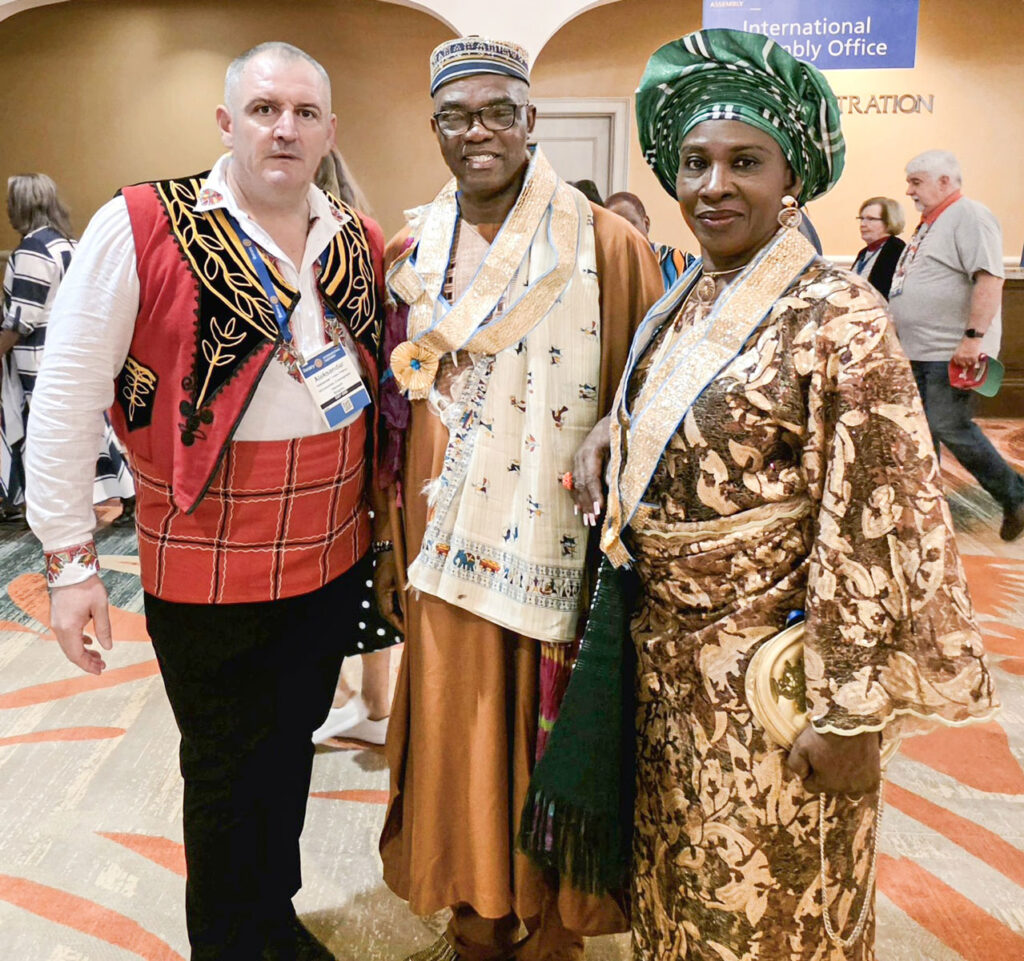
Yinka Babaloa’s wife Precy is a member of RC Port Harcourt Passport, and along with her husband, is an AKS member. He first met her at a Rotaract club meet. So, what kind of role did she play in his leadership journey in Rotary, I ask him. “When I addressed the spouses’ session at the International Assembly, I told them that when I had attended the IA as governor, I assumed that as my spouse was a Rotaractor, the first female president of a Rotaract club and married to a Rotarian, she knows everything about Rotary. So life should be easy for her.”
But a past district governor in Nigeria warned him on his return that nothing ever prepares a spouse for a Rotarian’s year as governor. “The truth of the matter is this… Rotary leadership is very demanding, and you have only 24 hours in a day, anywhere in the world. If you are going to deliver on the demands of leadership, somebody else needs to do some of the things you used to do. That naturally falls on your spouse. If you have a spouse like I had, who understands what the deliverables are, life is easier. And please note Rasheeda, I said life is easier; I didn’t say life is easy!”
He adds that “she’s a past president of a club, a past assistant governor, and I’m very grateful that Precy is my spouse.”