



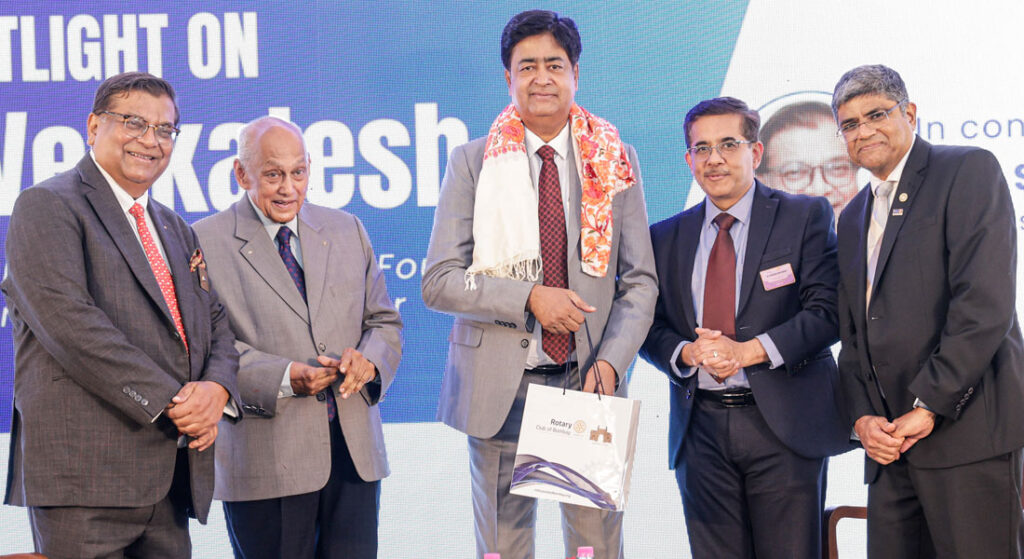
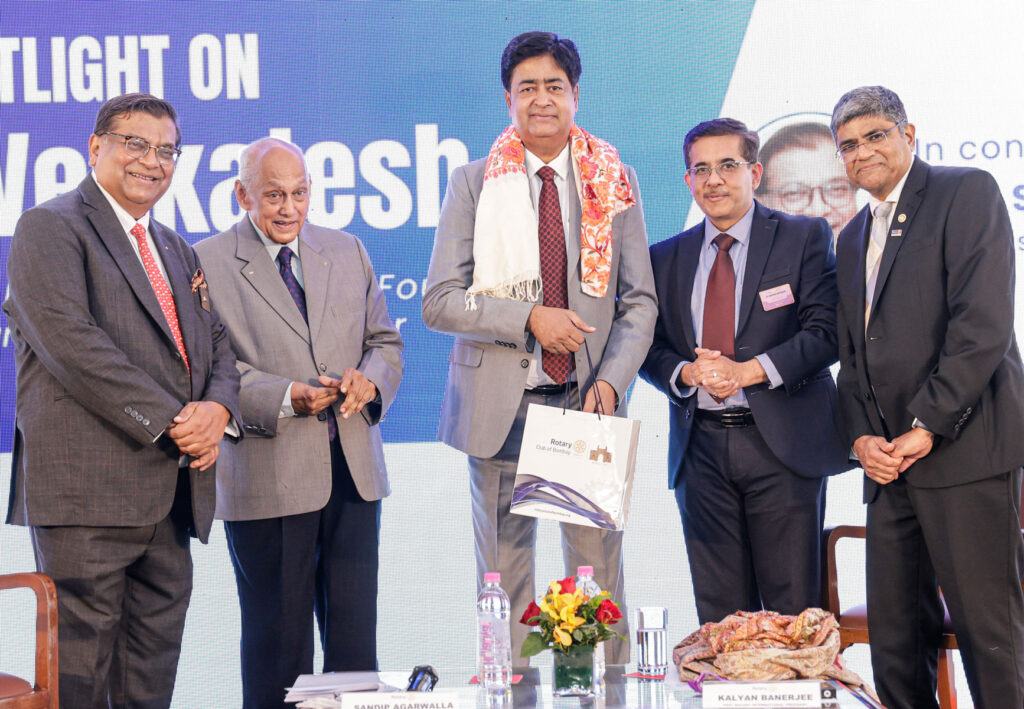
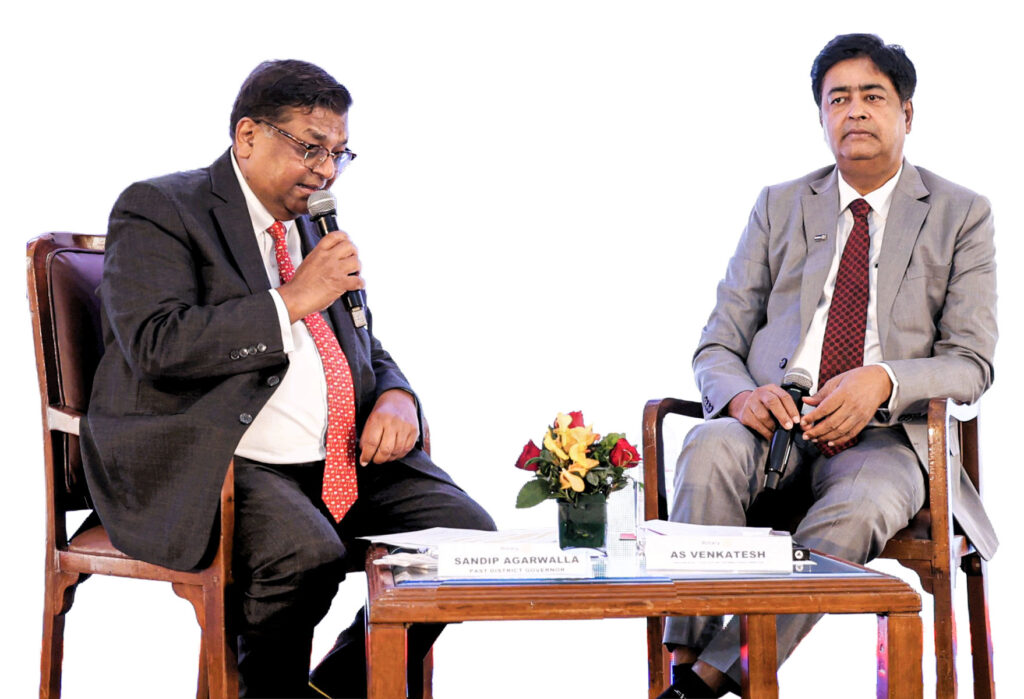
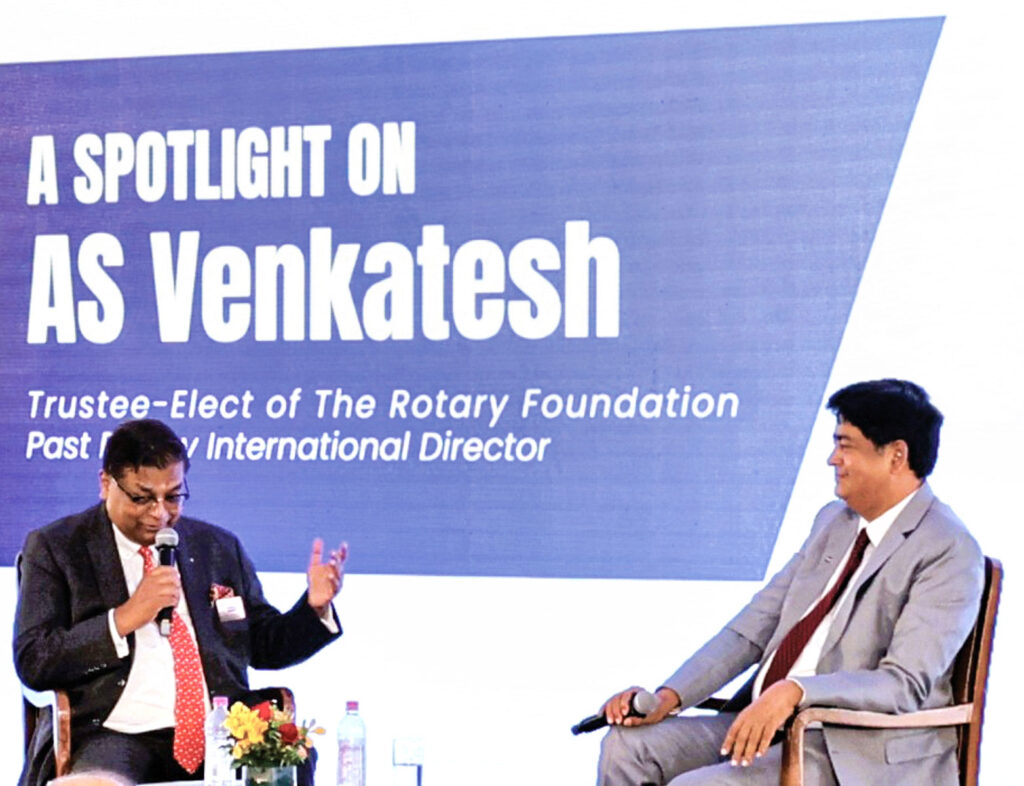
TRF may take time to move and make decisions but acts quickly in times of crises, emergencies or urgent needs, incoming TRF trustee A S Venkatesh said in a freewheeling chat with RID 3141 PDG Sandip Agarwalla at a meeting organised by RC Bombay.
Sandip Agarwalla: How is TRF adapting its funding priorities of global grant structure to address emerging world challenges such as climate change or post-pandemic recovery, that might not fit neatly into the current seven areas of focus?
A S Venkatesh: Adaptability is one of our Action Plan’s focus areas; we are capable of adapting to emerging needs and requirements. However, let’s not forget that The Rotary Foundation is an elephant which takes time to move. It’s not a cheetah that can turn around quickly. It takes time to move because we are a large establishment present in over 200 countries with our 12 lakh membership. So, it takes time to make some changes.
But we’ve never been found wanting in times of crisis, emergencies, or urgent needs. For example, post-Covid, we had Covid grants dispersed immediately. Almost 175 districts got Covid grants immediately. So, we were quick to adapt. Similarly, we had created a fund for Ukraine on humanitarian and not political grounds. So, we have demonstrated our ability to adapt in the past, and will do so in the future as well.
Coming to your point on areas of focus, honestly, till date, I have not come across a project, other than building/construction, which they could not fit into an area of focus because these are so all-encompassing, including what you mentioned about climate change, which fits into Environment.
If you do come across any project which doesn’t fit into an area of focus, except building/construction, I will be happy to take it to the trustees and create another area of focus if need be. Our aim is to ensure humanitarian needs are met; whatever it takes to do so, we will do.
SA: What is the Foundation doing to make the impact of grants more visible and accessible to new and younger members who may be more digitally focused, helping them connect local fundraising efforts directly to global results?
ASV: Fundraising efforts are not the starting point for any Rotarian’s engagement in Rotary or TRF. Engagement should start with being a part of a project, not necessarily fundraising, which will come automatically the moment you are engaged and have an experience of what a project does to the community, the beneficiaries, and the difference it makes. So starting point should be engagement in some activity.
Let me relate a story from my IIM days, about Betty Crocker’s cake mix. In the 1950s, when she launched this cake mix, it was a beautiful and tasty product, was placed on every supermarket, but the sales didn’t take off. Then somebody had a bright idea. They removed the egg from that mix and the manual said: Crack an egg, add it to this mix and then bake it. Now the sales zoomed. The only difference was that without the egg, it became my cake. Before that it was Betty Crocker’s cake. That was the difference.
This is applicable to Rotary. It will become my Foundation only if I get involved, not just by giving money, but through a hands-on experience of a project. So give the younger generation a chance to play a part in a project. Let them experience the joy of making a difference personally… through “my project”. Fundraising will come later.
SA: How can TRF help Rotarians to articulate better its value to potential new members and the general public? And what are the trustees’ favourite success stories other than Polio?
ASV: Polio is Rotary’s success story, but not an individual success story. What bothers, affects me, or what I will want to tell my children or grandchildren is what affected or influenced me.
Before global grants there were matching grants; at a small event my club donated 50 school benches to students in Chennai. It was early days of my Rotary career; I had no clue of TRF or a matching grant. I just attended meetings and enjoyed the fellowship. As sergeant-at-arms for that programme, my job was to collect the banner once the programme ended.
After the event, everybody ran out for samosas and chai. But one girl remained seated, and as she refused to leave, I had no choice but to sit next to her. I told her unless you come along, I’m not leaving this room. What she told me, in Tamil, hanged my perspective of Rotary.
She said, “In all these years, this is the first time I am sitting on a bench and not the ground. Let me experience this for some more time… you are God because you have given me this opportunity.”
I felt ashamed that I was taking credit for something in which I had no role. I had not paid any money to TRF, but here a girl was calling me God. I found from my club president about TRF and PHF and wrote out a cheque for $1,000 @ ₹32 or 33 a dollar. That night I felt I can take 1 per cent credit the girl had given. This experience changed me and made me a TRF advocate. My suggestion to youngsters is to play a part; don’t be a spectator, be a player.
SA: Beyond PolioPlus, are there plans for another signature campaign?
ASV: Till we are completely out of polio, it is not fair to talk about other projects and dilute our efforts towards this cause, for which we have been struggling for over 35 years.
Once Polio is done… and here I can only guess… the way I see TRF’s functioning in the last few years, there is more emphasis on moving towards regionalisation. What works in the US may not work in Japan, what works in Japan may not work in India. Rotary realises that one size doesn’t fit all. I’d think in the future there may be a menu of options for different regions.
SA: Coming to your Rotary journey, what inspired you to join Rotary, and kept you engaged to become a governor, RI director and now trustee-elect?
ASV: To be honest, I did not join Rotary to do any service; that was the last thing on my mind. I joined Rotary to make friends outside my profession, outside my business. That is why I joined Rotary. But the difference that I personally make to people’s lives is what keeps me in Rotary. My IIT fees were less than ₹2,000 for the entire B Tech course, which means thousands of taxpayers have paid to educate me; they didn’t know who the beneficiary was. If I have the right to take advantage of several people’s contribution, I have a duty to give back to the community, when I am in a position to return that favour. And TRF has given me an opportunity to donate without knowing who the beneficiaries (of my donation) are. I thought that was the best form of clearing my debt to the community.
SA: Can you tell us what the peace programme means to TRF and why it goes out of its way to support it?
ASV: Fantastic question! Peace does not mean absence of war. Many of us have not seen a war at all, but are we at peace? Is the community around us at peace? May or may not be.
Peace is when I know I can sleep without worrying about where my next meal is going to come from… that I will wake up tomorrow morning hale and hearty, and not worry about what disease has affected me. These are the elements of peace, not just absence of war.
Rotary’s idea of peace is a safe ecosystem for people around the globe and their existence without worries. Recently our latest peace centre opened in Pune at the Symbiosis University; I was there. The people who graduate from these peace universities will go around the globe providing solutions to conflict-affected areas so that these community can live in peace.
The reason why Rotary is spending so much money on peacebuilding and conflict resolution is that this is the mother of all projects. A few years ago, Vinita and I visited a school in Barbados which a Rotary club had opened. Six or seven children held on to my legs and told me the school also hosts a small dispensary and a canteen where the meal is provided by the Rotary club. These kids were coming here mainly for medicines and food, and because they had come so far, they were also attending the school. Their happiness came from the medicines and the food… they are at peace today. Not because there was no war in that region. Because food and healthcare were provided. These are reasons for Rotary devoting more and more resources to peace.
SA: How can Rotary bridge the gap between CSR and the grassroots service model of our clubs?
ASV: For any organisation to grow, not by small margins but exponential growth, partnerships are essential. You can’t hope to double what you are doing all by yourself in a short span of time. In corporate world, they call it mergers and acquisitions, in Rotary we call it partnerships. You need to join hands with like-minded people or people who fill the void in your plan of things. Here corporates come in; they complement our strengths. Together we can do wonders. They don’t have the foot soldiers that we have. We don’t have the kind of money that they have. So if we join hands and there is a beautiful marriage, both can meet our aspirations. Corporates want to make a difference. They don’t have the foot soldiers, and we don’t have the kind of resources.
As it was possible to raise more money through CSR in India, TRF made an amendment to make it India’s specific activity, and adapt to emerging needs.
SA: We often talk about attracting younger members. Beyond flexibility, what fundamental change do we need to make to do this?
ASV: In a focus group (20–35 years) feedback, the youngsters (below 35) said they don’t want speeches or fixed time commitment. Often, we mistake attendance for engagement, which has to change. Attendance does not mean engagement. If everyone attends all club meetings, the club subscription will have to be doubled. Because every Rotary club today runs on the cross subsidy provided by absentee members. The cross subsidy provided is a financial fact.
Coming back to the young; they don’t want speeches, they get these on Google, Meta or any AI platform. We still talk about networking through physical meetings. But the next generation networks 24×7… even when they have a cup of coffee, by posting a picture on Insta. So these are not our selling points anymore and we need to change our mindset. To attract youngsters, give what they want, suit their requirements. They may be remote and not come to meetings but they will champion a project in their neighbourhood. Encourage them.
Over a period of time, they will come back. When they come back to their neighbourhood, they will come back to where we are. But to initiate them, help them to actualise their dreams, not to be a part of our dreams. They will be part of our fraternity in years to come.
SA: How do you balance the business of running a multi-million dollar Foundation, which the TRF is, with the heart and volunteer spirit that defines Rotary?
ASV: TRF as an organisation has only funds. RI and its districts and clubs provide people. So actually there is no competition. TRF has the money, RI has the people; the more the availability of funds, more people will get engaged. TRF is there to help people. It is not an independent body but part of RI to assist in our endeavours to make a difference. We all know how it works. People who have, give. People who need, take. By ‘people’ I mean some regions in the world.
Going forward, I believe, TRF should get out of small projects. Let the districts and the clubs handle small projects on their own. We should be focusing on large impact projects through TRF grants. That will make a difference; sustainability comes with scale and that scale is possible if TRF starts focusing more on larger projects such as Programs of Scale in Zambia for malaria, cervical cancer vaccination in Egypt, or for the farmers in Maharashtra and Gujarat. That kind of impact has to be leveraged and scale carried forward in the years to come.
SA: We have many aspiring leaders in the audience; what advice would you give Rotarians who feel they have the potential to lead at the zone or international level?
ASV: Advice is a very big word. I don’t think I am there yet to be able to give advice to anyone. But I can share my experience; right from day one, I have never said no to any assignment given to me at any level. Be it at club, district, zone, or international level, it doesn’t matter. I might have already held a higher position and was offered something lower, but I have never said no to anything. So to anybody aspiring to grow in Rotary, I’d say, don’t say no. Accept anything that comes up. If you think you are extremely skilled and talented, make a difference in that role. Tell the world: ‘Boss, I can do much better than what you think I can.’ Show the world with your unique talent.
Pictures by Rasheeda Bhagat