





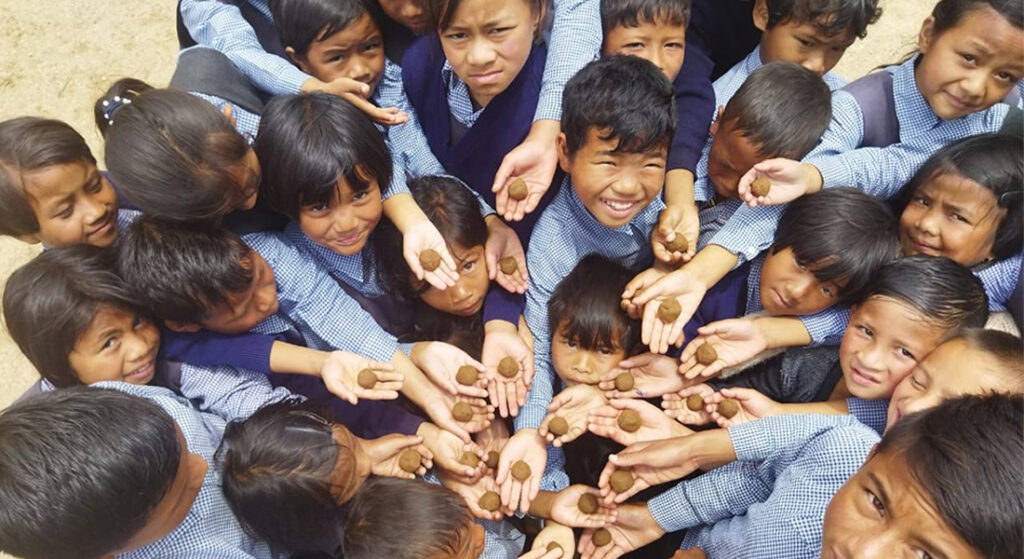
Schooling must include climate change in the curriculum.
It is often said that, “Today’s children are tomorrow’s citizens.” It follows from this truism that if we must build a better world, we must educate and equip our kids to bring about meaningful change that will contribute to the better health and well-being of our planet and its inhabitants.

Among the many concerns that dominate our lives, one is related to global warming, climate change, and environmental issues. Over the last few decades, we have been working to mitigate the damage humans have inflicted on Mother Earth. But we realise that a lot more needs to be done. Our children have no choice but to extend themselves a lot more than our generation to save the planet.
How do we equip them to do that? We can live green lives and set an example for them to follow. We can practice basic environmental rules at home, including waste segregation, reducing plastic use, and conserving water and energy. That is laudable, but is it enough? Friends who are environmentalists argue that incorporating topics such as climate change, environmental pollution and water conservation into the school curriculum has become crucial for formally educating children.
According to Mala Balaji, researcher, environment and climate action, at Chennai-based Citizen Consumer and Civic Action Group (CAG), climate change needs to be a standalone subject in schools, not just a chapter in science textbooks or a passing reference in social studies. However, until this new subject is incorporated, schools need to become more proactive and not just remember climate change on World Environment Day.

Writing in her blog on the CAG website, Mala notes: “We need to treat climate education with the seriousness it deserves. It should be a subject in its own right. If full curriculum integration takes time, schools can begin by regularly including it through after-school programmes, workshops, eco-clubs or dedicated class time.”
CAG has developed a climate change curriculum that schools can adopt, featuring interactive lessons, real-world examples, and hands-on activities. “The purpose of having a stand-alone curriculum is not just to inform, but to engage and inspire action, connecting classroom learning to everyday life. In doing so, we can empower students not just to understand the climate crisis but to become part of the solution at a young age,” writes Mala.
The CAG curriculum suggests that schools should introduce students to climate change concepts through their relevance to daily life, rather than complex scientific explanations. Thus, severe heatwaves, air pollution and adverse climate events are issues they would have faced and can relate to. Students in rural areas would be aware of how changing rainfall patterns affect farming. Adds Mala: “When students see these changes happening around them, climate change becomes a tangible issue rather than a distant theory.”
The CAG curriculum emphasises teaching through activities in which the students participate. This makes learning fun and not a drudgery. Much of the same focus is in the Green Schools Programme developed by the Delhi-based Centre for Science and Environment (CSE) which is designed to promote environmental education and sustainable practices in schools. The programme encourages schools to use their campuses as living laboratories for learning about sustainability.
Writers of children’s books focusing on climate change and related concerns are a clear indication that the younger generation is curious to learn about the issues involved. Mongabay, a portal that focuses on the environment, reports that there is a growing interest in children’s literature on the environment and climate and that the effort seems to be to “tackle complex subjects while infusing them with hope and humour.”
The veritable explosion of children’s literature on the environment started some seven years ago with Rupal Kewalya’s The Little Rainmaker. The story is about a world without rain for a decade and how ten-year-old Anoushqa seeks the help of scientists and magicians to honour her grandfather’s wish to see rain again. This was followed by a spate of books, including Siddhartha Sarma’s Year of the Weeds, Bijal Vachharajani’s A Cloud Called Bhura, Ranjit Lal’s Budgie, Bridge and Big Djinn and Nandita da Cunha’s The Miracle on Sunderbaag Street.
Meghaa Gupta, publisher, author, and co-founder of the Green Literature Festival (GLF) in India, told Mongabay that the number and diversity of books in this genre have been increasing. “We started in 2020 with 32–33 titles and were able to locate over 40 new releases in 2024. This is just based on the English language publishers of children’s books in India and does not include regional literature,” said Gupta, who curated the children’s programme at GLF till 2024.
The growing interest in books for children dedicated to climate and environmental concerns is reflected in the Azim Premji University’s Centre for Climate Change and Sustainability, which runs a newsletter, Nature Writing for Children, that discusses and reviews new books in this genre. It also includes writers in the discussions.
The need to involve and engage young people on issues like climate change cannot be overstated. A survey conducted by the CSE last year among 1,931 school and college students revealed that 94 per cent of the respondents said they were directly impacted by the disruptions caused by climate change. For them, eco-anxiety
was not a distant possibility but an immediate reality.
Analysis of data from 1973 to 2023 indicates that 85 per cent of Indian districts are vulnerable to floods, droughts, cyclones and heatwaves. Additionally, 45 per cent of these districts have exhibited a climate shift trend, with flood-prone areas becoming drought-prone or rain-deficient zones, and rain-deficient zones experiencing excess rainfall. Given all these impacts, our children have a right to know and be prepared to face the challenges of the future. They also need to learn how they can limit the damage being inflicted on Mother Earth.
The writer is a senior journalist who writes on environmental issues