

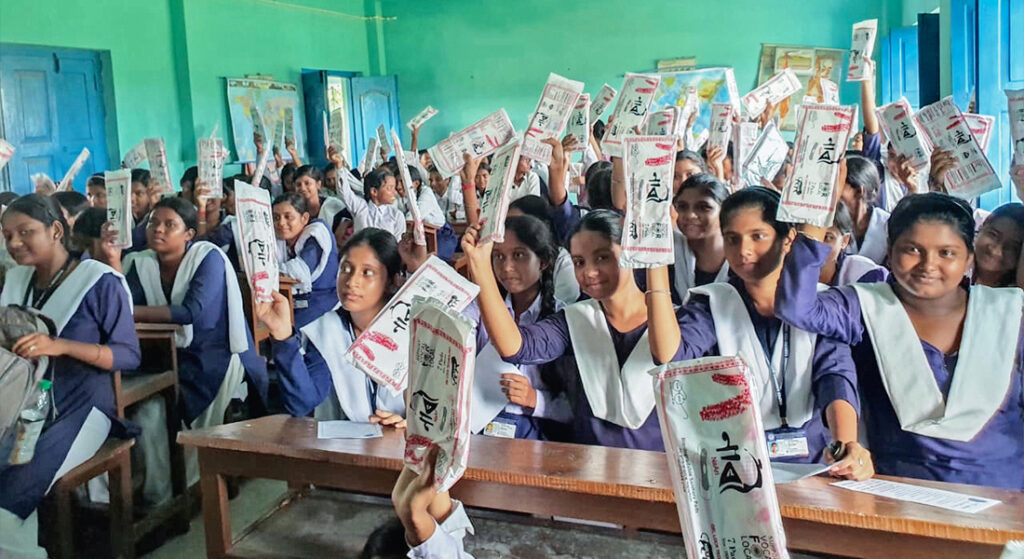
The Rotary Club of Bardhaman Heritage, RI District 3240, headed by a woman president, Nirmala Rajak, has done a clutch of projects on women’s education, health and hygiene, and economic empowerment in the last Rotary year.

On top of the charts is a project to promote and facilitate menstrual hygiene management (MHM) among school and college girls and young women. “From the very beginning of this Rotary year (2024–25) we did a needs-based assessment in our community, set up goals, and drew up an action plan taking into consideration the obstacles, cost, impact and the possible lasting change that our projects can bring into the lives of these girls/women,” says the club president.
I joined Rotary and this club during the Covid period and simply love the service projects that our club does. I know that the objective behind these programmes is to serve and make a positive impact in our community.
— Nirmala Rajak
president, RC Bardhaman Heritage
Herself a teacher working in a government-aided college (Dr Bhupendra Nath Dutta Smriti Mahavidyalaya) located in a semi-urban region of West Bengal, Nirmala says that in her college she had studied the pattern of usage of sanitary napkins by the students during their menstrual period. “We used to store the sanitary napkins in the library of our college and the girls could get them paying a nominal amount of ₹5. But the teachers found that the girl students felt this arrangement either inconvenient or embarrassing. As this was the case in other educational institutions too, we decided to donate 10 automatic sanitary napkin vending machines, partially funded by RID 3240’s Foundation Fund, to government-aided high schools
and colleges.”
The club has also formed two RCCs, named Ankur and Sathi, with all the members being women. “We utilise their services in reaching out to girls and women in rural areas to promote menstrual hygiene and health. These women have also helped to distribute about 7,500 sanitary napkins to girls in various schools, colleges and villages.”

Taking up the topics of MHM and spreading awareness on the dangers of cervical cancer on a war-footing, apart from organising 10 awareness programmes on MHM, the club has also conducted six seminars highlighting the need for prevention and early diagnosis of cervical cancer in girls/women. Screening and treatment were provided in some cases with the help of the Rotary district’s Disease Prevention and Treatment Sub-committee at a cost of ₹65,000, with the club raising ₹30,000 of this amount.
Next, the club organised in two government primary schools programmes to educate the girls on ‘Good Touch Bad Touch’ as “young girls in this region are not aware of the difference between the two and government schools don’t really teach much on this subject. After the recent rape case in the South Calcutta Law College, we felt this was really necessary,” says Nirmala.

Apart from this, seminars were organised on social justice and women’s empowerment in colleges. Though the Supreme Court has made it mandatory for all women’s colleges to have internal compliance committees on sexual harassment, she says that many colleges do not take this seriously and many girls are not aware that they can make such a complaint. “So our programmes explained to the girls about the existing laws and the mechanisms through which a complaint can be made when there is such harassment.”
Asked about the kind of interest these programmes on women’s issues raised among the girls who participated and the kind of questions they asked, Nirmala said, “These are not English medium colleges and the girls are very timid and shy and don’t generally ask questions. So in order to find out and analyse the impact of the programmes, the club drafted questionnaires and distributed them among the girl students at the colleges where the programmes were held. The response was collected from 450 students, and the process of analysing the answers is on.”

The club president added that the club has recently formed an Interact club in a co-educational government-aided school, but care has been taken to select only girls as Interactors. “We did this because we want to continue working on girls and women’s empowerment and spread our messages through the Interact club. It helps if the members are girls, because girls in this region are hesitant to connect with boys,” she added.
RC Bardhaman Heritage has a total of 17 members and has only two women members; earlier there were four but two women have left Rotary and the club, “because some families cannot afford to pay double membership fees and other club dues.” In such cases, invariably the woman bows out!
But Nirmala, who is the second woman president of the club, and is determined to take part in the club’s projects to empower woman, will continue to remain in Rotary “because I joined Rotary and this club during the Covid period and simply love the service projects that our club does. I know that the objective behind these programmes is to serve and make a positive impact in our community by uplifting the status of women through education, awareness on disease prevention, and equal treatment in society,” she adds cheerfully.