



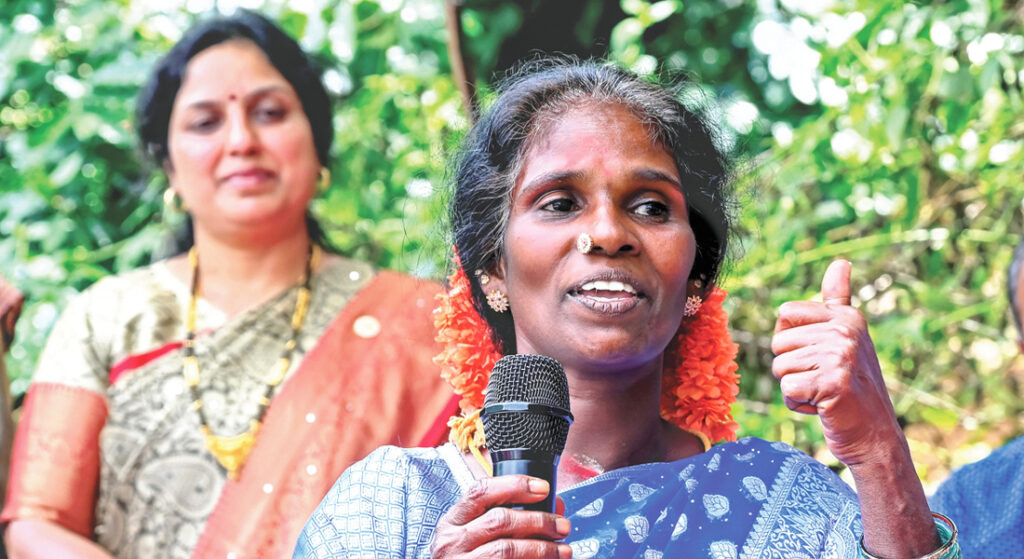
Everything about Malliga exudes cheer, confidence and positivity. That’s why it’s a little difficult to process what she shares, very cheerfully, in response to my question on her age. With a hearty laugh she says: “Madam, I have no idea about my age. Forget education, I’ve never seen the inside of a school… I’ve never even got close enough to a school building to get some shade.”

And yet Malliga has effortlessly taken over the leadership of a tribal hamlet, bang adjacent to a reserved forest area in Valaigiri, about 30km from the cool and iconic hill station of Kodaikanal, Tamil Nadu. Here, thanks to one Rotarian’s passion, vision and dedication, Malliga’s and 13 other families have got brand new brick-and-mortar homes. Till June-end, these 14 families were living in this tiny hamlet in homes that were virtually put together with thick blue and white tarpaulin sheets, along with tin plates, arranged over four wooden poles.
The Rotarian who put together this ambitious project for which he singlehandedly raised ₹70 lakh from friends and acquaintances, who included a few Rotarians, is past president of Rotary Club of Kodaikanal (RID 3000) Rajkumar Raman. “I always wanted to do a service project that would benefit some tribal families living in this belt. The idea about a project to provide homes to tribal people was first planted in my mind in 2022 by PDG Jawarilal Jain of RID 3231 when he came to our Carlton Hotel (where Rajkumar has been working for long years and is now its vice-president) for his PETS and SETS programme. He asked me to address the meeting for five minutes on the joy of giving. This was because during my year as club president I had done over 300 projects.”
I have no idea about my age. Forget education, I’ve never seen the inside of a school… I’ve never even got close enough to a school building to get some shade.
— Malliga, village leader
In the evening, in a conversation with Rajkumar, Jain appreciated the work the former had done during his presidential year and “asked me if I could look at some tribal hamlets where it was possible to build houses for tribal people. We put the cost of each house at ₹2 lakh and he said he would help me in this project.”
This was also the time when Rajkumar was the assistant governor of RID 3000. The excited Rotarian started the reconnaissance work straightaway and roped in Murugesan, the local RDO (Revenue Divisional Officer), to help him identify such a hamlet. Subsequently, Jain was able to give him only ₹2 lakh, meant for one house. But the Rotarian was determined that if not a huge project, he could do a smaller project in a smaller hamlet where fewer houses were needed.

Talking to Rotary News, Rajkumar said there are about 22 tribal hamlets in this area, and along with the RDO he examined the feasibility of providing homes in one of the hamlets. In three of the hamlets they visited there were challenges in getting the land and clear permissions from the government to build those homes. “If the papers were not clear and we built homes and later if the officials objected, these homes could be demolished, so we had to be very careful,” he says.
Finally, in Valaigiri, he found the perfect tribal hamlet, where a lot of things fell into place. “There were 14 families living here in makeshift homes, which were actually huts made of plastic sheets and bamboo poles, a couple of which you saw. And the land where they had put up their huts was just on the edge of the reserve forest. With the RDO’s help I found that the land belonged to Bharat from Madurai, and I spoke to him about my project and requested him to donate a small piece of his land to build 14 homes for the tribal families who lived here.”

Bharat owns a large parcel of land which is around 33 acres and “after two sittings with him, he very kindly agreed to donate 28 cents of land — two cents costing around ₹2 lakh for each family — and I knew my dream project could finally begin.” A heartwarming feature of this project is that both the land and the houses have been registered in the names of the women in the family, eliminating the risk of the male members selling the house in the future, in case any of them was trapped in drinking or gambling debt. But for public display it is joint ownership — each house has a cute name plate in Tamil saying Senbagham and Prakash Illam (house), or Paapaati and Palani Illam.

Malliga and the other tribals inhabiting this hamlet belong to the Paliyar group; Paliyars and Pulaiyars are the two main tribal groups inhabiting the Kodaikanal hills. The Paliyars live in the higher reaches, while the Pulaiyars reside in the lower regions. Both the tribes have a deep cultural connection with the forests, which they consider sacred. The government has given rights to these tribals to collect herbs, honey, fruits and other medicinal plants from the forest, which they sell to traders. But their main survival comes from doing farm labour and other coolie work. Owning two cents of land and building a brick-and- mortar house on that land is well beyond their reach.
When one of the girls said she wants to become a district collector, Nagaraj Setty from Mumbai volunteered to pay the fees till she completes her college education.
From the beginning RDO Murugesan had set his mind to ensure all help possible to see that this project got the necessary permissions and the paper work regarding transfer of the ownership of the land was completed as quickly as possible. “What normally could have been an arduous and time-consuming affair was achieved smoothly thanks to the RDO’s help. He is a very sincere and compassionate man. And all the 14 women in these families have today become landowners,” beams Rajkumar.
Next came the difficult part of raising funds. What sets this project apart from other Rotary projects is that even though the sum involved is substantial — all of ₹70 lakh, and a little more now that Rajkumar has learnt the bitter truth that the electrical connections which he had earlier believed would come free from the government will now cost ₹5,600 for each home — the money has come “neither through a global grant, district grant nor my club’s funds, even though I’ve made it my club’s project. I’ve raised the money by appealing to my friends and corporates known to me and most of them have responded positively.”
The other major problem was the escalation in cost; as the work began, all the difficulties associated in constructing anything on a rocky terrain, with each of the 14 houses being on a different elevation, unfolded. There was a much higher cost in transporting the building material, the narrow paths made it impossible for vehicles carrying construction material to come to the building spot and human labour had to be used. All this pushed up the cost; he had estimated each house — 150sqft — would cost ₹3 lakh each, but finally the figure swelled to ₹5 lakh per house, as the Rotarian did not want to make any compromises on the quality of the material used — be it the doors and windows or the tiles in the bathrooms.

As Rajkumar relates the story, his wife Meera, also a Rotarian from the same club — RC Kodaikanal — recalls the hiccups and low points in the last three years. The bhoomi pooja was done in June 2022, but “there were many problems which crept up on the way. There were times when he was depressed and wanted to give up the project, and I’d tell him let us do it little by little. Let’s first build two houses and then add two more, and we will take it forward slowly. And so we worked like that.”
Her husband smiles as he recalls the different kinds of help which came from different quarters. “I would send messages for help to my friends and many of them responded positively.” He is particularly grateful to his friends, many of them Rotarians, such as Habil Khorakiwala, chairman of Wockhardt; Avais Musvee, chairman, Concord Textiles; Rotary Club of Bombay North Charity Trust; Lakshminarayanan, MD, Sundaram Home Finance; Ravi Nithyanandam, MD, Vasavi Thanga Maligai; K S Nagaraj Setty and Suraj D’Souza from Mumbai; Sathish Kumar Bhonsle from Bhagwaan Project (which built the houses); Rtns Shoba and Sriram from Chennai; RC Tiruchirapalli Rockcity; Ligi George, PDG Jawarilal Jain; Vasudevan; C Jayapaul and P Ravichandran.

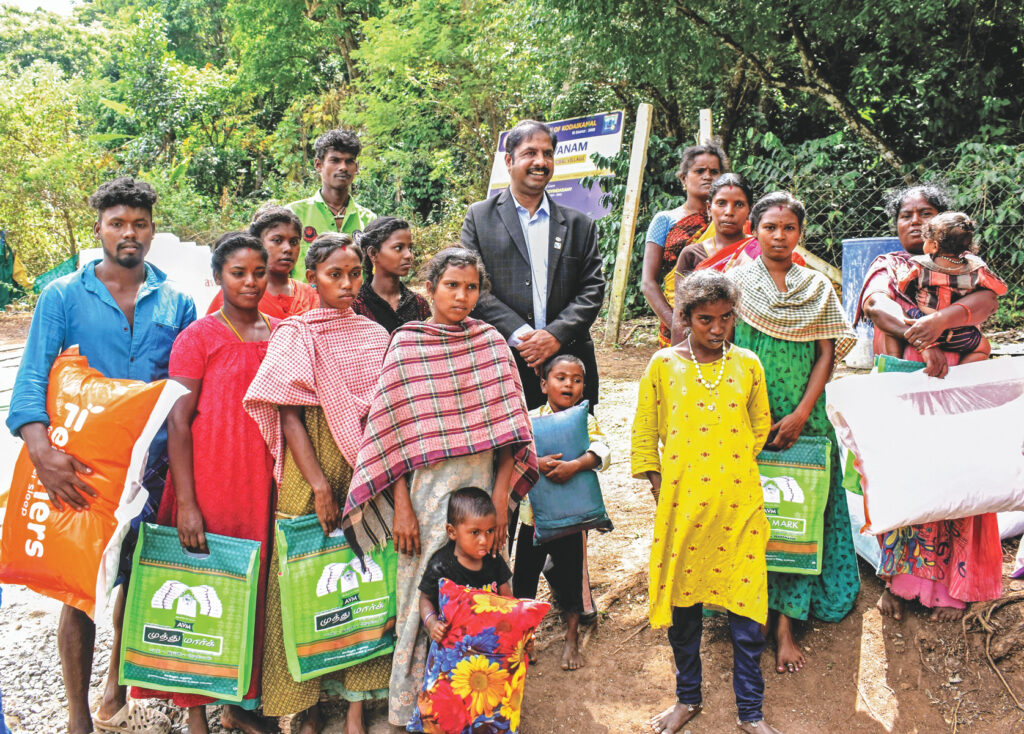
He is grateful for all the help that this project got; “D Easwaran from Tirupur gave me the frames for all the doors and windows, worth about ₹3.5 lakh, the tiles were given by 4S Associates, Kodaikanal, while another friend donated electric material worth ₹1 lakh. Today, to mark your visit I wanted to give them a set comprising a saree, shirt, pillows, etc, and I asked Muthukumar, a friend in Madurai, if he could give me these things at a nominal cost, and he said he would donate the clothes. So this is the way so many people have helped.”

Even as the project was on and he had a severe health setback, past president from his club and project coordinator L Jeya Prasad overtook the supervision of the ongoing work. Others from RC Kodaikanal who have helped him see this project through include past presidents Dr Madan, D Rajkumar and Rohan Samuel.
Seated in her glistening new house, along with her grandson — she has six grandchildren — and pet dog Damu (who quickly learns the art of posing for pictures as he follows me around and jumps into the frame when I pull out my camera!), a beaming Malliga assures Rajkumar that all the children in the hamlet are regularly attending school. “Yes, I know that you had insisted that the girls in particular should go to school, and I am ensuring that,” she smiles. The children go to three different schools; six of the older ones are attending a school that is 5km away and are staying in the government hostel there.
Even today, when it rains in Kodaikanal, I think about the mother who had to stand for three long hours, holding her seven-month-old child in a dry spot, as water was continually running through her hut.
— Rajkumar Raman, RC Kodaikanal
Rajkumar explains that while Malliga’s house has a washroom, “traditionally these people do not like to have a toilet inside the house. So in the homes built later, we put the washroom adjacent to the house. Now the Forest Department has come forward to say they will build a toilet block for the families, and that will be a big blessing for them. I have also spoken to the (Dindigul) district collector
A Sarvanan, and he has promised to help the tribals get all the benefits from the various schemes that the government has earmarked for tribal people.” This includes a patch of land where they can do collective farming.
Smiling faces greet me as I walk around that small area; after all, owning a house is a lifetime dream for most people. Nageswari, along with the others, also collects herbs, fruits, honey etc from the forest but her main income comes from doing farm labour. When work is available, she makes about ₹300 a day from this work. For men like Pawanraj, farm labour, mainly plucking coffee beans, or coolie work, fetches him ₹400–500 a day, “but we do not get work every day,” he says.

But around their own homes, says Malliga, the tribal dwellers do grow some fruits such as guava and avocado, which are in demand in cities, and even coffee seeds. Rajkumar recalls with a warm smile an occasion when he was travelling from Kodaikanal with his wife Meera, while the project was on, and as usual, they made a stop at the project site. “When we were leaving an elderly woman asked us to wait, darted inside her hut and came back with some fresh coffee powder and delicious hill bananas. Who can forget this kind of precious gifts given with so much love?”
In June 2025, when the then RID 3000 DG Raja Govindasamy inaugurated the project titled Rotary Model Tribal Village, there was a festive air in the village with all the homes being cheerfully decorated with banana leaf sheaths which were dancing in the gentle breeze that grazed the hamlet. The women turned out in shining new sarees and the children in colourful dresses with the men looking bright in their new shirts and veshtis (dhotis). Milk was ceremoniously boiled to mark the grihapravesham, and each family received gifts such as blankets, bedsheets and foodgrains and other provisions to last a whole month. These were donated by Ashwin Rajkumar, Kodaikanal, and Roma Setty, Mumbai.
IPDG Govindasamy said, “This is a first-of-its-kind work being done by one individual Rotarian such as Rajkumar and it needs to be appreciated and shared, as it might motivate others to replicate it.” Sundaram Home Finance MD Lakshminarayanan, who has donated one of the homes, said that after having seen the dwellings of the tribal people earlier, he was amazed by the kind of transformation these new homes will bring in their lives. Nagaraj Setty, one of the benefactors, said he was eager to help the children here for their higher education as well. “When one of the girls said she wants to become a district collector, Setty volunteered to pay for her education till she completes her college education,” said Rajkumar.
But the star of the day was Malliga, who picked up the microphone like a seasoned orator. Dressed in a bright blue saree with matching bangles, and bright orange flowers adorning her hair, she spoke with confidence and regaled the audience with her heartfelt thanks and assurance that the villagers would make good use of this once-in-a-lifetime opportunity and work hard for a bright future.
The houses have been occupied but one loose end needs to be tied up —
electricity connection at home. Till now this hamlet had no electricity, but now electrical supply has been initiated and all the cable work completed. “I had taken it for granted that being tribals they would get free electricity connections in their homes. But I discovered only three days ago that while each home will get 100 units of power free of cost, each connection will cost ₹5,600 per house. In all,
I need another ₹1.44 lakh but PDG Selvanathan from Pondicherry and another friend have promised to help with a major part of this cost.”
Even today, though his dream project has been completed, in his mind, Rajkumar often revisits the visual of one of the women inhabitants of this hamlet, who, during torrential and non-stop rain, had stood carrying her seven-
month-old child in one spot which was protected from the falling rain for three long hours. “She could not sit inside her hut or keep the child there because water was running through the hut. This was a few years ago; after I heard this story, every time it rained in Kodai, I would think only of that mother holding her little child and standing in a sheltered spot to protect it from the rain. It is comforting to know that at least these mothers in this Valaigiri hamlet now have a pucca house to give them shelter during rain.”
Pictures by Rasheeda Bhagat