

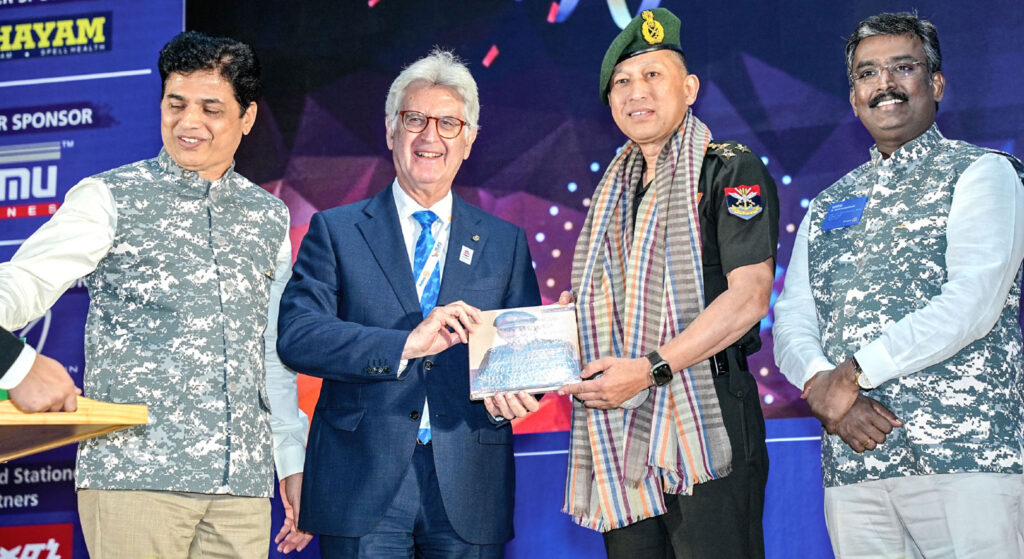
At one of the sessions at the Tejas zone institute in Delhi, Brig D S Basera, secretary of the Kendriya Sainik Board (KSB), Department of Ex-Servicemen Welfare, Ministry of Defence, enlightened a packed hall at the Manekshaw Centre on why people join our defence forces and why those guarding our nation are fearless.
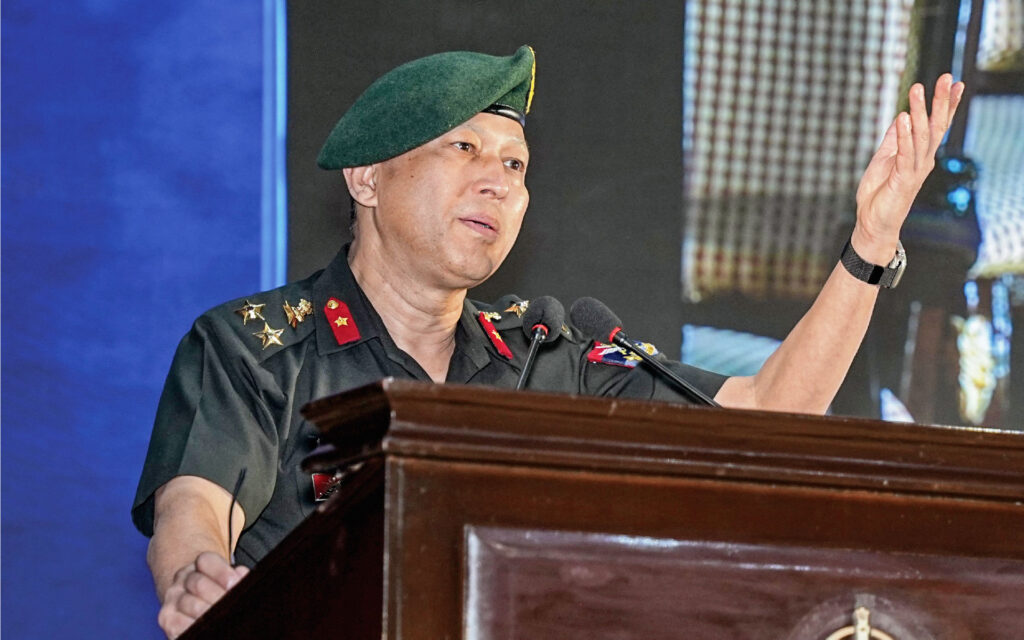
General Manekshaw, after whom the venue was named, belonged to the Gorkha regiment; Basera was from the 35th Gorkha regiment as well. “In case of war, we are the first ones to be launched in any part of the country.” Manekshaw was elevated as field marshal in 1973, in recognition for winning the 1971 war when Bangladesh was liberated. Basera himself was a third-generation officer from his family in the Indian Army. “My grandfather fought in World War II, was shot in the head, declared dead, and was awarded the military cross. After 21 days he came back alive, recovered, fought again and was again awarded the military cross!”
Despite all the travails he faced, he motivated Basera’s father to join the Indian Army; he fought both in the 1962 and 1971 wars. “In the insurgency, my father lost his right-hand finger and was about to be withdrawn from the army. He remained in the same branch, served in various situations and motivated me to join the army at the age of 18. And today after 33 years of service and four years of training in the National Defence Academy and Indian Military Academy, I stand before you. My son is with us, and he will join the Indian Army too.”
What inspires people to join the armed forces is naam, namak and nishan… naam is Bharat, namak is soil and nishan, our national flag.
When he was commissioned in 1992, the insurgency broke out in the northeast and he was involved in the counter insurgency operations, “where you do not know where your enemy is… as the enemy is within. So, we fought a different kind of warfare. And I still want my son to join the armed forces, despite all the challenges. You must be wondering, despite getting shot in the head, losing limbs, and the challenges in my own service career, why do I want that.”
The broader question, he added, was what inspires generations to join the armed forces time and again. “It’s naam, namak and nishan. Our naam is Bharat. Our namak is the soil, and our nishan is our national flag. For these three things, we can go to any extent.”
One of the things that motivated the Indian soldiers and made them fearless was that “the soldiers and their families are taken care of while serving, after retirement and even after death. This is the reason that we are fearless. We don’t have to fear. If we are alive, we have medals on our chest. If we are dead, our name is at the National War Memorial behind India Gate, written in golden words. Every day, thousands of people remember us. What bigger honour than to be wrapped in the national flag while departing from this world,” Basera asked a mesmerised audience.
What makes Indian soldiers fearless is the confidence that their families are taken care of while serving, after retirement and even after death.
KSB looks after about 37 lakh ex-servicemen and promotes their welfare. Giving the genesis of the Manekshaw Centre where a part of the Tejas Institute was held, he said around 2009–10, various conclaves and discussions were held to discuss the armed forces. “We are the second largest armed forces in the world today, totalling over 14 lakh.” Of these, about 12 lakh are in the Indian Army, 1.5 lakh in the Air Force and 75,000–80,000 in the Navy. After these discussions it was decided to have an exclusive centre for the defence forces to hold their own meetings, conclaves etc, and the Manekshaw Centre came up in 2010.
Coming to the crucial need to look after ex-servicemen and their families, Basera said that the Kargil war was the last he had fought at the age of 27. It was a short but intense and high-risk war, and required younger, and physically very fit soldiers and those without heavy family responsibility as a high casualty rate was a given in that war. “I had the privilege of participating in that war, where we were operating in minus 35–40 deg Celsius. Because we were young, we could sustain. But in just one week, I lost 12 of my battle mates, and of those the wives of four were pregnant.”
The consequences of a much younger army is that instead of the earlier retirement age of 50–55, today soldiers retire at around 35. “What happens then? While you are in the army, it’s all very good. You have seen the glamour of the Indian Army at the Republic Day parade. You’ve seen us moving around in peace situations. But not many of you get to see us when we are in difficult operational areas operating in extreme temperatures ranging between plus 50 deg C to minus 35 deg C.”
All this takes a big toll on the soldiers’ health. “Imagine the plight of a jawan retiring at age 35; what is our social responsibility towards him? How much can the government do for such a mighty force guarding such big borders?”
As somebody who was involved in the welfare of 37 lakh ex-servicemen in India and Nepal, he sought help from Rotarians not only to help the families of those killed at the front, but also the young retired people who need to be re-employed, whose children need to be educated. Expressing his gratitude for the way in which organisations like Rotary and other Indians rooted for and rallied behind our soldiers, Brig Basera said: “we fight fearlessly because of the kind of respect, honour and dignity that you give us. We are assured that even if I am gone, my wife, my children will be taken care of, and with lot of respect. My humble request to you all is that whenever you meet your soldiers, they don’t need any money from you. They want respect. We fight for honour and ethics. In Kargil war, we had so many enemy dead bodies lying there. But not a single person was left behind. We gave them all an honourable burial. After the 1971 war, 93,000 enemy forces were returned to their country. Which country has done this?”
In conclusion, he added that there was a time when senior army personnel never came out in the open to address meetings. “But now the times have changed. The direction from the government is that our citizens must know our history.” Having served in the UN for two years and visiting 18 countries, particularly in Europe, he was very impressed with the kind of knowledge the people there had of their armed forces and the respect they showed them. “They understand because they are informed about what is happening. In our country we were not informed. Our citizens did not know.” But this was changing.
He added that he looked forward to partnering with Rotarians in working on projects, particularly in healthcare and prevention of breast cancer, cervical cancer etc.
A soldier is taught to never retreat
Saying that every picture/portrait displayed at the Manekshaw Centre had its own history, and every painting its own story, Brig Basera narrated a gripping tale of an operational task done by the Indian armed forces in the 1962 war in Ladakh.
“We had an aggression from a neighbouring country, and in the northern Ladakh area there is a place called Rezang La (a strategically vital, high-altitude mountain pass). Here, 120 soldiers from the 13th Kumaon Regiment, fighting under the leadership of a Major, faced a barrage of Chinese soldiers with heavy firing. A major has about 8–9 years’ service. The battalion started fighting the enemy forces but at some point, ran out of ammunition. “They got orders that okay, if the ammunition is finished, we cannot supply anything more as there is no time, no logistics, so bring on the artillery fire.”
Basera explained that there is a system in the Indian Army’s war fighting strategy; when there is nothing left and you are surrounded by the enemy, you have to continue inflicting casualties on them, fighting with whatever you have. “Even if you die, as long as the enemy is getting inflicted casualties from us, we are ready to sacrifice our lives. That situation came, the fire was brought and they took positions in the bunker and inflicted a lot of casualties on the enemy.”
But a point came when the battalion ran out of artillery fire, and “the officer was directed to fall back with his men. Now ladies and gentlemen, in the Indian Army, we never come back. We are not taught to come back. I don’t know how to come back. I am not trained to come back. I will never come back. There is no question about it…”
So the young major kept his troops at the station… “they fought with whatever weapons they had, they fought with their hands and then their nails.”
Basera added that when he saw their pictures at the National War Memorial behind India Gate, he was really devastated. “I am a soldier… tears don’t come easily to us. But that day I cried, and thought why was I born late and not well before 1962, so I could have fought in that war. The story of how these 120 people fought fearlessly… and with whatever they had, and killed 3,100 enemy soldiers is deeply moving. In the end, none of them survived. All 120 sacrificed their lives. There were so many ways they could have fallen back; they were told to fall back. Nothing would have happened to them. But they didn’t. This is the Indian Army.”
This has now been made into a film, 120 Bahadur, and is streaming on Amazon Prime.