




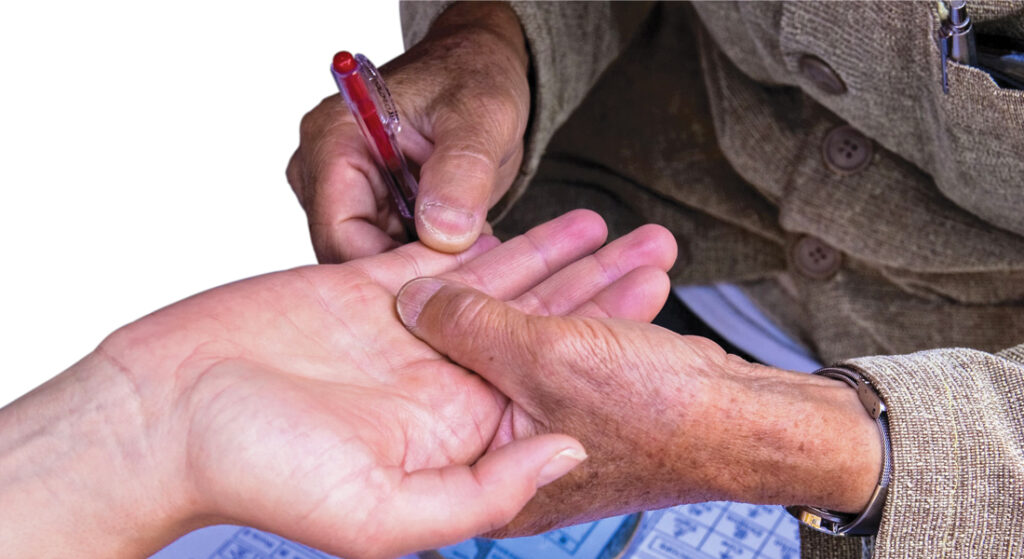
People have long been fascinated by palmists. Can they really predict the future? Palmistry has attracted amateurs, professionals and self-taught enthusiasts. There are countless books on the subject, and even online palm readings.
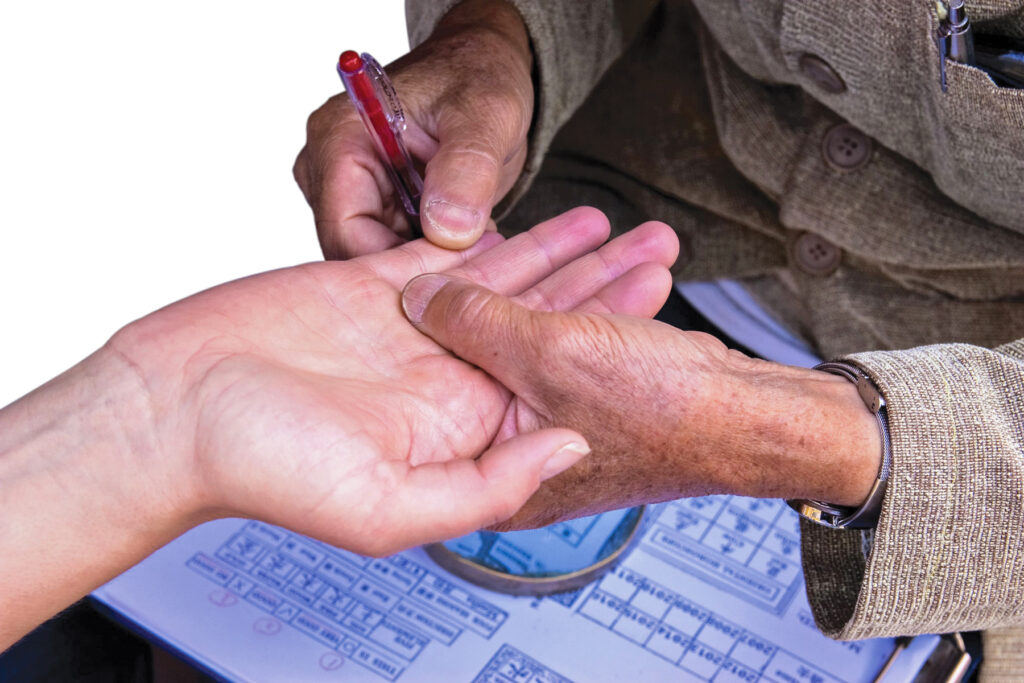
The truth is that our palms and soles carry irrefutable evidence of identity. Palm prints and fingerprints, marked by unique whorls, arches and loops, are individualised and never identical, not even in twins. Long before DNA analysis, fingerprints were one of the earliest and most reliable biometric methods of identification.
Magicians and soothsayers noticed that the lines of the palms, shape of the hands, and length of the fingers varied from person to person. Palmistry soon became a lucrative profession, much like astrology. Experienced palmists are often well-read and observant, making shrewd assessments of body language and appearance. Even before looking at a palm, they may gauge a person’s mental state, character or health simply by watching how they walk and carry themselves.
For instance, the way we hold our hands often reflects our body mass index (BMI). Those with a BMI above 30 (obese) tend to stand with their thumbs pointing backward. Overweight individuals (BMI 25–30) often hold their arms with thumbs sideways, while people of normal weight (BMI 20–25) naturally stand with palms facing forward. An obese, unhealthy person is unlikely to live long, while an anxious, restless posture may reveal hidden psychological distress.
Interestingly, modern medicine now accepts what palmists have profited from for centuries, that a careful study of the palms and hands can indeed provide valuable insight into medical history, diagnosis, lifestyle and even life expectancy.
Palmar creases begin to form around the 12th week of pregnancy, when the foetus keeps its hands tightly clenched in the womb. Normally, three distinct creases develop on each palm.
Any physical, medical, illness or drug-induced injury to the foetus during this critical first trimester can leave a permanent mark, altering the formation of these creases. Such abnormalities can sometimes be detected on ultrasound scans after the 12th week of pregnancy. If unusual palmar creases are observed, the foetus should be carefully monitored for associated developmental abnormalities in the kidneys, heart or other organs. After birth, these abnormal palmar creases, shaped by the clenched fists in-utero, are clearly visible on the open palms of the infant.
Sometimes, the two upper palmar creases fuse to form a single crease across the palm, known as the simian line. This feature is often associated with chromosomal abnormalities. The most common condition linked to it is Down’s syndrome (trisomy 21), where extra genetic material on chromosome 21 leads to developmental and physical differences. Other trisomies, such as those involving chromosomes 13 and 8, may also present with abnormal palmar creases.
Interestingly, a single palmar crease can also appear in one out of every 30 otherwise normal individuals. It is more common in males and usually affects only one hand, with the other showing the typical three creases. In some cases, one or both parents may also have this crease on a single palm.
While often harmless, this variation is considered a minor anomaly and it should prompt careful observation. Some children may later show subtle abnormalities in other organs, and studies suggest a slightly increased risk, about 50 per cent higher, of developing leukemia or other blood cancers.
Marfan’s syndrome is a genetic disorder characterised by arachnodactyly — abnormally long, slender fingers resembling those of a spider. This condition can sometimes be detected before birth by measuring the length of the middle finger and hand on the ultrasound. Marfan’s syndrome is often associated with abnormalities of the heart, eyes, blood vessels and the skeleton.
A tripartite hand, in which the index, middle, and ring fingers are of nearly equal length is associated with congenital hypothyroidism, some kidney disorders and specific forms of dwarfism.
Research shows that individuals with certain mental illnesses tend to have more open loops and fewer whorls on their fingertips compared to the general population.
Abnormal palmar creases need not be inherited or caused by genetic disorders. Women who consume alcohol during pregnancy can give birth to children with foetal alcohol syndrome characterised by the presence of a single palmar crease.
Cigarette smokers, individuals with chronic respiratory problems, or with congenital heart disease have poor oxygenation and can develop discoloured bluish nails.
Certain lung conditions, such as bronchiectasis, and chronic intestinal diseases, can lead to clubbing of the fingers. In this condition, the nails become rounded and acquire a convex, parrot-beak appearance. Encouragingly, nail clubbing often reverses once the underlying disease is successfully treated. Even finger length ratios are influenced by hormone exposure in the womb. Regardless of gender, individuals with a shorter index finger than the ring finger were exposed to higher levels of testosterone before birth, while those with a longer index finger had greater exposure to oestrogen. The difference may be as little as 2–3 per cent, but it has been linked to personality traits and career inclinations.
Studies suggest that professional women and female scientists often have higher prenatal testosterone exposure, giving them certain cognitive traits more common in men. Conversely, men with higher relative oestrogen exposure are more often found in fields such as fine arts and social sciences.
With a little practice and careful observation, you too can learn to recognise the fascinating secrets hidden in the lines of the palms.
The writer is a paediatrician and author of Staying Healthy in Modern India.