


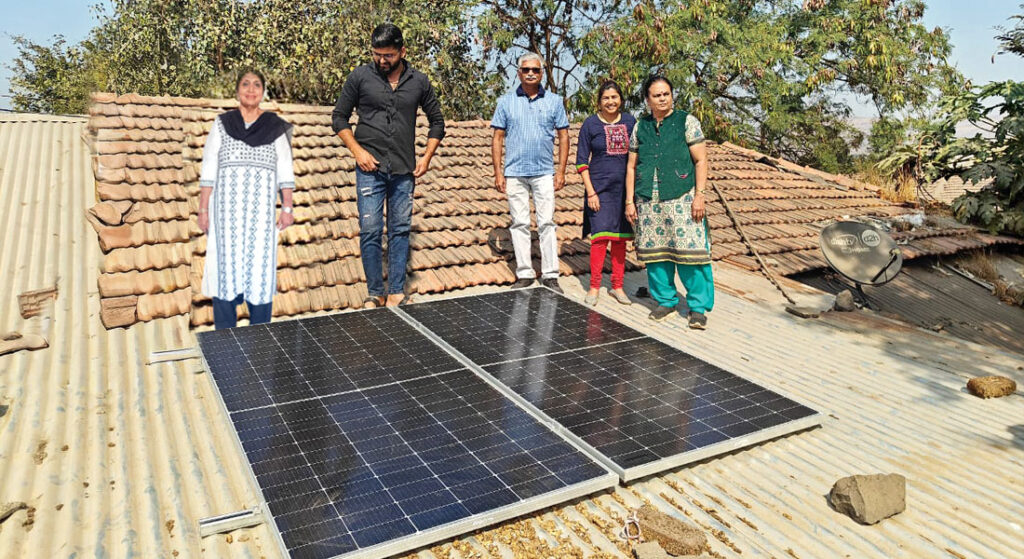
Two Rotary clubs — RCs Pune Hillside and Pune Yuva, RID 3131 — have done a clutch of community service projects in education, health and sanitation, water conservation, both for the farmers and the general community, and have now moved on to provide solar energy to rural schools and homes. With the help of CSR funds this project has helped put up solar panels in over 42 rural and semi-urban schools, and over 300 poor and underprivileged households in a radius of around 60km from Pune.
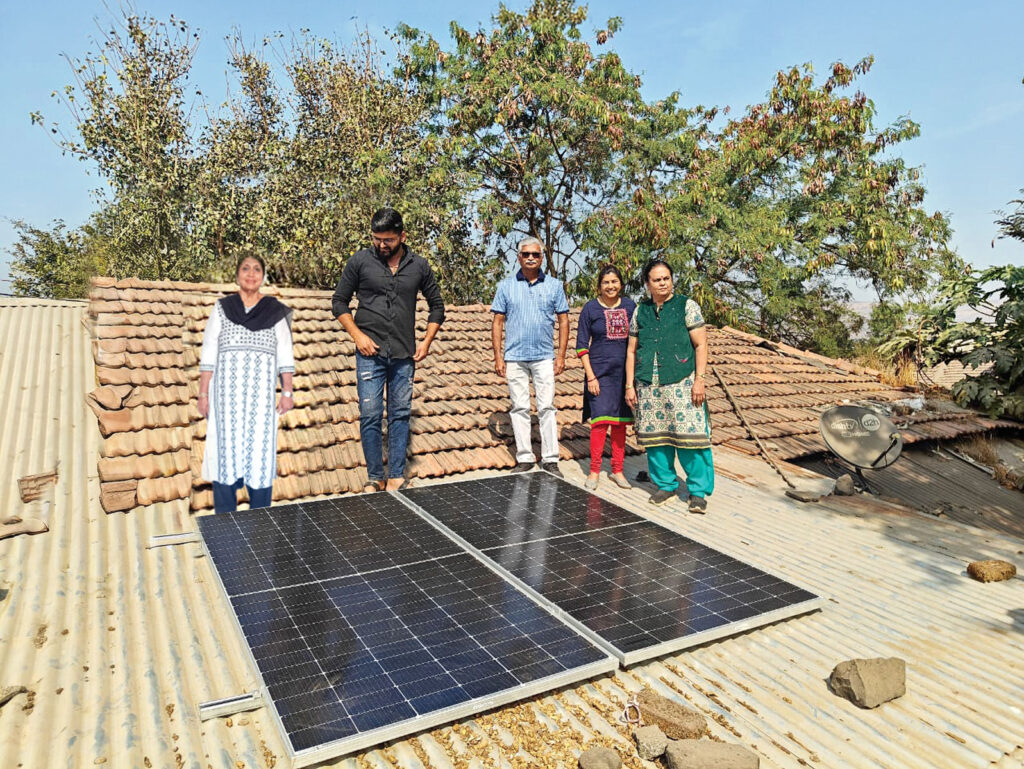
The CSR funds for this project costing upward of ₹1.61 crore have come from Emerson Electric Company India. “Last year our clubs completed a solar energy project for the village of Hatve Budruk, about 42km from Pune, and its success spurred other households to demand a similar project on a bigger scale. So we approached the same corporate, who has helped us for other projects earlier, to provide more funds as we were planning a much more ambitious project,” says past president of RC Pune Hillside Dr Meena Borate, project director, and the moving spirit behind these projects.
She attributes the huge financial help from Emerson to the push given by a senior officer from the company, Abhay Bansod, “whose word really matters in that organisation. Year- after-year he has been bringing big money for Rotary service projects, but always chooses to remain invisible.”
Last year our clubs completed a solar energy project for the village of Hatve Budruk, about 42km from Pune, and its success spurred other households to demand a similar project on a bigger scale.
— Meena Borate, Project Director
Meena, whose passion for water conservation has earned her the nickname Pune’s jalpari (water fairy), is also passionate about the environment and concerned by the statistic that “nearly 60 per cent of India’s energy needs are met by burning coal, which is a disaster for the environment.”
The availability of extra funds added a big incentive to the rooftop solar project, “which we consider our gift to the environment of not only our country but the entire globe. The more tangible and concrete benefit for the families, almost all of them agri-based, is that their monthly electricity bill, which is around ₹700 to 800 is now reduced to ₹0,” she says. Of course, the households will still have to pay a monthly fee of ₹120 for the meter.
On the consumption pattern in these rural homes, she says that most of the houses in these villages have a kitchen and one room, so there are at least two bulbs, one fan, a small TV set, an electric mixie for the kitchen, and perhaps a small refrigerator in the more affluent homes. Most of the homes consume 1 kW per month and the solar energy system the Rotarians have installed on their rooftops is sufficient to meet their energy needs.
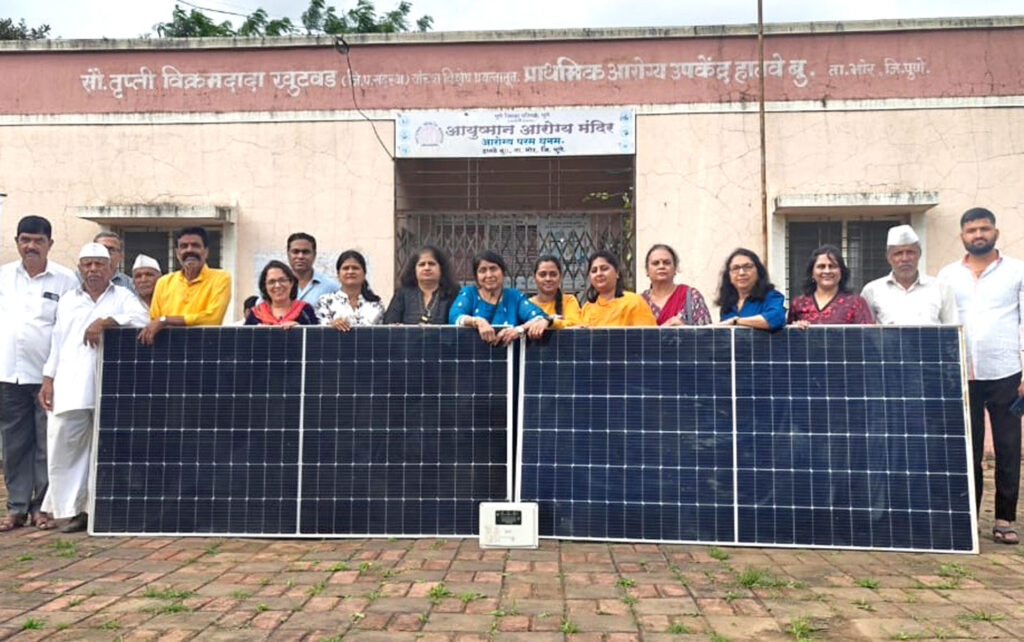
Coming to the zilla parishad (ZP) schools in which the Rotarians have installed solar panels, Meena says that their CSR partner agreed to provide funds for solar energy solutions on the condition that they choose as beneficiaries the ZP schools in Chakan–Talegaon belt where the company facilities are located.
This was easier said than done and the Rotarians faced a major challenge in fitting solar panels on these schools. The problem here, as in most government schools, was that “most of these schools are in bad shape and do not pay their electricity bills for one or two years, often because the grants come late. We had to get this sorted and told them that you somehow find the money and settle your dues.”
The beneficiary schools will be able to use the money saved from paying power bills to provide better educational infrastructure and the households will be able to use the saved money for better nutrition and education of their children.
Even before putting up the panels, both the Rotarians and the vendors faced challenges. Only schools and houses having an MSEDCL (Maharashtra State Electricity Distribution Company Ltd) connection with individual meters were selected for this project. Their average needs are less than what will be generated by the solar systems. From each of these installations, the surplus solar power generated will be fed into the MSEDCL grid and the schools and households will not have to pay any electricity bills. The average life of these solar plants is around 25 years, and if there are any maintenance issues, Rotarians will be available to help.
Also, the MSEDCL needs consumer’s sanctioned load — a minimum of 1 kW — to accept the application for a solar net meter. “Many of the smaller schools had a sanctioned load of 0.2, 0.3, or 0.6 kW. So they had to first apply for an increased load on the MSEDCL portal. Once this was done, it took 2–3 billing cycles to reflect the change. But in this difficult task, the liaison skills of our Rotary friends helped,” says another pillar of the project Aditi Rahane.
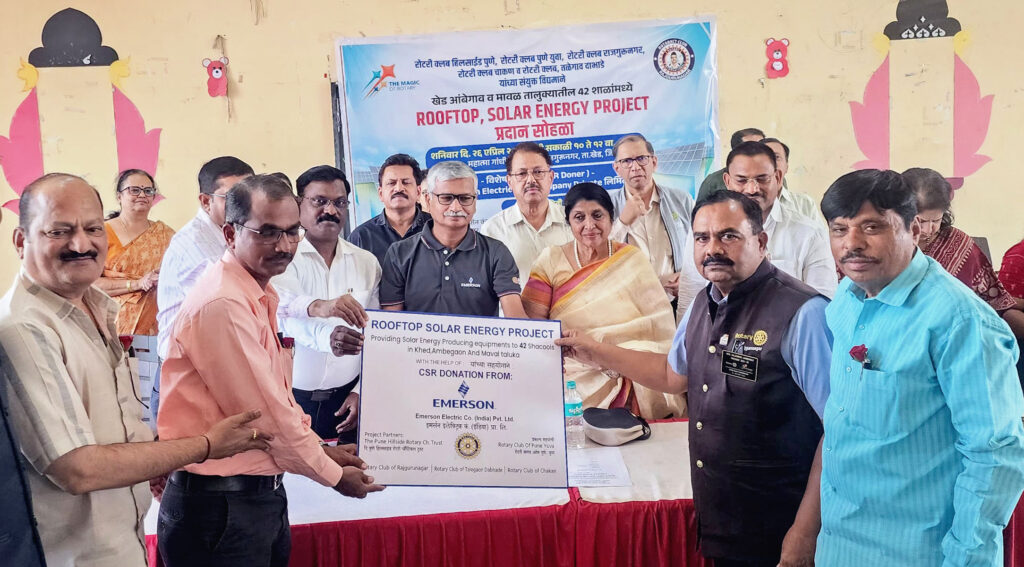
On the power requirements of the schools, in accordance with which the project had to earmark funds for the solar systems, Meena says that the size of the ZP schools vary from rather big to small… with the result that while some of the schools need up to 14–15 kW, the smaller schools need only 1–3 kW. Here the Rotarians had to be judicious and do some balancing… and choose more of the smaller schools so that the money in their kitty could be spread further.
Apart from the solar panels with stands that were fitted on the roofs, generation meters/net meters and anti-lightning rods were fitted, and earthing done.
The Rotarians were happy to complete this project in three months. Now for the coming year, the project leaders want to take up the solar electrification of 250 more homes, as more village settlements in the region are requesting to give them solar energy too.
They also have a plan on how to meet this additional financial obligation. The solar systems for homes cost about ₹70,000 each, for which a Central government subsidy of ₹30,000 is available under the PM Suryaghar Yojana. But this money comes only as reimbursement, after the solar systems are installed. “So we told the families that the subsidy money belongs to us and not them, as we are doing all the spending, and has to be handed over to us as a donation, so that more people could benefit.” Those who could afford it paid upfront, and those who could not were given credit on trust. “We realised that those who could not pay the subsidy amount upfront were the really needy ones who deserved our help, so we told them that we will trust you completely and install the solar systems, but once you get the subsidy, hamarey saath beimani nahi karne ka (please don’t betray our trust and cheat us).”
I am curious to know if those who got ‘credit,’ paid up once they got the subsidy. The Rotarian beams: “Oh yes, completely! You will be surprised how honest these people are; all of them have paid the total amount. These people live in a closely knit community in these villages which are really small, so if someone defaults on the payment, there will be gossip in the whole village and they don’t want to be seen as ungrateful or dishonest people.”
With the subsidy money that will flow back into the Rotary Trust which implements these service projects, an additional 250 homes will be done. Meena explains proudly that this is one of the main reasons why corporates choose to work with Rotary. Not only is it a reputed global organisation, its members come from different professions and have varied expertise which they are willing to contribute free of cost, adding their own money if there is any shortfall, if it means better living conditions for that community.
Aditi Rahane explains that there are no administrative charges, and expert and voluntary hours are contributed by the Rotarians, who coordinate with the vendors for a better price, closely monitor proper end use of installed systems, submit information on the power generated by the systems, and help with maintenance/minor repairs. The grant of CSR funds requires timely submission of proper accounts and other details, and even though this is difficult at times as they are dealing with government systems and villagers, this was done meticulously. Otherwise, partnerships with corporates will not sustain, she adds.
In identifying the beneficiary schools and other liaison work, this project got help from the Rotarians from local clubs such as RCs Chakan, Rajgurunagar and Talegaon Dabhade, who visited all the schools run by the government or reputed trusts and submitted detailed reports on the number of classes, students, grades etc. A few schools serving the physically or mentally-challenged students, and offering vocational courses such as nursing, were also included.
Meena is happy that the initial project meant for 50 homes, grew much bigger and continues to expand, thanks to both the social and media attention it got, and work in many of the homes chosen is continuing. “We hope that the beneficiary schools will be able to use the money saved from paying power bills to provide better educational infrastructure and the households will be able to use the saved money for better nutrition and education of their children.”
It will also lead to enhanced reliability, security and resilience of the state’s power grid, reduced carbon emission and air pollution from energy production, and expand clean energy access to rural schools, she adds. The CSR partner is happy that the money given to them was “fully spent on the actual project, and no overhead expenses or transport costs to visit the sites were taken from the grant.”
Ashwini Bansod and Abhay Bansod are two other pillars of this project which is under execution and will continue in this financial year (2025–26), at the end of which an audited utilisation report will be presented to the corporate as mandated.
The next big project these Rotarians are planning to take up is “proper garbage disposal; if you go one mile outside Pune city, and into the smaller towns and villages you will find there is no garbage disposal system of any kind. We hope to make a difference in this too in the coming days,” adds Meena.