
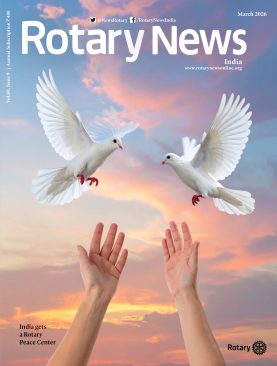

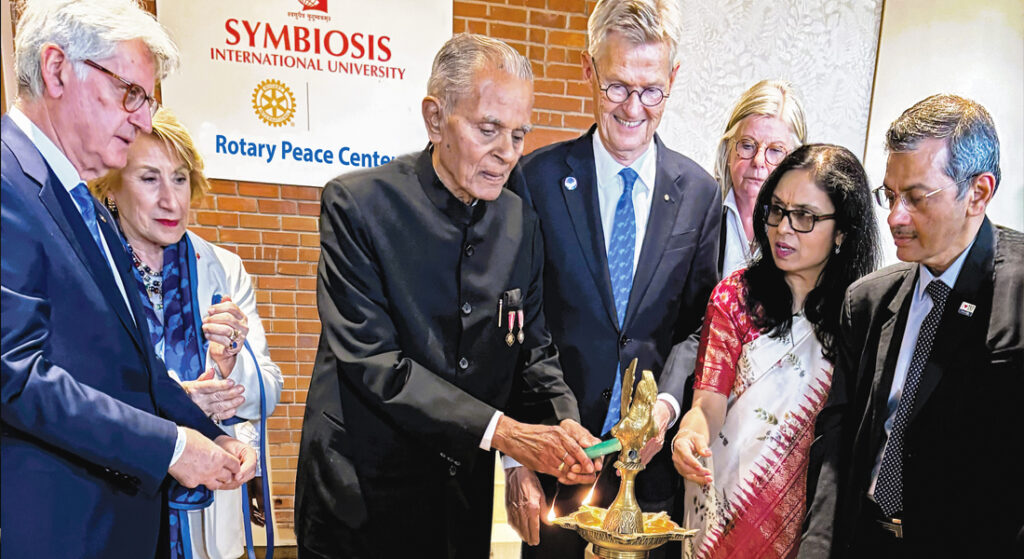
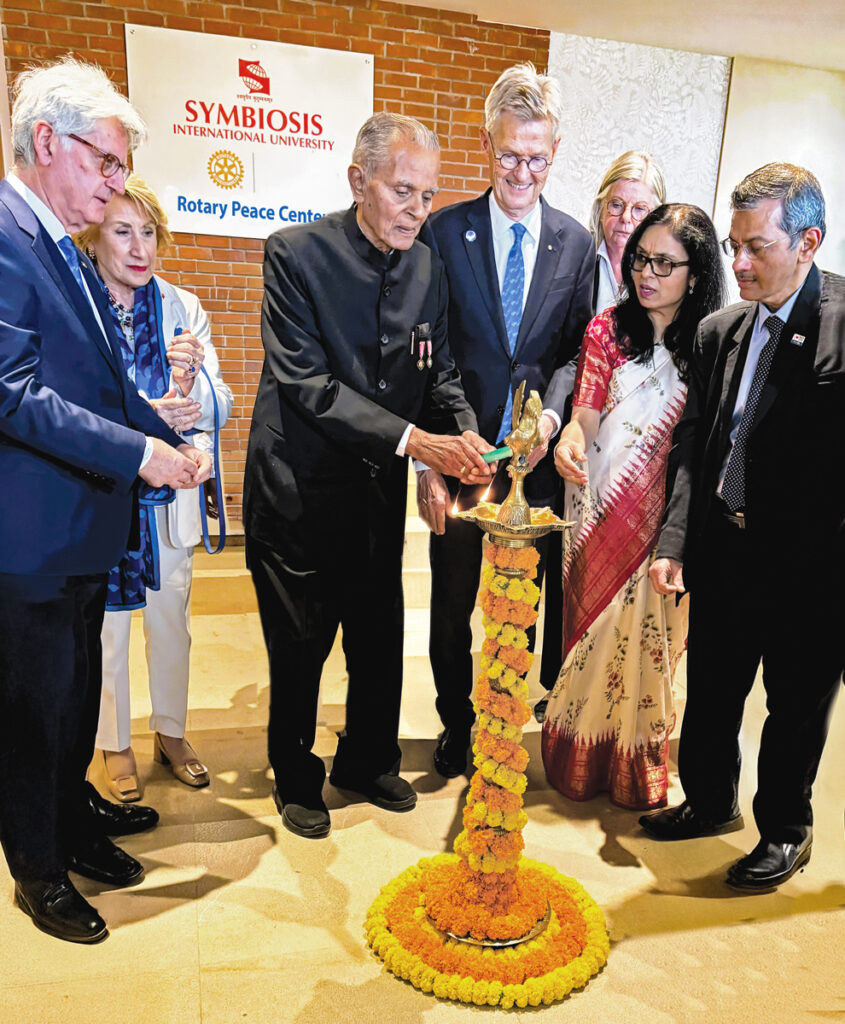
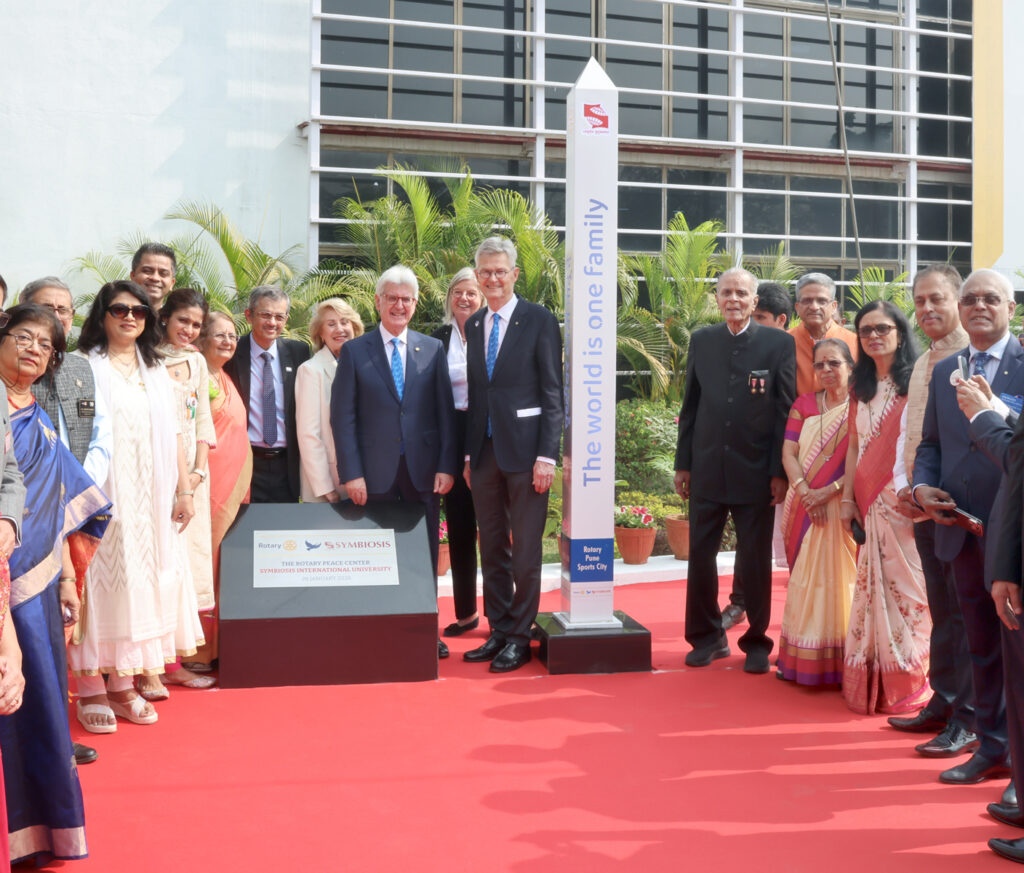
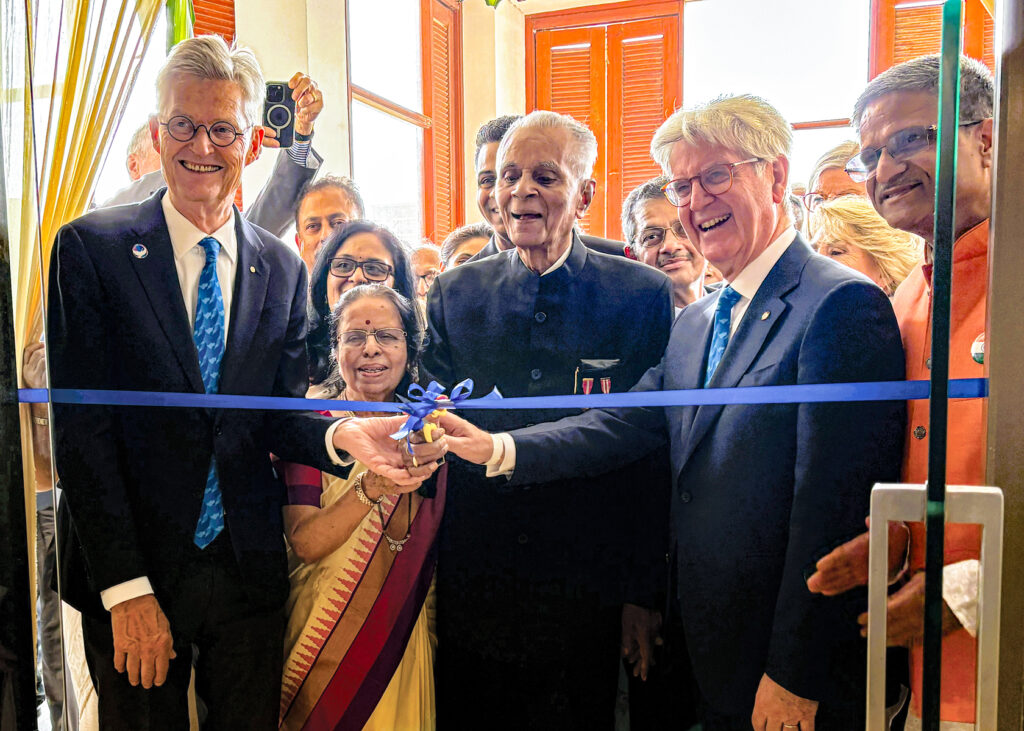
Most of the conflicts that our world is facing today are the result of fear and failure to understand the other side. Many people speak about “peace as if it is only the absence of war, but peace is much more than that. Peace is the presence of trust, understanding, justice. It is the daily work of building bridges and helping people live free from poverty, hate and prejudice, because these things create conflict and destroy peace,” said RI President Francesco Arezzo. He was participating in the inaugural ceremony of Rotary’s eighth Peace Center in the world, and first in South Asia. This centre is located at the sprawling 400-plus acre campus of the Symbiosis International University (SIU) in Pune, Maharashtra.
Peace cannot exist without freedom, and respect for the dignity of every human being. But we live in a strange time, when people have more freedom than ever, but too often this freedom “serves only their ego. We forget our duty to care for humanity. We live close to other people, but we feel far from them and are lonely in a crowd. When you are lonely in a crowd, fear grows. In many parts of the world, people fear an uncertain future. They fear losing their identity and fear strangers who have been shown as evil and dangerous.”
If we want peace in the world, we must face our fear of the other. The other person, the other culture, the other way of life. We must resist the arms of modern life that makes us isolated and closed.
— Francesco Arezzo, RI President
The saddest part, Arezzo said, was that both sides related “the same story” — fear on both sides became a weapon. But fear cannot be defeated by running away, or aggression. Giving the example of a child who fears darkness or hearing sounds at night, he said these fears are resolved not through armed guards but information. Knowledge was the first step toward peace. And this was the purpose of a Rotary Peace Center, “which helps to replace fear with understanding and turn confusion into clarity. It teaches skills that reduce conflict and support cooperation, trains people to listen well, build trust and solve disputes without violence.”
Arezzo said that while good intentions did matter, they weren’t enough, and peace didn’t happen by accident. “Peacebuilding needs skill, practice and people who are trained to work in hard places, with calm minds and steady hearts. A peace centre also builds a strong network. People trained at this peace centre will not be alone. They will stay connected to others who do this work in many countries and many cultures. Peace is fragile when it is carried by one person, but peace is stronger when it is carried together.”
That is why Rotary invests in peace centres, in order to “build peace, not only for today, but for the long future.” His theme for this year — Unite for Good — was more than a slogan. “It is a challenge to build peace in ourselves, in our communities and in our world. To unite for good doesn’t mean we are all the same, or we erase our differences. It means we refuse to treat differences as enemies, and we choose to work together, even, and particularly, when it is not easy.”
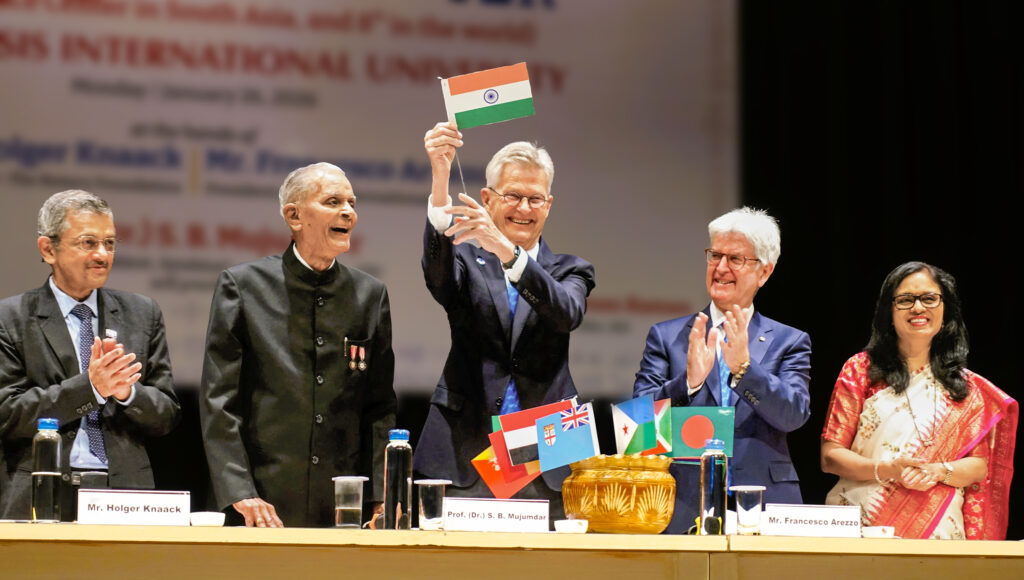
The RI President said that while a university is “a place of learning, it is also a place of listening. It is a place that makes room for questions, debate and truth, because peace needs that kind of space. Today, we opened this new Rotary Peace Center, and we renew a simple belief that peace can be built on purpose, not quickly, not perfectly, but on purpose, through learning, training and partnership.”
Rotary was an organisation built on friendship, knowing, understanding and caring about other people. “When we build friendships across borders, we build peace.” Peacebuilding also required self-reflection; if we want peace in the world, “we must face our fear of the other. The other person, the other culture, the other way of life. We must resist the arms of modern life that makes us isolated and closed.”
A new peace centre is a new source of knowledge, a new network of trained leaders, a new place where Rotary’s values can take roots in the minds and action of people who will carry them beyond this campus.
— Holger Knaack, Trustee Chair
Peace came from small steps, “taken together toward mutual respect and understanding. Peace was essentially knowledge, awareness of our duties and wise defence of our rights and the rights of others. It was a shared path, which could be long and hard, but it could be walked, if we walk it together.”
By inaugurating its eighth Peace Center, Rotary was opening “a door to learning, partnership and service. It was building a lasting place where peace is not only “discussed, but learned, practised, and carried into the world.”
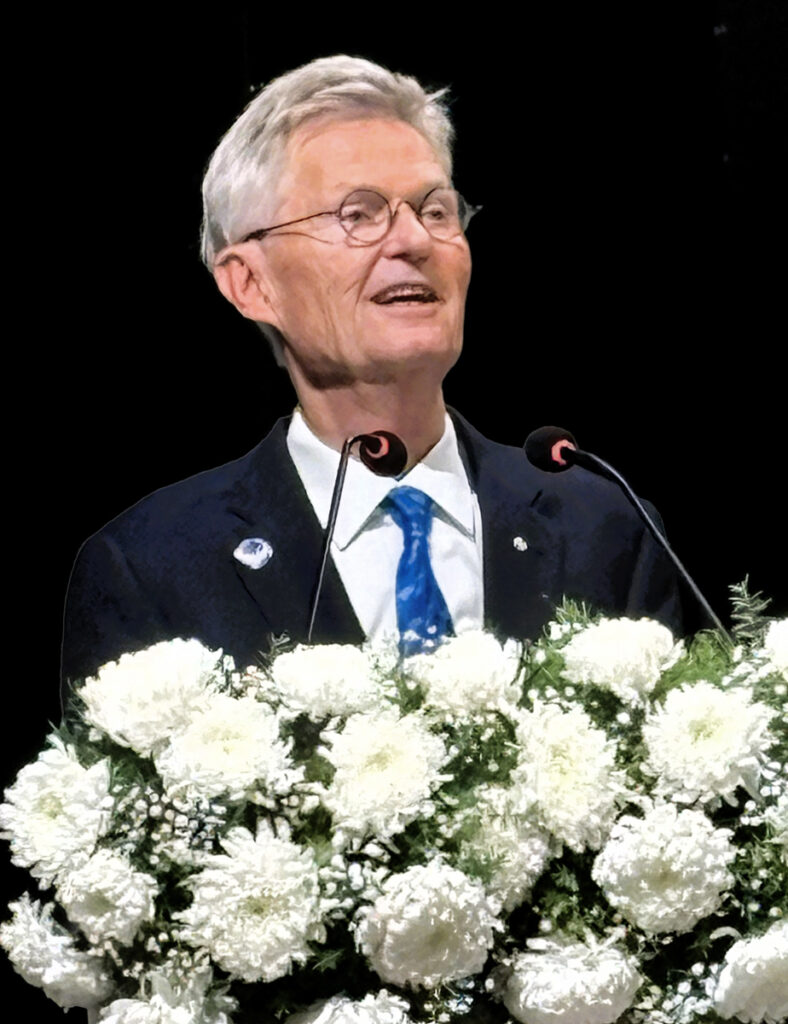
A ddressing the meet, TRF Trustee Chair Holger Knaack said Rotary Peace Centers were a source of pride for Rotary and an investment into the future “built on justice, understanding, and problem solving.”
TRF, supported by its generous donors, existed to help Rotarians “turn compassion into action, and this centre would be a new home for peacebuilding in Pune and in the heart and careers of the people who will study and grow here.” The Foundation enabled Rotarians to turn their “best ideas into reality, at scale, with strong stewardship and with long-lasting impact. We invest in projects and programmes that protect health, expand opportunities, and strengthen communities. And we do this because we believe that dignity and hope should not be a rare privilege, but normal conditions for human life.”
That was also why peace was a cornerstone of Rotary’s mission. Its peace centres have trained more than 1,800 peace fellows to become effective catalysts for peace through careers in government, education, and international organisations like UN agencies. “This is why today is so meaningful in these difficult times. A new peace centre means a new source of knowledge, a new network of trained leaders, a new place where Rotary’s values can take roots in the minds and action of people who will carry them beyond this campus.”
Knaack said that a Rotary Peace Center was only as strong as the institutions that host it. “That is why we are so grateful to Symbiosis University, which has a clear commitment to education, service and building understanding across communities. These values are so close to Rotary values which are built on friendship and service, just as Symbiosis is built on learning and connections. Together we are a very powerful combination. We do not see this as a simple agreement. We see this as a long partnership, one that we will value, protect and grow.”
The Trustee Chair also thanked the TRF trustee from India, Bharat Pandya, for connecting Rotary with Symbiosis and helping identify such a strong partner. Such partnerships don’t happen by luck and require a lot of work. He also thanked members of RI Districts 3141 and 3131 for taking the responsibility of being hosts to the peace fellows who will come to this centre. Hosting, he said, was not just about logistics; it is making them welcome and supporting them. It is making sure that people who arrive from many places feel they belong here and that they can succeed here. “Your role will help shape their experience and it will help shape the future of this peace centre. And TRF will stand with you in this work.”
He assured the aspirants that behind every peace fellow is a network of support, faculty, mentors, Rotarians, community partners and donors. “That is how Rotary works. We build a system of support around the world and people who want to serve.”
Thanking the generous donors of TRF, who made such Peace Centers possible, Knaack promised the donors that their gifts will be used “with care, transparency and with real impact. When we say we are committed to peace, we also mean we are committed to the hard work that peace requires over many, many years. This is just a beginning… of new learning and friendship for new peacebuilders who will go into the world better prepared to reduce conflicts and build trust.”
The Trustee Chair added that Rotary’s mission was to create lasting change, and peace was at the centre of that mission. This new Rotary Peace Center would “help change lives; one fellow, one community and one partnership at a time.”
Founder and Chancellor of SIU Prof S B Mujumdar said he constantly heard accolades about how he has created a wonderful university. He was born in a small village in Kolhapur district of Maharashtra. “There were no lights or towers, no phones, TV or radio. I completed my primary and secondary education from two small government schools. And the beauty of those schools was that the children of poor and rich, children of parents of various castes and religions studied together.”
After completing his education, he joined the Fergusson College, Pune, in 1963, and later started Symbiosis. Along the way he faced many challenges and had “very sad and bitter experiences.” Once, he asked a student from Ghana what do you want to do with your life? “He said I would like to run away from your city as soon as possible. I said why? He said, early in the morning when I go to the bathroom, your Indian students either close their eyes or turn their heads. Because they believe that seeing anything black early in the morning is a bad omen. When I travel in a local bus, Indian girls prefer to stand rather than sit beside me.”
After hearing similar experiences from many students from Kenya, Uganda, Tanzania, Vietnam, Thailand and Sri Lanka, he was both distressed and disappointed, and wondered what kind of impressions these students would carry home about Pune, or India and our culture. So he started a small centre in a 10×12 room and being a teacher of botany, the word Symbiosis came naturally to him. Realising that though their colour and culture might be different, their blood was red, just like ours, he thought if “we provide a home, away from home to these foreign students by giving them courtesy, good treatment, they will be our cultural ambassadors in the world.” And that is how Symbiosis International Cultural Centre was established, so that cultural education would go hand-in-hand with whatever stream of education they chose.
A grateful Prof Mujumdar said that “when Symbiosis was passing through teething troubles, it was Rotary which came to my rescue, and gave us ₹1 lakh to start a Symbiosis Educational Centre. Our collaboration began from 1973, and continued in different ways.”
There were also frequent exchanges between Rotary clubs and Symbiosis International students. “This is a small, simple way of contributing to global understanding, which will perhaps lead to world peace.”
In 2002, the institution got the status of a university and now it has off-campus centres in Bengaluru, Hyderabad, Noida, Nagpur,Nashik and Mumbai, and more recently Dubai. India has 1,053 universities, and over 50,000 colleges. But at Symbiosis, the accent is on internationalisation; it has students from 85 countries and all states of India. “They play together, read, sing together and they often quarrel together.”
He is often asked about his future goal, which is to create global citizens. He hoped the “Rotary peace centre will send a global message to global students that peace is the only craving of humanity. Wars and battles are no solutions for human problems.”
He assured the assembled Rotarians that this Peace Center would flourish and prosper and the fellows who passed out from it “will be the messengers of peace across the world.”
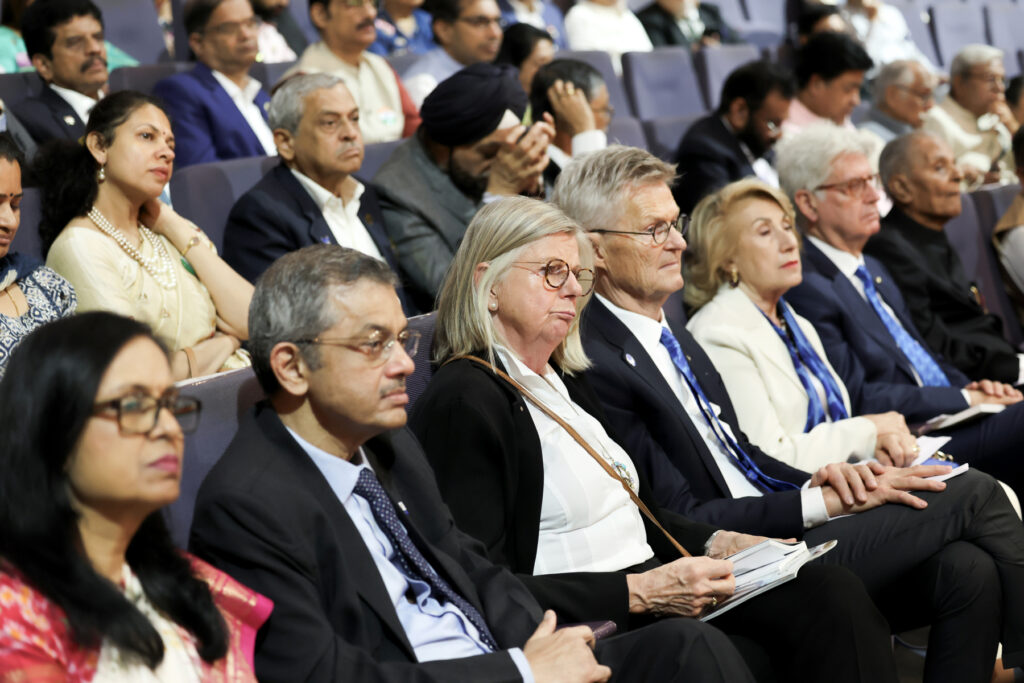
TRF trustee Bharat Pandya said the fact that out of the 42 RI districts in India, 23 were represented at the inaugural of this Peace Center was a testimony to how much importance Rotarians gave to peace.
In today’s world, global conflict has created a huge crisis. There are 17 million-plus refugees and displaced persons in the world. In 2024, it was estimated that the economic impact of conflicts, displaced people and refugees to the world is $19.97 trillion.
Economic toll was only a part of this huge crisis; Rotary not only talked about peace but worked in all areas related to peace, such as health, economic and community development, water and sanitation, disease prevention and environmental protection, to create conditions which help peace to flourish.
Another important step was its peace centres and peace scholars. By empowering young emerging leaders and opinion makers and equipping them with the skills for conflict resolution and sustainable development, Rotary is helping to create an impact both at the local and global levels. “Arch Klumph once said that if you build temples, churches and mosques, they will crumble into ruins. If you build monuments, time will deface them. But if you work with the minds of people and imbue in them a sense of compassion, integrity, responsibility, cooperation and understanding, then you are doing something that is imperishable and that will last for centuries to come.”
That was the objective of Rotary in building its peace centres. Pandya thanked SIU and its leaders for hosting this peace centre, and Rotarians from districts 3141 and 3131 for sowing this important seed for peace to flourish in our conflicted world.
Pro Chancellor of SIU Dr Vidya Yeravdekar said the inaugural of the new peace centre also marked the 55th Foundation Day of SIU. She had learnt there were several applications from across the world for the establishment of the Peace Center, and after a rigorous selection process, SIU was chosen. Perhaps the RI committee’s interaction with both Prof Mujumdar and the international students had helped clinch the deal. “Thank you, Rotary, for showing so much faith and trust in this university,” she said.
She assured Rotarians that the core values of their organisation and the guiding principles of SIU, particularly its motto Vasudhaiva Kutumbakam (the whole world is one family), were in total sync. She was confident that the Rotary peace fellows who will get admitted to this centre in 2027, will be “well-equipped with adequate skills and knowledge that would help them to promote world peace.”
Sudakshina Sen, centre head for the Rotary Peace Center, said its establishment at Symbiosis was all the more significant as both the organisations shared core values of service to society, respect for diversity, and commitment to education.
This centre will cater to the greater Asia region, “integrating an interdisciplinary approach with experiential learning. The diploma programme will be offered in a blended learning format to empower mid-level professionals working in different spheres of peace and development, to advance their engagement in sustainable and actionable outcomes for social change in Asia,” she added.
Past RI director Mahesh Kotbagi recalled the long relationship the Rotarians in Pune had with SIU, particularly in healthcare, where Rotary had helped the hospital in Symbiosis with both funds and equipment, particularly in establishing the dialysis centre with 35 machines where free service was given to poor patients. He announced that the number of dialysis units would be increased from 35 to 50, and DG Vinod Saraogi, RID 3234, who was present at the meet, had given an instant commitment that he would take care of the funding.
Pictures by Rasheeda Bhagat
What is on offer
The newest Rotary Peace Center established at the Symbiosis International University in Pune will provide a fully-funded one-year PG diploma programme in Peace and Development Studies to its scholars. Rotary’s peace programmes are designed and targeted at mid-career professionals working in various fields in government and private sectors that deal with welfare, development, law and order, judicial systems, and so on. The Pune centre will give an opportunity to professionals within Asia and Asian communities.
Applications for this PG diploma programme at SIU will be open from Feb 1 – May 15, 2026. Visit rotary.org/peace- fellowships to learn more about the Rotary Peace Fellowship programmes and how to apply.
Currently, Rotary awards up to 170 fully-funded fellowships for dedicated peace and development leaders from around the world to study at one of its eight peace centres across the world.