

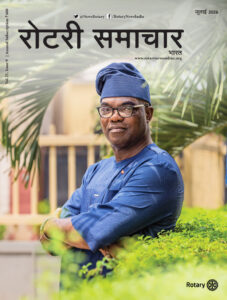


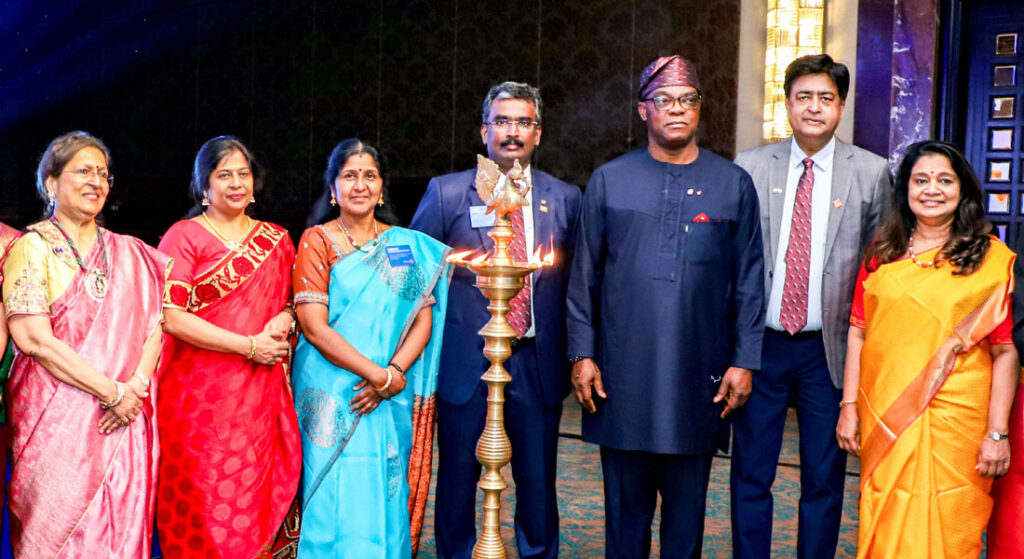
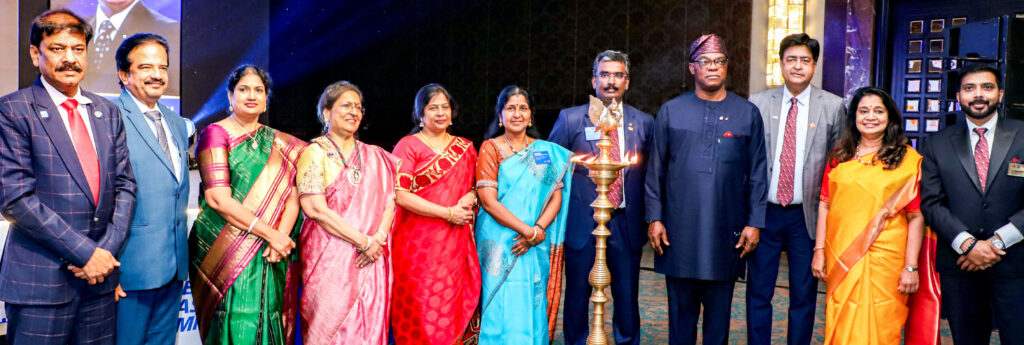
The joint Membership Summit of RI districts 3231, 3233 and 3234, held in Chennai during the India visit of RIPE Olayinka Babalola, was a call to action for the incoming district and club leaders to draw plans to strengthen Rotary’s membership. With Rotary’s ambitious Vision 2030 — targeting 1.25 million Rotarians and 125,000 Rotaractors by the organisation’s 125th anniversary — the summit urged the DGEs to begin work immediately to expand and strengthen membership.
Babalola set the tone with urgency and clarity. “We cannot wait till July 1 to start. We need to start now,” he said, stressing early collaboration between incoming leaders and current governors. He reminded the DGEs that while their year in office is significant, humility and long-term relationships matter more. “You will be governor for one year, and PDG for life. So please do not ruin the life possibilities with one year of perseverance.”
Drawing from Rotary’s vision statement and his presidential message, Create Lasting Impact, he challenged Rotarians to shift their perspective inward. “As members we’ve been creating lasting change across the globe through our Polio eradication programme, the peace centres where we equip people with skills to build peace, and our various global grant projects. Now I want you to ponder how Rotary has changed you as a Rotarian,” he said, emphasising that personal transformation stories are key to meaningful membership growth. “For Rotary to grow, every Rotarian must be able to tell that story.”
Through deeply personal anecdotes, he illustrated Rotary’s unseen value. Recalling a Rotarian whose daughter’s life was saved through the timely financial support of fellow members, he said, “Rotary has a way of showing up quietly, silently, when it matters most.” Sharing his own experience of receiving unexpected help in securing a visa, he reinforced that Rotary gives in ways beyond service: “It’s also okay to receive… your Rotary connection has opened doors for you in many places.”
He cautioned against impersonal narratives when speaking about Rotary. “Very boring stuff,” he remarked about statistics-heavy introductions. “Because for you it maybe something. But it may not impress a layman.” Instead, he urged members to connect emotionally. “You can start by saying, for me, this is how Rotary has transformed me. And tell your story.”
Stressing on inclusivity and club culture, Babalola recalled his own near rejection from Rotary due to an unwelcoming club. He called on leaders to be especially mindful of Rotaractors. “Let us value them for the skills they possess. Let us not be asking them to do basic things, or look at them as small boys and girls who have come to enjoy free food.”
On membership targets, he simplified the seemingly ambitious goal. Referring to RI director M Muruganandam’s call for adding 10,000 members every year for the next four years, he noted, “We are simply asking that every club have a net gain of just two members! That’s a very easy target. Any club that does not bring a new member has a destined handshake with extinction. Every new member is an asset, a resource, a new fund raiser.” He urged the district leaders to better their best and “stop saying Rotary is declining. You don’t see a decline in your region. Yes, it is… in some part of the world; but we’ll change that.”
With data-driven details and a structured roadmap, RID Muruganandam explained the Red-Amber-Green (RAG) classification of clubs based on membership strength. “To achieve our goal, push the Red clubs to Amber, and Amber to Green,” he said, noting that nearly 43 per cent of clubs in India are in the Red category (below 25 members), and 35 per cent in Green (25–50 members).
He outlined a comprehensive seven-point agenda, anchored in a “1:2:3 formula” — adding 100 Rotary, 200 Rotaract and 300 Interact clubs, alongside 100 new RCCs. This, he said, would result in “a net growth of 10,000 Rotarians and 10,000 Rotaractors each year for the next four years.” He also called for increasing women’s membership by 5 per cent and projected that “India will give 40 per cent contribution to world Rotary membership.”
Highlighting a major gap, he pointed out that of the 4,963 Rotary clubs in India, nearly 3,000 clubs had not chartered even one Rotaract club, and 3,800 had not started an Interact club. “So, we are not bothering about youth,” he observed bluntly, urging immediate corrective action.
Striking an optimistic note the director highlighted India’s strong performance globally. “Zone 5 tops the world in membership performance,” he said, detailing achievements in new clubs and member additions.
PRID A S Venkatesh highlighted the challenge of retention. “Every year, Rotary inducts 150,000 Rotarians. But the net growth is not even 4,000,” he said, pointing out the high attrition rates. “Let’s also make sure that those who are in, stay inside Rotary.”
PRIDs P T Prabhakar and Mahesh Kotbagi extended their support to DGEs T S Ravikumar (3231), Shriram Duvvuri (3233) and D Suresh Jain (3234), while they shared their action plans aligned with Vision 2030.
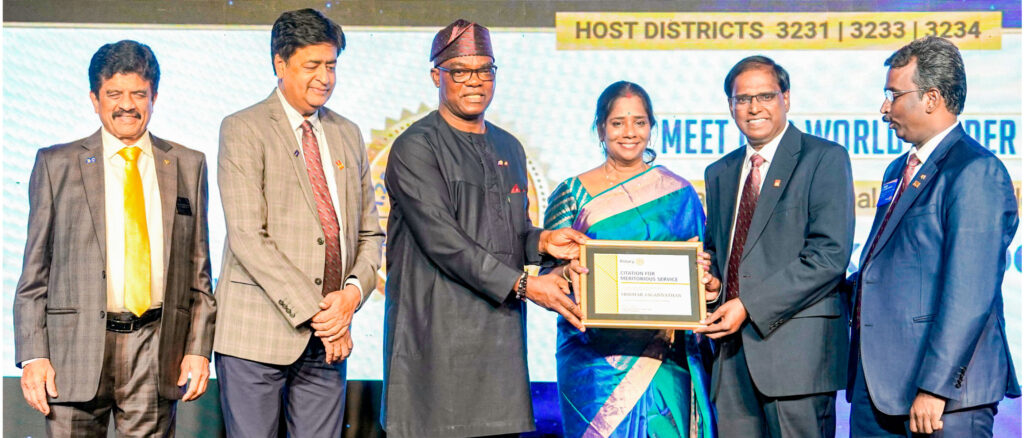
The Rotary clubs of RID 3233 contributed $100,000 to TRF commemorating the RIPE’s visit. Babalola presented the Citation for Meritorious Service to PDG J Sridhar.