


Rotaractors, the youth power bank of Rotary
Orthopaedic surgeon
RC Varanasi Elite, RID 3120
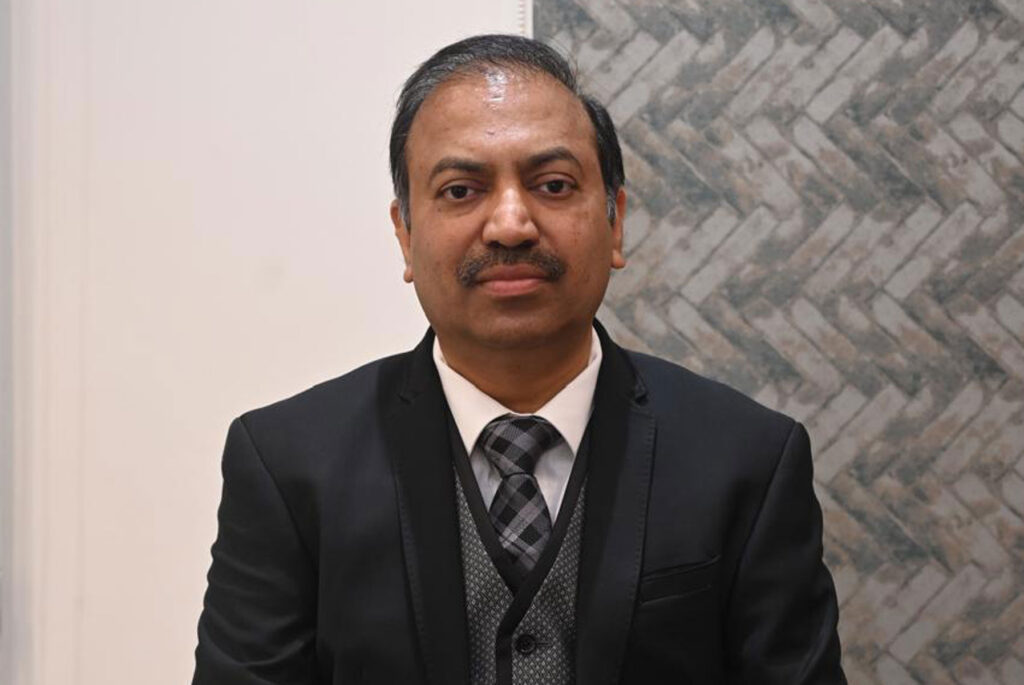
For Ashutosh Agarwal, “Rotary was never a distant concept. It was a lived example.” Growing up in a Rotarian household, with his father, N H Agarwal a Rotarian since 1985, “service was naturally woven into everyday life.”
The district achieved a 180 per cent growth in Rotaract, expanding from a single club to 1,350 Rotaractors across 17 clubs, with the support of DRR Mahi Bhan. Over 100 Interact clubs are actively functioning across the district. Agarwal says Rotaractors are the “youth power bank of Rotary. They have to be taught that sustainability comes through financial discipline. So, we have to encourage them to pay their dues and remind them that Rotary offers unmatched networking opportunities, not just in one city, state or country… the world is yours.”
While a 20 per cent increase in female membership and the addition of 300 new members were achieved, retention has been a challenge. To address this, he introduced the Ghar Wapsi programme, under which club presidents personally visit former members, understand their concerns, and reconnect them with Rotary.
Through a tie-up with R J Shankara Hospital, Varanasi, over 40 clubs conducted weekly eye check-up camps for six months. The initiative benefitted over 600 patients and enabled 200 cataract surgeries. The district also contributed to three endowments and five global grants, worth $320,000.
Service as a way of life
International logistics
RC Anna Nagar Aadithya, RID 3233
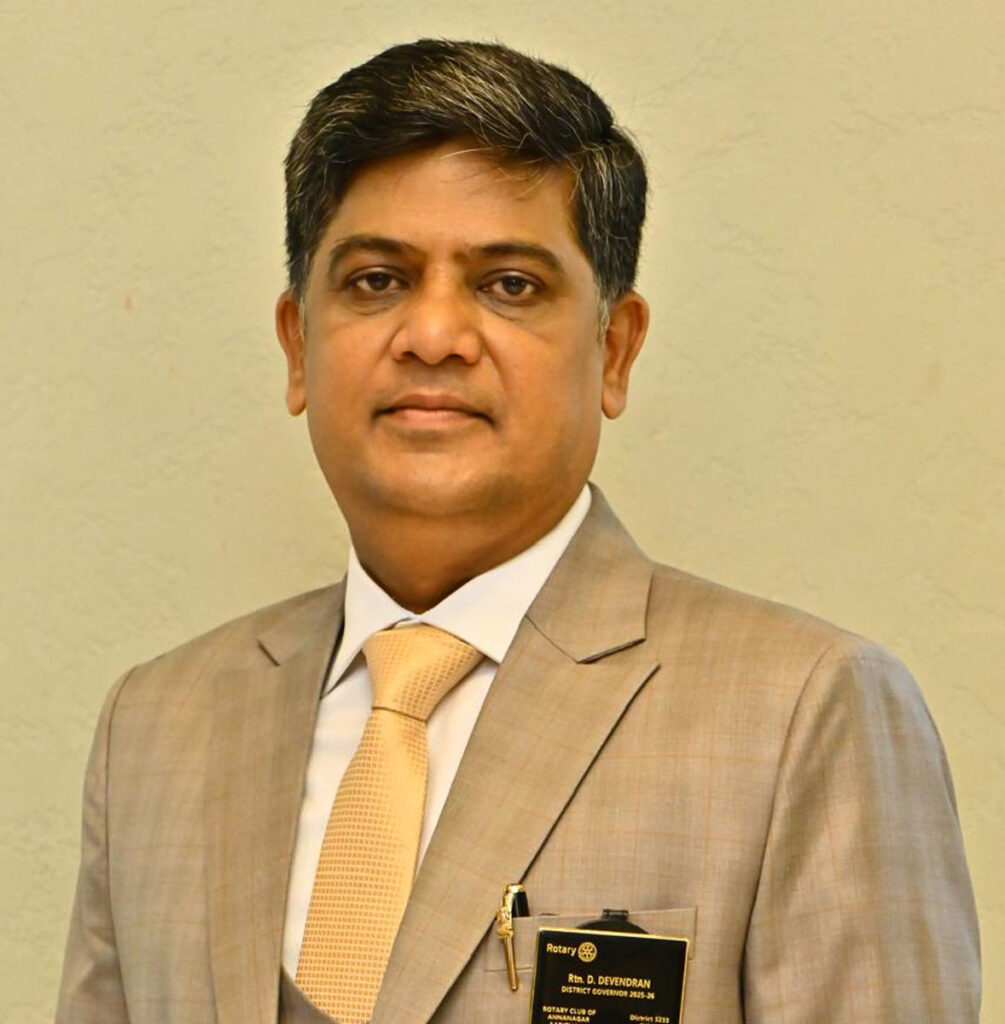
D Devendran joined Rotary in 2001, “inspired by the selfless commitment of senior Rotarians. Over the years, Rotary has shaped my values, leadership approach, and sense of purpose. To me, service is a way of life,” he says.
He urges club presidents to invite professionals who exhibit integrity, social responsibility, and a willingness to serve in Rotary. He emphasises sound Rotary knowledge and meaningful engagement from the outset.
The district is actively promoting DEI, “supported by training and awareness programmes that reinforce DEI as a shared mindset rather than a mandate.”
This year’s major initiatives include the District Olympiad 2025, benefitting over 1,500 students; cancer awareness walkathons and screening drives, the Green Rotarians Movement for environmental responsibility, skill development and women’s empowerment programmes aimed at long-term economic independence.
His TRF goal for this year is $1 million and will be focused on Annual Fund, Polio and Endowment contributions. Despite challenges, he remains confident that “transparent communication and showcasing TRF’s impact will drive donations. The district is also strengthening CSR partnerships in healthcare, education, water conservation, and digital literacy to scale community outcomes,” he says.
The district has chartered two new Rotaract and 11 Interact clubs.
Meaningful membership, not numbers
Architect
RC Bangalore South, RID 3191
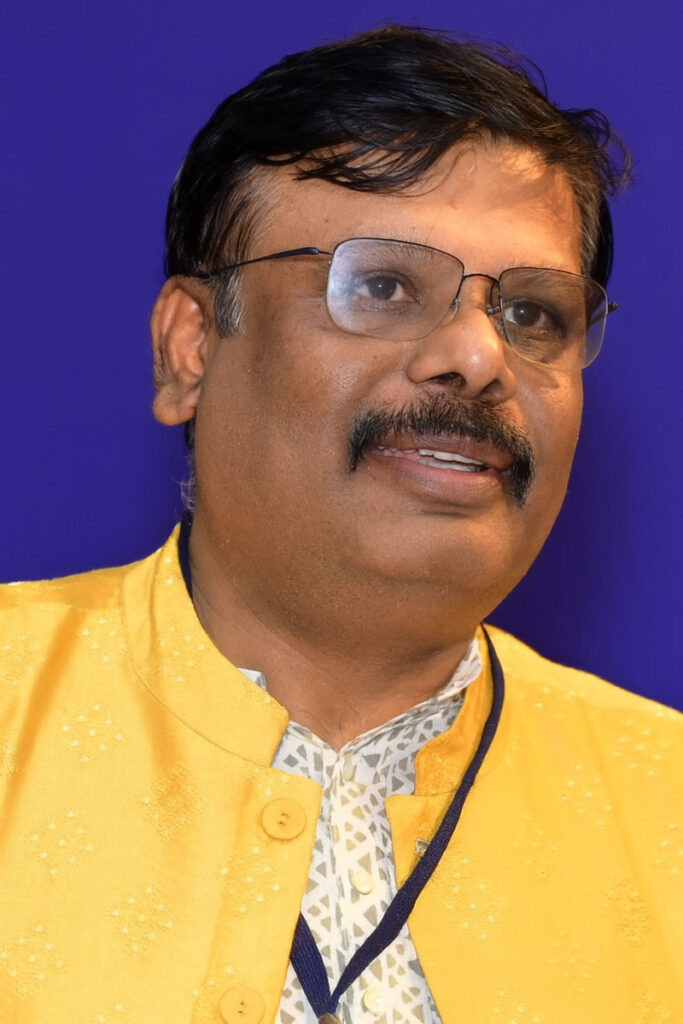
B R Sridhar’s Rotary journey began in 2000 with “a simple invitation from his first client to attend a meeting. That experience introduced me to the power of collective service.” He believes strong clubs are built through meaningful engagement, not numbers alone. He encourages clubs to highlight outcomes, strengthen member-experience through engaging meetings and leadership opportunities. Personal outreach, he says, remains the most effective way to grow membership.
The district is working to increase women’s leadership, engage youth and differently-abled individuals, and bring in professionals from under-represented sectors. DEI is also being integrated into PETS, SETS and other district training programmes, with “equal support extended to clubs of all sizes.”
Service priorities focus on healthcare, women’s empowerment and the environment. Healthcare initiatives include cervical cancer vaccination, Type-1 diabetes support, medical camps, and upgrades for PHCs and government hospitals. Women’s empowerment projects include providing milch cows to rural families, while environmental efforts centre on tree plantation, water conservation and waste management.
The district has set a TRF giving target of $3.6 million. Sridhar wants to ensure every club experiences TRF’s impact through effective use of global and district grants and eventually strengthening the district’s overall giving culture.
Small contributions, large outcomes
Orthopaedic surgeon
RC Shillong, RID 3240
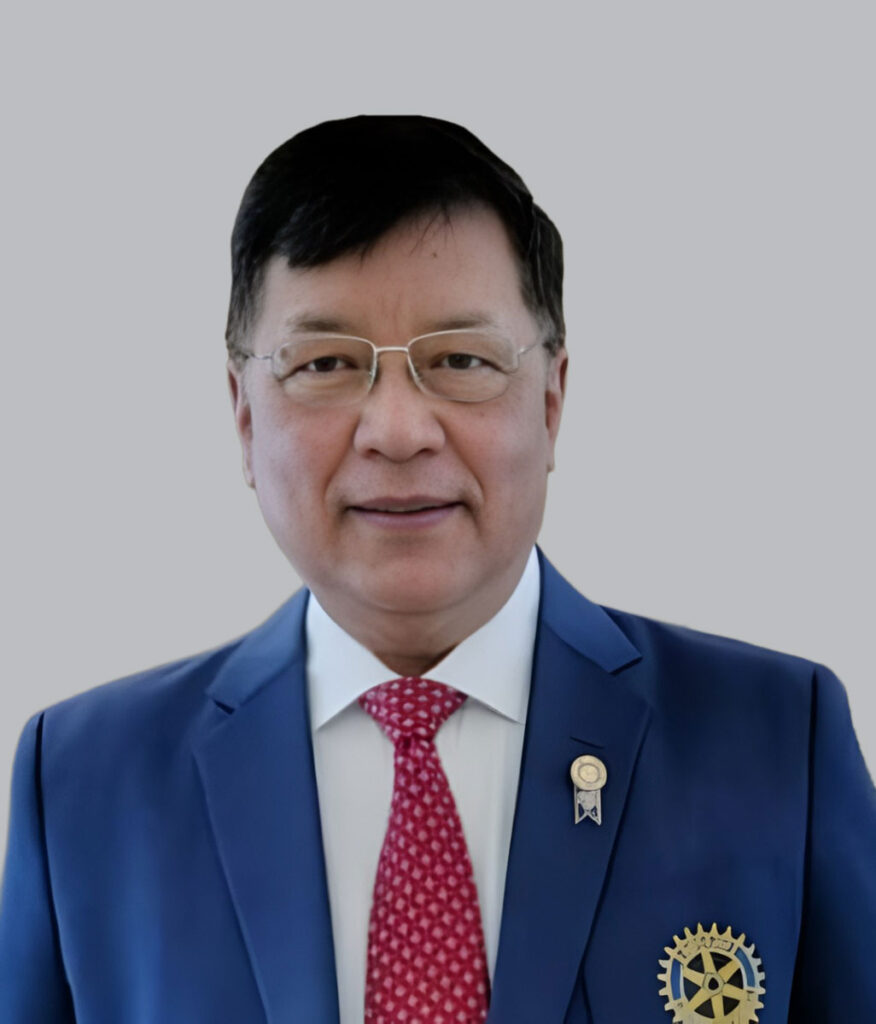
In the early years, when Dr Kameswar Elangbam joined Rotary, professional commitments limited his participation. He observed a senior Rotarian “who, despite immense responsibilities, never missed a Rotary meeting or service project. That quiet dedication inspired me to reassess my role,” he says.
He strongly believes in the power of small contributions to TRF. “Even $20 or $30 can change lives across continents.” As the district’s foundation secretary in 2021–22, he introduced a culture of donor appreciation by recognising every contributor, regardless of the amount. The district’s TRF target is set for $1 million.
CSR contributions were affected due to mandatory requirements (CSR Form 1 compliance and valid 12A and 80G registrations). To ensure continuity, the district “is coordinating with compliant clubs to support the continuity of CSR projects.” The district added 150 new members and chartered one new Rotary, 10 Rotaract and
11 Interact clubs.
A GG to provide 5,000 smokeless chulas to rural homes is being contemplated. District projects include a CSR-funded floor at the Silchar Cancer Hospital and an electric crematorium complex in Ukhra.