
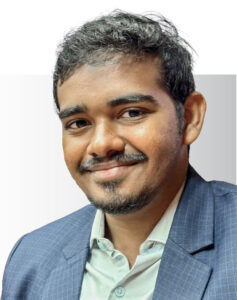
When Ahmed Ibrahimsha was a final year student at the Kamaraj College of Engineering in Madurai in 2021, he was told about the RYLA — Be an entrepreneur programme being conducted by the Rotary Club of Virudhunagar.
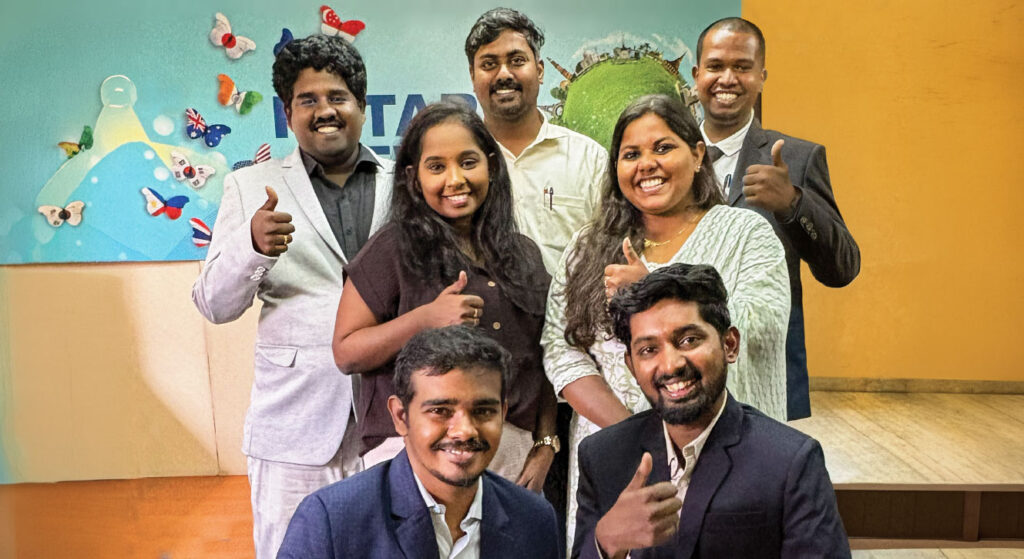
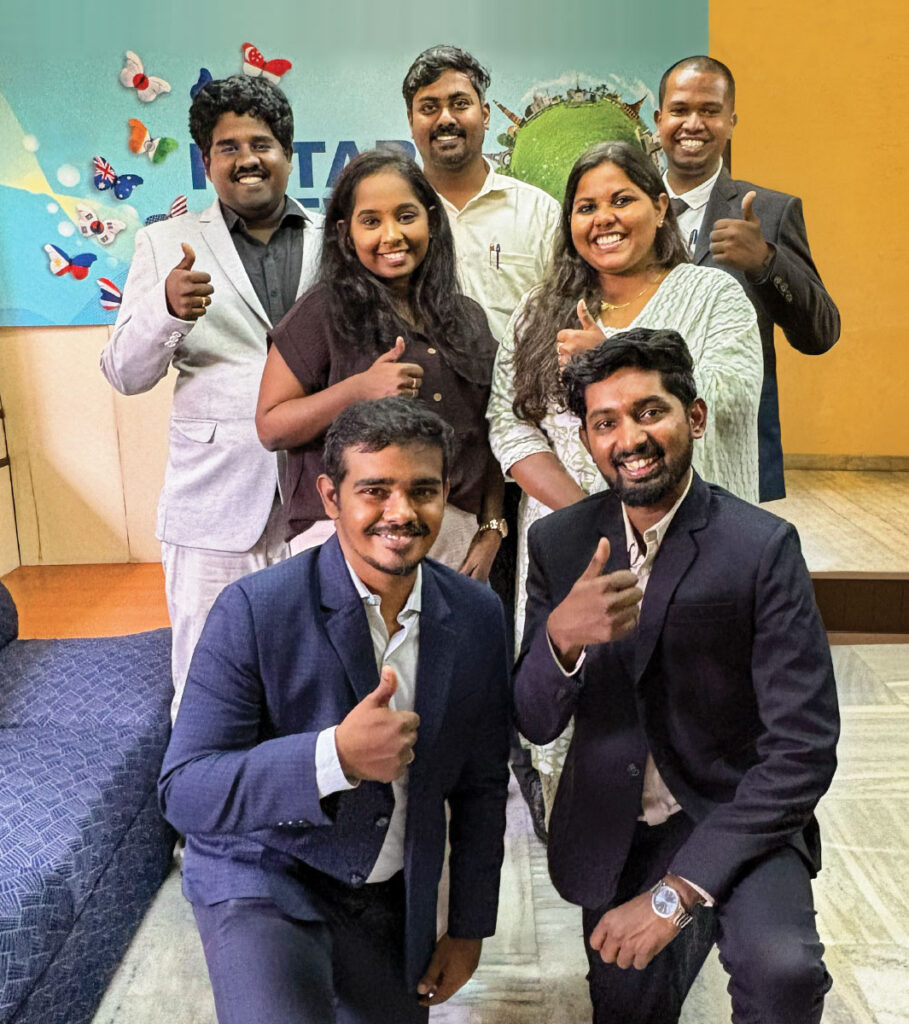
He found this three-day event totally different; “it was so practical, and hands on,” says the young entrepreneur, seated in the Board Room of Rotary News Trust. Six other entrepreneurs in the room nod in unison.
They’ve all emerged entrepreneurs after attending RYLA sessions in different parts of Tamil Nadu conducted by RC Virudhunagar, and sponsored by Idhayam, an edible oil brand owned by PDG V R Muthu, RI District 3212.
Ahmed was always “fascinated by the food industry, but landed up with a job three years ago in the tourism sector,” and has now started his own company called Blue Gateways, which handles both inbound and outbound travel, from Southeast Asian countries and many states of India by people interested in visiting temples in Tamil Nadu, particularly the Madurai-Rameshwaram belt.
So what did he learn at RYLA? “I learnt that when you are passionate about something, you work tirelessly… you don’t look at the time at all, and that brings success.” He has started dabbling in food tourism and his dream is to explore this further… and also open a hotel.
Kanishka Sagadevan is from Chennai and attended the third batch of RYLA. A Rotaractor from the age of 19, she learnt about RYLA sessions being conducted to give practical knowledge to youngsters on how to “become an entrepreneur and create jobs instead of seeking jobs.”
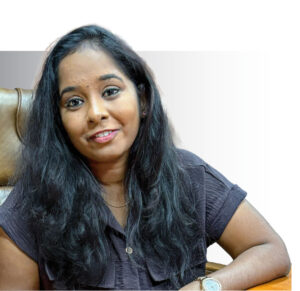
An MBA from VIT, Chennai, she had always wanted to be an entrepreneur. Along with two other partners, she has developed a data-base akin to LinkedIn, “the difference being that we only give verified data from individuals.” The three youngsters developed a prototype and started Noshack Solutions, investing ₹12 lakh. Kanishka got her share of ₹4 lakh from her mother. “But we required a lot more money to scale up, which we didn’t have, so we jumped into another business.”
This is called Dreamer’s Kit which offers customised storybooks for gifts. “If someone wants to make and gift a book about his/her life to anybody, they give us the info and we convert it into a nicely designed book and present a copy to the individual.”
Her marketing pitch: “At Dreamer’s Kit, we create personalised storybooks to celebrate a person’s most meaningful moments. Each book is crafted with care to capture the individual’s journey and can become a keepsake.” On an average, depending on the number of pages, each book costs around ₹2,000 and till now they have produced 500 such customised books. The youngsters use AI for the writing part, enabling a hefty profit of ₹1,600 a book.
The profit from this venture is put into her core company — Noshack Solutions, which “can’t bring us money. It is something like social service for us! That is why the other model. After two years, we’ll make some money and jump into another model. We have a lot of ideas,” she beams.
Venkatasubramanian and Nishanthini Raja have set up Lab N Box in Chennai, which offers DIY science kits and organises fun science events for children. Venkat, as he is known to his fellow entrepreneurs, is a mechanical engineer. “Right after college I ventured into a startup, having been exposed to the startup ecosystem even in my college days where I was part of a core team running a stationery shop on the campus of our engineering college.”
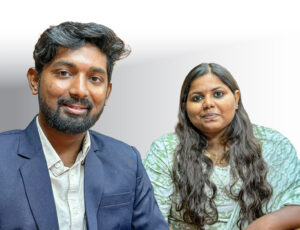
As a couple of generations in his family have only been in government service, this was all very new and exciting for him. Just before he passed out in 2020, his team won the Smart India Hackathon conducted by the AICTE, for building an air cooler model. “But we weren’t able to make our innovation into a venture, because in my team, I was the only one ready for a startup,” he sighs.
So he took up a job, quitting within a month, believing “we have to take risks when we are young as after that there will be lot of responsibilities.” He started Lab N Box, and after a while joined hands with his senior in college Nishanthini. She is a biomedical engineer who already owns a company called 16 Groups Innovation Labs, which was running a lot of activities for kids.
Nishanthini is all smiles as she says: “I love kids and wanted to do something that ensures interaction with kids.” The two went through several incubators in order to get funding, and by chance met a food scientist Pasupathy, who introduced them to PDG V R Muthu.
When the duo met PDG Muthu, “he immediately saw that we were so passionate about what we were doing and said for products like ours, which were linked to education, marketing was needed, and recommended a RYLA session being conducted by him as Rotary district governor.” Pasupathy is the project director of another project initiated by Muthu — Vignana Ratham (Science on Wheels).
The RYLA session, which they attended in 2023, proved extremely useful to in fine-tuning and marketing their products which strive to make science a fun learning activity for young children. Says Nishanthini: “Lab N Box brings science to life through high-energy science parties, engaging school science shows, and thoughtfully designed science kits. Our Science Parties turn celebrations into hands-on adventures where kids experiment, explore, and have loads of fun.”
Adds Venkat: “In schools, our interactive science shows make learning exciting and spark curiosity among students. Our take-home science kits extend learning beyond the event, encouraging children to explore concepts at their own pace. Guided by our motto, Lab N Box — Fun Science Unboxed, we make science joyful, accessible and unforgettable.”
He explains that in the DIY science box, when a child opens the box, 10 or 20 different things pop out and while playing around with them, she discovers many science fun facts. One fun fact I discover in this conversation is that girls are much more interested in science than boys. “Boys are more into sports and doing things… but girls are fascinated by science. They were so interested in our forensics box, which is about forensic investigation.” Depending on the composition of their boxes/kits, the cost ranges between ₹500–1,200.
Venkat found his RYLA session akin to “a trigger… the faculty plants so many ideas in your minds. The whole experience lights a spark in you… a spark of entrepreneurship. Personally, I felt that these RYLA sessions are suitable for everyone… even those who don’t know even the meaning of the word business.”
The DIY also offers a new package called Science Parties which is getting popular with parents celebrating their children’s birthday. It costs ₹990 per child and the minimum number required are 10 children. The average billing per parent is around ₹20,000, and the ideal age group is from 4–8… “it’s an age when the sense of wonder is still alive in the child.”
So are these packages more popular for the birthdays of girls or boys?
“Of late girls; earlier it used to be only for sons. But these days girls’ birthday parties are highly ticketed. Parents of daughters take only premium packages and they have to be aesthetically good too. Recently, for a daughter’s birthday party, the parents paid around ₹55,000,” says Venkat.
John Thomas says: “Building stuff is my thing!” He attended a RYLA session in 2022 and was the president of his Sivakasi college’s Rotaract club. “Somebody suggested I attend this programme and I did, having no idea what it was all about.”
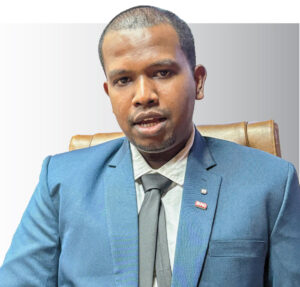
He was then doing a diploma in mechanical engineering; earlier he had dropped out of two premier colleges in Chennai — Loyola College and Madras Christian College. While in Loyola, he teamed up with another student and “we made an EV scooter way back in 2019. I love building things… LEGO and stuff like that were my favourites. That was the only thing I was passionate about, and wanted to do it for the rest of my life.”
But his father, an import and export consultant, disapproved. The son wasn’t interested in trading and despite doing a BBA diploma course at Loyola, would work on the EV model with student in another stream. Finally he quit BBA, and got into BA History at the MCC, but that didn’t interest him either. “During my MCC days I built other EV prototypes and all this before I was 23! I had a few sets of motors, and I would build and break down the chassis and rebuild new ones,” he smiles.
Not happy with History either, he returned to Sivakasi to work in a small workshop of his own. “Initially my dad provided some funds, but he thought I was reckless. For him things like innovation or experimentation were taboo, and he always advised me to play it safe, saying: I have an established business; why don’t you take it over?”
But the son was not interested and decided to do a diploma in mechanical engineering at a polytechnic in his hometown, and get into EV as a mainstream for commercial operations. “But as you know, that’s a very capital intensive business. My father said: ‘If you want EV, join Tata Motors or something like that. Either go work somewhere, or start with something small.’ ”
Six months after he finished his diploma, Thomas got married, at 23! And now has a daughter. “So I lost the ability to go out, explore and do some additional experimentation. My dad borrowed a few machines from his partners, gave me one of his old industry buildings and said instead of EVs, build some steel structures.”
He tried a few projects, which didn’t work, before he succeeded in making steel furniture racks, chairs, etc which can be assembled at home… IKEA style. He also makes agri tools and other machinery. But this was not really his cup of tea and “I was making substantial losses as there were so many details that I could not understand.”
At some point his father cut him off, saying if you want to do something more, pledge your own jewels. His wife helped by giving her jewels too, and he raised some more money through a parallel business he runs of buying and installing solar systems. “We buy solar panels, inverters and batteries and I have a team which installs total solar systems. This is a profitable business.”
His startup is named Trinity ICR Enterprises; it is a diversified manufacturing and engineering company focused on “innovation, conservation and reformation. Built on strong and essential industrial domains of solar system installations and precision-fabricated steel products like designer steel furniture, agri tools and machinery, solar mounting structures (which are made at his site), and bulk custom-engineered components, with a hands-on approach to design, prototyping and scalable production, we provide manufacturing services to tier-3 cities like Sivakasi.”
Even though he wants to improve both technology and design-led manufacturing, and create precision, durable and efficient industrial products, his heart is still into EV business, including agri EV machinery. He has stated making small EV tractors. “Right now, it’s a struggle but I’m confident that I will eventually succeed in doing what I have been passionate about, and that is product manufacturing. I want to build OEM components for customers like Tata Motors and others,” Thomas says confidently.
Kirubhakaran Sathiaseelan, who graduated in civil engineering in 2017, is from Rajapalayam in Tamil Nadu. For over four years he worked in the engineering field before he heard about RYLA being conducted by a Rotary club in his district (Virudhunagar) and he attended a session in Nov 2021.
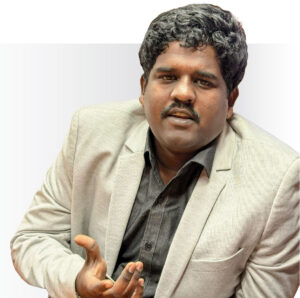
Asked how the three-day session helped him, he said the way in which the model was structured “helps us to make easy progress. And it is very practical; they give you 10 factors and you have to tick them according to your preference. They don’t tell you what enterprise you should choose or how this or that venture will help you make so many crores. But if you tick eight factors in any particular segment, they tell you what are the problems you are likely to face in that specific business and what realistic steps you can take to solve them. That is why all of us keep saying this training is so practical.”
So they are not exactly selling dreams… I prompt my young interviewees… and in one voice they say: “Exactly; that is what we mean by saying this RYLA course is so practical.”
Kirubhakaran underwent the training and zeroed down on manufacturing Spirulina capsules which are packed, he explains, with nutrients such as proteins, Vitamins B12, E, K and Omega 3. “It is a superfood and required for people who do not get adequate nutrition from their daily food.”
He invested a capital of around ₹3 lakh, which was given to him by his mother. He explains that in RYLA “we have investment mentoring, which is part of the business plan we have to prepare.”
He admits that along the way, in the making and marketing of Spirulina, he encountered many problems but handled them. His marketing is done online and at exhibitions. Confident about the future, he says proudly, “We manufacture high-quality Spirulina and offer value-added products like capsules, tablets and chocolates which are perfect for fitness enthusiasts, health seekers, and environmentally aware individuals. Our product is nutrient-rich and sustainably sourced, catering to health-conscious consumers. With focus on quality and innovation, we aim to make Spirulina accessible and enjoyable for everyone,” is his marketing pitch.
Madhusudhan Rajrani is from Trichy and into the construction business, handling both real estate as well as interiors. When he attended his RYLA session in 2023, done by RC Trichy, he was “already into business for three years. His initial business dream was to develop a self-sustained township model.”
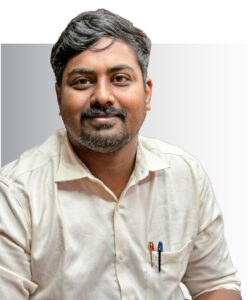
But wouldn’t that need a huge investment? “Yes, but since I’m a structural engineer that’s been my dream from college days.” He worked in Chennai, where he did his PG in Civil Engineering, for a year, but when Covid struck, he returned to his hometown. Not wanting to “sit idle” he started his own real estate venture. “We’d build five or six houses and then sell them when ready.”
For this he took a loan of nearly ₹60 lakh, but not from a bank. It was an unsecured loan at an astounding monthly interest rate of 2.5 per cent!
To my horrified ‘What?’ he says with a smile: “Yes, that was a huge mistake. I was completely lost.” He admits that he did this despite his family, which has been in business for 30 years, advising him against such rash behaviour. “They did warn me, but I just didn’t listen and jumped into it.”
Eventually he went into joint ventures. Madhusudhan says the mistake he made was being rigid and waiting till his fixed price was met to make a sale. He thus burnt all his profits in the high interest rate. “But when I went for RYLA, they told me that ego should not be there when it comes to money. If it’s destroying your business, you have to get out of it. To be honest, before I came into RYLA, I was completely lost,” he admits candidly.
“The financial pressure on me was huge. Even the profits which my company earned from other projects in construction, interiors etc was going into paying high interest rates. That kind of interest is not sustainable, so I wasn’t able to think properly how to take my business further. I was not able to quit also because I had to pay back everything.”
He didn’t want to ask his parents for help either “because I didn’t listen to them in the first place.” He started getting out of the hole he had dug himself into by selling his housing units even at the base price. This way he managed to pay off almost 80 per cent of his loans of nearly ₹70 lakh. He paid off around ₹55 lakh but still ₹15 lakh remained. But he was able to manage because with a bulk of the capital gone, the interest amount came down and he is back in black.
He has changed his business model too by roping in investors in his ventures, and building apartments instead of individual houses, with the investors getting share in the profits. “I no longer have to pay interest,” Madhusudhan grins.
But his dream still remains “building sustainable townships,” and he is confident he will do that some day!
Pictures by Rasheeda Bhagat
The RYLA cheerleaders
For John Thomas, one of the entrepreneurs trained at RYLA, the session was more like a three-day crash course or “an MBA with a much more practical approach. I got a much clearer idea about what business I wanted to do.” Asked to elaborate on how he could compare a short RYLA session with a crash MBA course, Thomas explains that each participant is given ₹400, to order raw ingredients, turn them into a product and sell it at the local market. Such as fruits for fruit salad or paper, glue etc for paper handicrafts. “We are briefed on the profile of customers at that market and their spending pattern.”
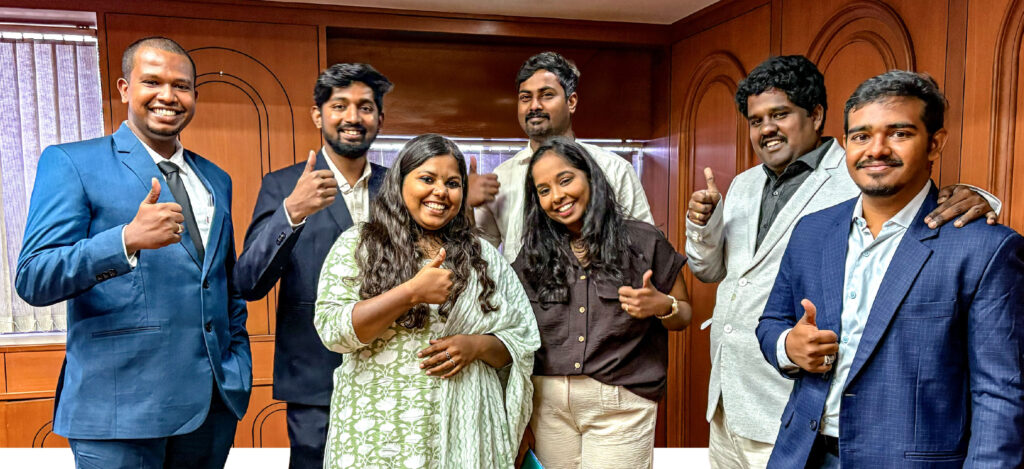
The products range from fruit salad and rose milk to pani puri or paper crafts. Once, “some participants made paper earrings, expecting teenage girls to buy them.” But their end customers were actually “the boys who bought them for their girlfriends!”
Talk about marketing dynamics!
Participants can also market their technical skills; digital content like a one-minute reel, and promote it on their social media for a fee. The clear motto: Create a business model and make money! There are appreciative nods around the table and the discussion veers around “how the subsequent batches of RYLA are doing a lot better than us. Each RYLA is becoming better,” is the unanimous opinion.
The participants who’ve becomes entrepreneurs also keep in touch through a WhatsApp group called RYLA Starter Stars. There are 328 members and anybody having a business requirement can spell it out on this group and connect with the person who responds.
From every batch, two-star participants are selected for a trip to Singapore where meetings are organised for them. The idea is to give them an exposure to the business culture there, and to understand or get a feel of why the economy has developed so well in that country.
Ahmed, Kanishka, Kirubhakaran and Madhusudanan made it to Singapore and simply loved the experience. Says Kanishka: “The RYLA experience trains us to communicate… it just pushes you, shows you the direction. You have to walk and run, but on your own. They will just guide you, also to deal with problems, saying every business has problems. Deal with them.”
Venkat adds how these days much younger people are getting into RYLA, including students. “They offer digital marketing services to us. When we contact them, they say I’m a second or third-year student and if you pay me this much, I will design so many Insta posts for you. They have no investment, but are monetising their time.”
Asked on his expectations and the outcome of the programme he has so lovingly nurtured and financially supported, PDG Muthu says: “I feel a sense of profound fulfilment watching young people grow into confident and capable entrepreneurs who innovate, create jobs and strengthen India’s economy. Seeing them take charge and grow as successful business persons gives me immense delight and pride.”
Faculty member A A Jayaraman, a consultant to major industries and who the RYLA participants adore, says a distinguishing feature of this programme is the approach — prior to the programme “each participant’s profile, business interest, workable idea and the specific questions they want answered are captured. We ensure that these questions are addressed meaningfully,” their intent is strengthened and ideas refined.
The template and diagnostic tools he use for industry workshops are applied to “offer customised solutions, enabling participants to gain clarity.” The participants’ “take home: a confirmation that their business idea is workable; a business plan that helps them plan ahead and a material kit designed by him. As also a reassurance that our team will continue to be available for consulting and mentoring even after the workshop.”
The crucial factor, adds Jayaraman, is that “it is not really a three-day workshop. Our engagement with participants begins the moment they register. Six days before the workshop, we initiate pre training exercises that include assessment and other activities, so that once they are with us, we simply plug them into the mainstream flow.”
Also, the three days are extensive and intensive; “because participants arrive already primed for an entrepreneurial journey, we see a strong conversion rate. Thus, three focused, immersive days are sufficient to sow the seeds — provided there is sincere and serious follow up. Our team takes ownership of mentoring each participant and tracks their progress. This mechanism has helped us continuously evolve our programme design based on real needs.”
This is corroborated by the entrepreneurs; one of them relates excitedly how he had a “long chat of 45 minutes only the previous evening with Jayaraman Sir.”
And he remembers him?
“Of course, he remembers every RYLA he has conducted,” is the response.
RB