

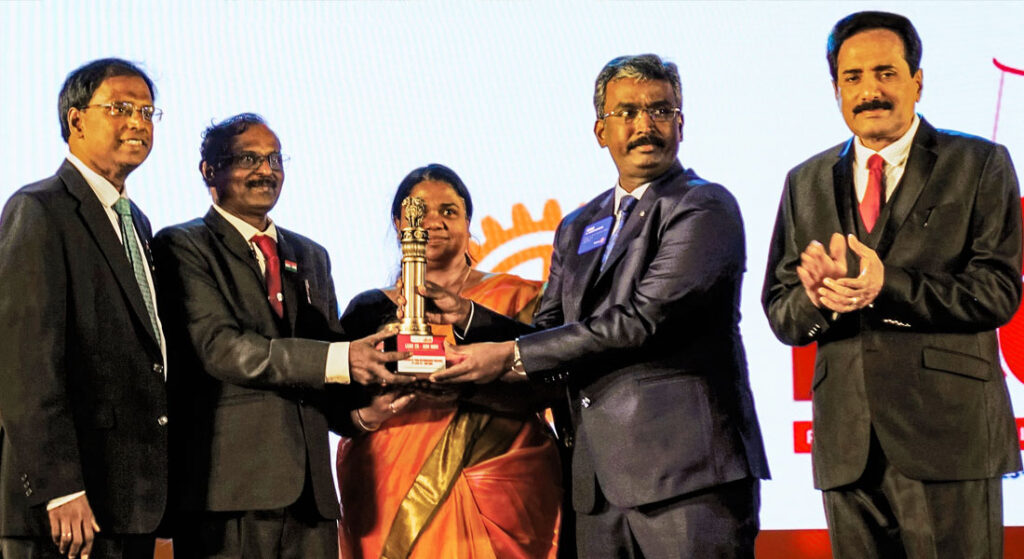
A very informative and entertaining session at the Lead25 Conclave in Chennai was an exhaustive, and yet entertaining hour-long talk by ISRO chairman V Narayanan, He took the audience through a journey of what India and its capabilities were when we got Independence in 1947, and where we stand today. Particularly when it comes to space research and application, launching of satellites and sending missions to the moon.
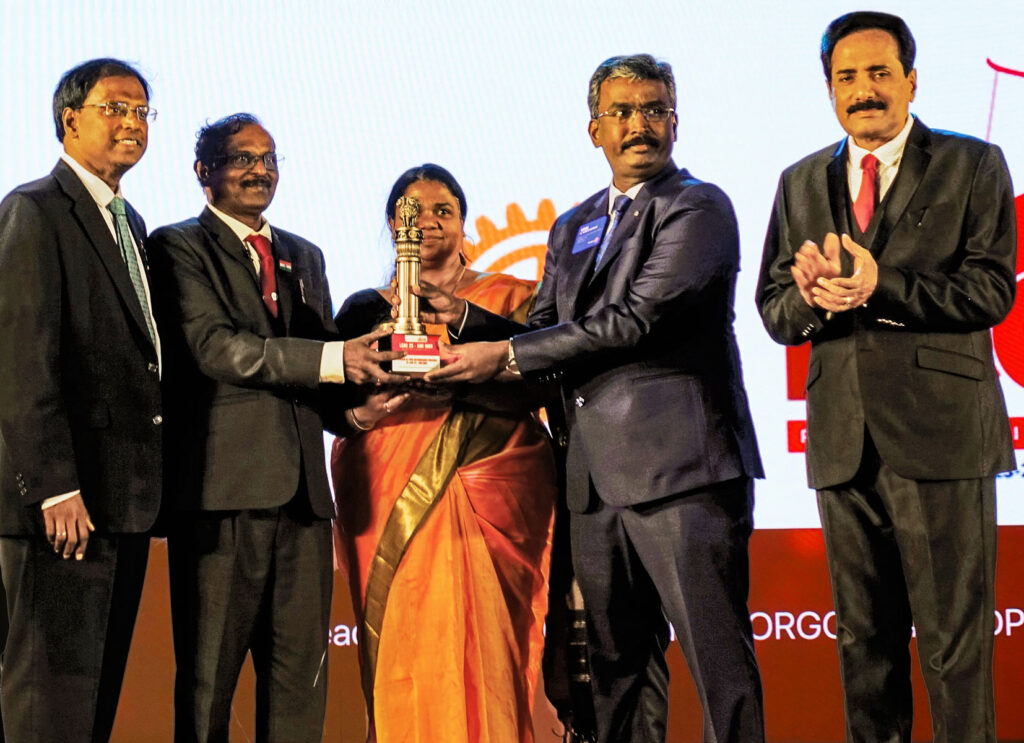
At the outset, he thanked Rotary for its work for local communities and said he was highly impressed by the 100 social service projects launched during this conference, “particularly the ‘100-autos-for-women’ project which would give economic empowerment to 100 families.”
He came from a humble background, he said and recalled that when India attained Independence, 94.5 per cent of its population was below the poverty line. “I studied in a Tamil medium school in Kanyakumari district. In those days barely 50 per cent of the people had two meals a day, the remaining 50 per cent survived on just one meal. From that humble beginning, when we depended on food imports, we are now a foodgrains exporting country, and have become the 4th largest economy in the world.”
From an era when we had to transport a rocket by a bicycle, today we are standing shoulder-to-shoulder with developed countries in the space programme.
The average life expectancy then was 33 and deadly diseases such as polio were rampant; today that age had gone up to 72 years and India has become a polio-free country. “Take the education sector; at Independence, only 12 per cent Indians were literate; today that number has gone up to over 79.7 per cent. Primary schools have gone up from 2,825 to 8.5 lakh. There were no IITs, IIMs or AIIMS. We have to appreciate our education system, including the village schools, from where I come. In those days only 3,091 villages had access to electricity; I come from a developed state like Tamil Nadu and a developed district like Kanyakumari. In my village we got electricity when I was in Class 9; till then I studied using kerosene lamps. Today almost all of our 60 lakh villages are electrified.”
Narayanan said India had developed to a great extent and predicted that “before our 100th year of Independence, we will be a developed country. I have no doubt about it. We have grown in all sectors… infrastructure development, air transport, telecom, industries, education, health, agriculture, and science and technology.”
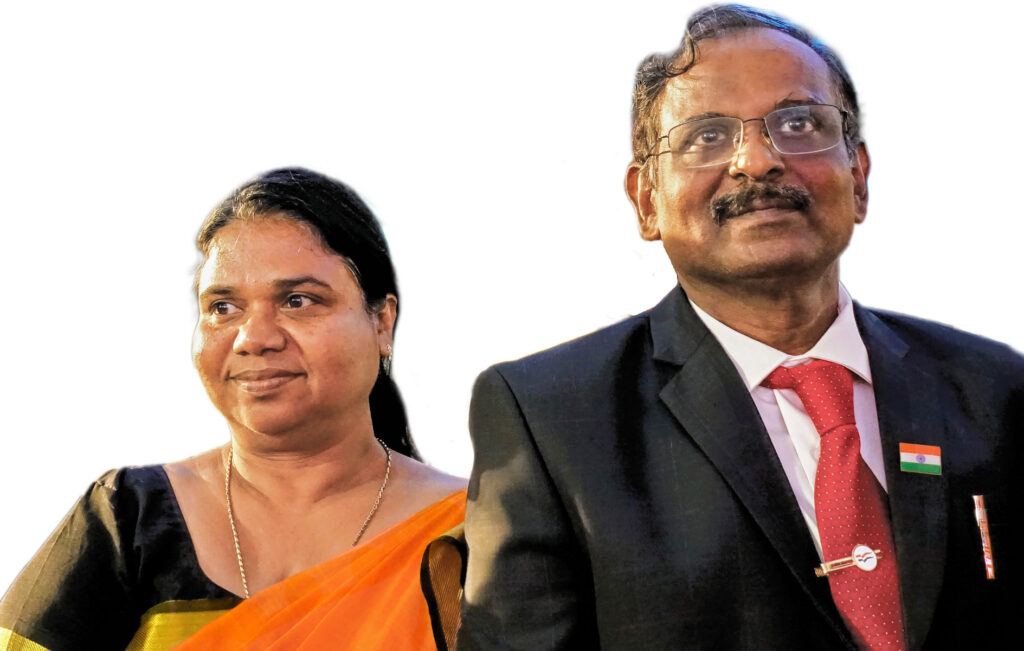
The ISRO chairman took the audience down a nostalgic journey of the Indian space programme being launched in 1962 and progressing fast to become the pride of the nation. It was started by Vikram Sarabhai, “who is the father of the Indian space programme.” To bring the benefits of the space programme to the common man, three components were needed — satellites, launch vehicles to place the satellites in the orbit, and the ground equipment to support launching the satellites into space to collect data. Our space programme was started in 1962 in a fishing village near Thumba (Thiruvananthapuram) and ISRO was set up in 1969.
He recalled that in Nov 1963 “when we had the first rocket launched from India, the rocket was donated by the US.” Again, later when we wanted to demonstrate mass communication through satellite and there were 2,400 TV sets kept in 2,400 villages in six states and “we had to get a satellite signal to pass through those TV sets, once again the US supported us for this. Truly, we were 50 to 70 years behind advanced countries,” he said, displaying a picture of a rocket being carried on a bicycle.
Sending people to the moon is very easy, but we have to send and bring them back… we are working on that!
Also, we did not have adequate vehicles to move satellites and had to use bullock carts. (The reference is to ISRO using a bullock cart in 1981 to transport its experimental communication satellite, APPLE, for a special antenna test to ensure a non-magnetic environment. Later, Texas Instrument, the first multinational IT company in India, brought its satellite dish by bullock cart to Bangalore to provide uninterrupted communication with the US.)
“From that bicycle and bullock cart era, and getting donations from other countries, to July 2025, on what was a historic day for India, we launched a satellite called the NASA-ISRO Synthetic Aperture Radar (NISAR). It can take photographs in space in all weather conditions. The total cost ₹10,360 crore and this satellite was jointly developed by India and the US. Today we are standing shoulder-to-shoulder with developed countries in the space programme,” he said with immense pride.
India’s space programme comes directly under the Prime Minister, had 43 offices in 22 locations, and was supported by many industries, and 130 academic institutions. “Our annual approved budget is ₹13,500 crore,” he added.
Giving the example of a Deepavali rocket which has a mind of its own and can go anywhere (see Box), the scientist talked about the first experimental flight of India’s indigenous Satellite Launch Vehicle (SLV-3) programme in 1979, led by former President Dr A P J Abdul Kalam. This was a partial failure due to a control system malfunction, causing the rocket to crash into the Bay of Bengal, but valuable lessons were learnt from this, which resulted in the successful launch of the SLV programme in July 1980, and India’s first satellite Rohini-1, was placed in orbit. From then to now, 150 satellites of different levels have been launched and currently 58 are in the orbit.
Coming to application of space technology, Narayanan said, “Very few believed that space technology could help the country, but today there are 55 space applications, contributing to food and water security, power, TV broadcasting, rural connectivity, telemedicine and telecommunications.
The ISRO chief then asked the audience if they recalled an era when every Friday we could watch only five songs on TV; “if you missed it, you had to wait till the next Friday. And do you remember how tough it was to make a trunk call, waiting in a long queue, from Chennai to Delhi? You’d get the connection and the line would be disconnected after few seconds. Today you can make a call to the US from your home in seconds.”
There was an era when one had to go to the railway station to book tickets and while travelling, had to often wait for hours at the station due to delay of trains. “Today, thanks to space technology, 8,700 trains are connected in real time, and you can see these on an app. Thanks to its application on weather forecasting, the huge number of deaths that resulted from calamities such as the 2005 tsunami and the Orissa floods can now be prevented.” As for Operation Sindoor, “I can’t give you details of the part we played, but I can tell you our satellites have done a perfect job for the safety and security of every citizen of India. Hypothetically, if one day at a given time, if our satellites are switched off, there will be no ATM transaction, no TV will work, and no weather forecasting made.”
Summing up India’s spectacular advance in space technology, Narayanan said from a very humble beginning, apart from its own satellites, India has launched 433 satellites of 34 countries from Indian soil! On our successful Chandrayaan Mission, he said “India, along with the US, is among the first two countries to find water molecules on the moon. And today, we have the best camera in the moon’s orbit, and the best photos from the moon come to us!”
Another important activity ISRO was performing was to study the sun, and “the project director is one of our outstanding scientists Nigar Shaji, whose brother (PDG Sheik Saleem) is in the audience. India is the 4th country having a satellite to study the sun, and we have enough scientific data to be No 1 in some critical aspects. When we placed 104 satellites, we created history; we have also managed to dock or connect two satellites in January. … a long journey from the time we faced so many insults from the international community on our limited space capability. The world now knows not to underestimate the growth of India’s space programme, even America is amazed at our fantastic achievements. Today we are supporting and helping other countries with less capability to grow, and handholding private companies to do space activities.”
Future plans include building 300 satellites in the next 15 years, and a programme to send our own people to the moon, the genial scientist said, before adding a punchline in his characteristic brand of humour: “Sending to the moon is very easy… but we have to send and bring them back… we are working on that!”
Pictures by Rasheeda Bhagat
When a Deepavali rocket defied a rocket scientist
At the Lead25 Conclave in Chennai ISRO chairman V Narayanan emerged a darling of the audience with his simplicity, humility and a very earthy sense of humour. He had the participants in the packed hall in splits when he described an anecdote about how he learned, the very hard way, that unlike the rockets and satellites he and his team at ISRO make, Deepavali rockets have a mind of their own.
“I can tell you that there is a small difference between our satellite launch vehicles and our Deepavali rockets. Deepavali rockets… when you fire them, about 10 to 20 per cent don’t work, and whenever such a rocket works, it goes wherever it wants to! But our rockets have to be very precise,” he said.
Narayanan described his experience with a Deepavali rocket last year; five days before the festival of lights, he was driving down from Madurai to Kanyakumari with his wife Dr Kavitha, who was present in the audience. On the way, he saw many shops selling crackers. “The attractive display made me stop the car, get down and I bought 10 rockets of 700mm height. My wife thought it was something for the children,” and held her peace.
“On the Deepavali day, I asked my son why don’t you fire a rocket and he said ‘No, no, there are so many houses around, I will not do it.’ Meanwhile my wife was saying ‘why did you buy so many of them? Around our home, there are several buildings, one a nine- storeyed one!’”
Putting things in perspective, the genial scientist told his wife: “I am a rocket scientist working in ISRO for 41 years, and know about rockets.” He decided to fire them himself and headed to a vacant plot near his house. “Not trusting him much, she followed warning ‘if it goes into anybody’s house you will be in trouble, be careful.’ With great difficulty and care, with her standing beside me, and going on repeating ‘be careful, be careful’ putting me in tension, I took out the first rocket, placed it very carefully pointing to the empty space and ignited it.”
He was very happy that it “worked nicely and lit up, but then suddenly, it turned 90 degrees and went into the building nearby! My god, before the rocket could fire, my wife was firing me… shouting ‘what have you done?’” Before the neighbours could come out and find them, they bolted and next day he handed over the entire packet to his driver, asking him to be careful, saying “the Deepavali rocket will go wherever it wants to.”