

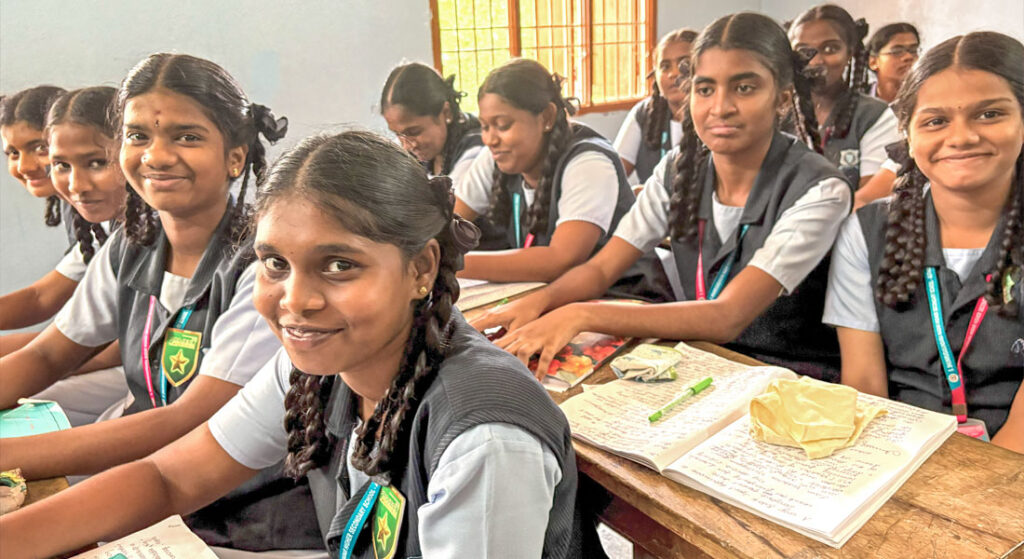
It is with a lot of confidence that Koshika Mariappan, a Class 11 student of S Shunmugasundara Nadar Matriculation Higher Secondary School, Authoor, near Thoothukudi (Tuticorin) in Tamil Nadu, holds a conversation with me in simple English. One would expect her to have basic skills in spoken English, considering she is studying in English medium. But the problem, points out PDG V R Muthu, RI District 3212, is that “while students, even in the smaller towns of Tamil Nadu know and understand English, they cannot speak in English, because they always communicate in Tamil with friends and family. All of them can write beautifully in English, but their skills in spoken English are either poor or non-existent.”
But the aspiration of almost all parents in these smaller towns, and even villages, is that their children should be able to speak English, as English-speaking capability is a matter of prestige in most places. So when he was elected as governor, he felt that among the community welfare projects undertaken during his tenure, there should be one programme to fulfill this aspiration of parents on spoken English skills.
To do this he launched Project Punch, a three-day programme which was initially meant for the students training to be teachers in B Ed colleges in his district. “I thought that if the teachers could speak good English, they would impart this skill to their students in a much more effective way,” he says, as we drive from the Tuticorin airport to the school in Authoor, where I want to see for myself how confidently the schoolgirls, who were finishing the third day of the 109th session of Project Punch, could hold a short conversation in simple English.
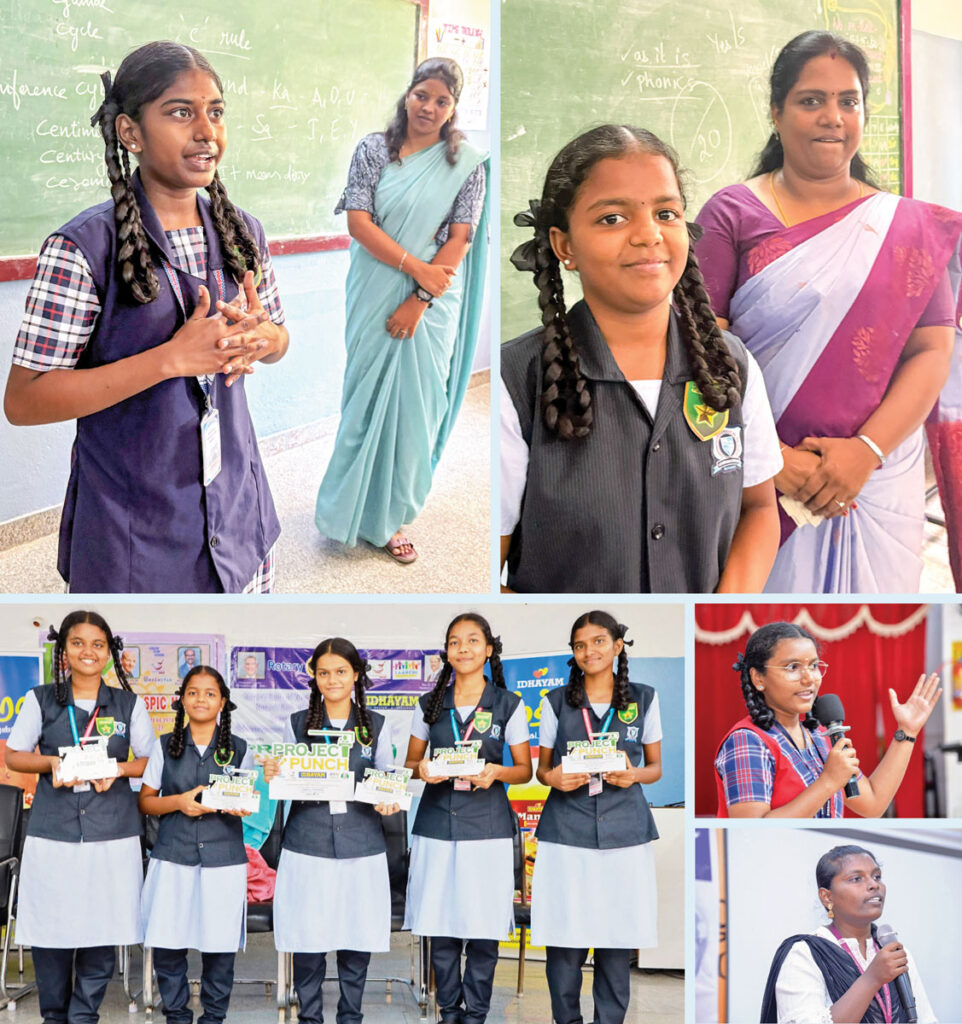
There was such enthusiasm and demand for this programme, that the first session was held for B Ed students in Dec 2021, a good six months before he took over as DG in July 2022. It picked up momentum and on popular demand it was continued beyond his year as governor. By Sep 15, 2025, Project Punch had held 130 training programmes benefitting 14,400 participants across 91 institutions, with support from 36 Rotary clubs. Within RID 3212 alone, 75 training sessions have helped over 7,500 youngsters shed their fear of speaking in English and gain confidence as they try their hand at spoken English. The project has gone beyond RID 3212, to the rest of Tamil Nadu, reaching 6,400 beneficiaries, and two sessions have been held outside Tamil Nadu. I was witness to a conversation where a Rotarian in Odisha wanted to take the project to his State.
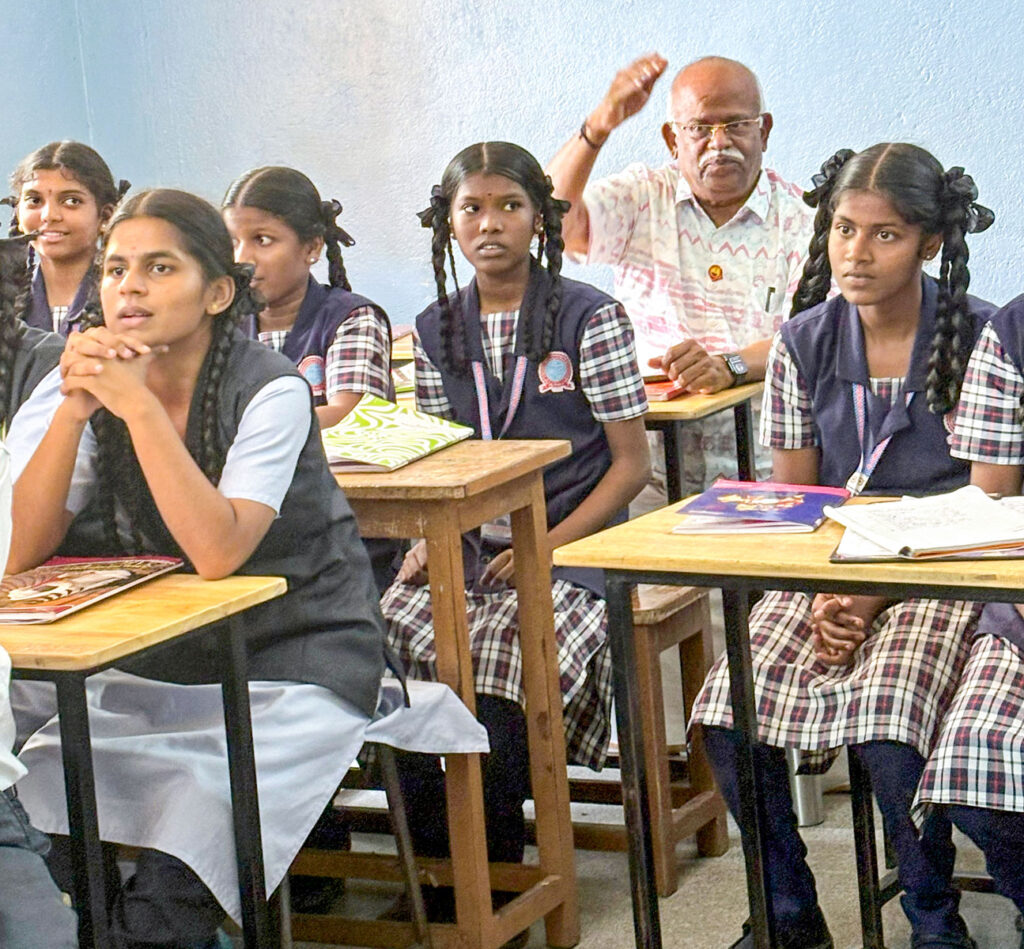
Apart from B Ed colleges, Project Punch has been held in higher secondary schools, arts and science, and nursing colleges, and has been held also for qualified nurses and hoteliers.
While it is sponsored by PDG Muthu’s company Idhayam Edible Oils, and is supported by RC Virudhunagar (RID 3212), Muthu’s home club, it is dedicated to the memory of Prof Panchanathan from Tiruchi, who was regarded as a ‘maha guru’ by several Rotarians. The training sessions are conducted by Beehive Communication Club, a training organisation which specialises in communicative English, public speaking and storytelling, and was founded by A Shyamraj, a member of RC Virudhunagar, an educator and communications expert.
The aspiration of parents in smaller towns, and even villages, is that their children should be able to speak English, as English-speaking capability is a matter of prestige in most places.
After completing this course, the best students are given an invaluable learning opportunity beyond the classroom, when factory visits to Idhayam Oils, India’s largest manufacturer of sesame oil, are organised for them. Here they get to see how edible oil is produced and interact with PDG Muthu, who shares with them his views on Rotary, business and success. Till now, 34 such factory visits have been conducted for 1,367 students.
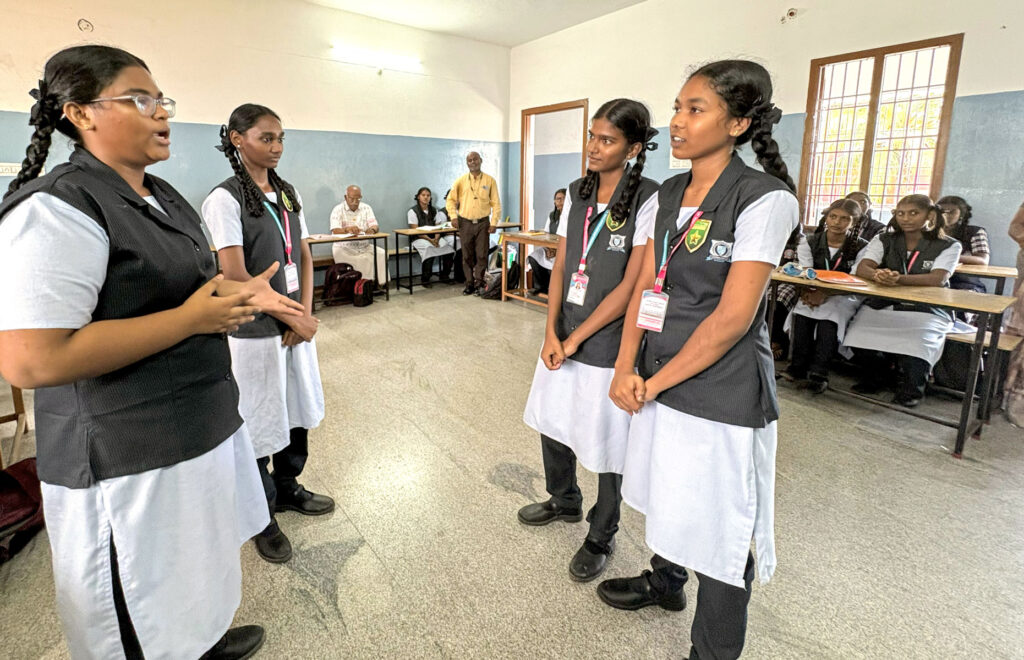
Returning to Koshika, who steps forth with a smile to hold a conversation with me, when we visit her classroom, she enunciates clearly that her “father works in a private company as an admin manager and my mother is a housewife.”
RID 3212 DG J Dhinesh Babu, PDG Muthu, Shyamraj and I go around a few classrooms in this school on the final day. So did the course help her, I ask. “Oh yes,” Koshika says enthusiastically, adding, “I had great fear to talk in front of a crowd but now I feel very confident to speak in front of people… I feel very happy that this 3-days training programme is very helpful to me to speak freely in English and communicate with others in English.”
A college principal was moved to tears after witnessing her students’ impressive performances, admitting that she discovered their hidden potential only through Project Punch.
The conversation continues; there might be a slight mixing up of the tenses — Wren and Martin (whose book on English Grammar and Composition I used to abhor in high school, and that too from the privileged background of a reputed Convent school in Madras) might have frowned, but in a little town beyond Tuticorin, Koshika’s ability to speak English so easily and effortlessly will surely be the envy of many a girls and their parents!
After completing Class 12, what are her plans? “I want to complete MBBS and then do surgery,” is her chirpy response.
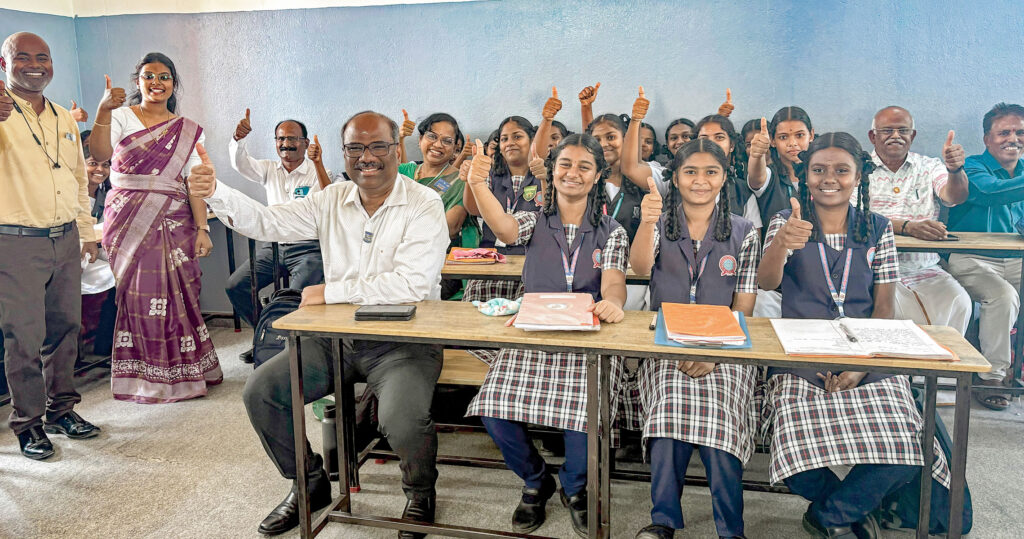
Why surgery? “Because I am interested in studying different parts of the body and cure the diseases that poor people suffer from. I need to serve poor people with Ayurveda and Siddha medicines.” In conclusion, she adds with a flourish: “I can speak properly and I think I am speaking very well. I don’t fear speaking in front of others.”
Her classmate Muthu Abhinaya has only one sentence to offer when asked why she wants to learn English. “Because I want to speak in English.” Sangeetha Udayakumar, whose father works as a hotel manager in Abu Dhabi, next steps up to say confidently, “I have learnt how to speak to people without any fear. And how to keep eye contact with everyone and stand in the right position while speaking to people.” Her future plans? “I want to become a psychiatrist.”
By Sep 15, 2025, Project Punch had held 130 training programmes benefitting 14,400 participants across 91 institutions, with support from 36 Rotary clubs.
We go to other classes and bright-eyed, cheerful and confident girls step forward to speak to me in English. Varalakshmi found the classes “very useful. Before this, I could not speak in English.” She needs a translation in Tamil when asked about her future dream. The answer is short, but confident: “Collector”.
Another girl, Muthusree, wants to “become a veterinary doctor, because I love animals.”
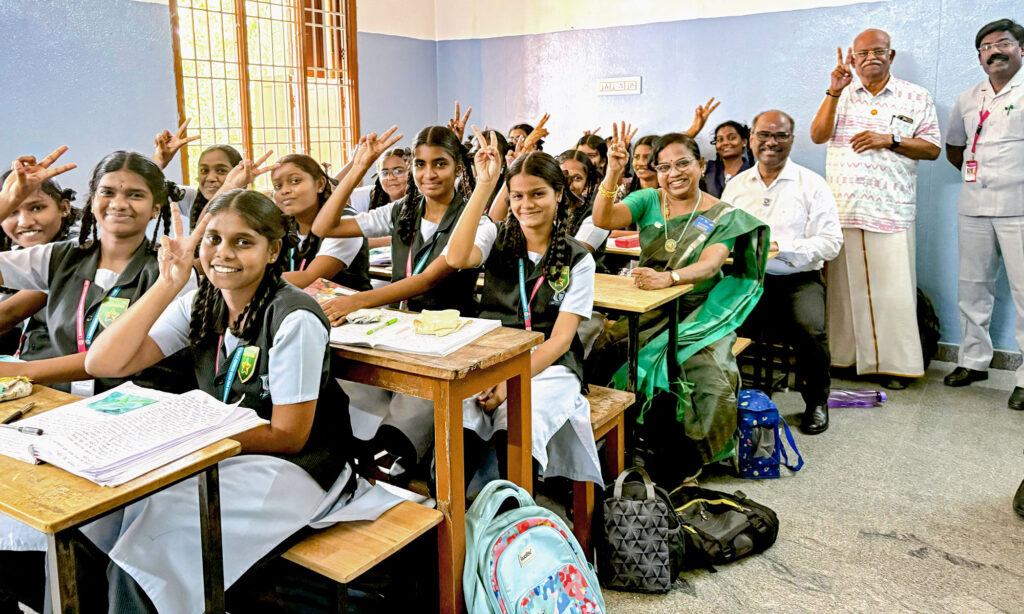
I invite four girls for a group discussion in English on the movie they want to watch that evening. While two girls vote for a Tamil movie, the other two prefer an English film, fetching the comment: “It is easy to follow the dialogue and plot in Tamil movies; English movies take more time and effort to understand”. But one girl in the other group makes this point: “It’s better to watch English films and get used to their dialogues, because when you ever take international flights, you will have to communicate with the flight crew.” Touché.
So who is their favourite hero in Tamil films? No prizes for guessing… it is Vijay. In English, it is Johnson. I have no clue which Johnson, so we leave it at that. Somebody whispers, he is associated with rock music. Their favourite genres are, interestingly, horror and humour!
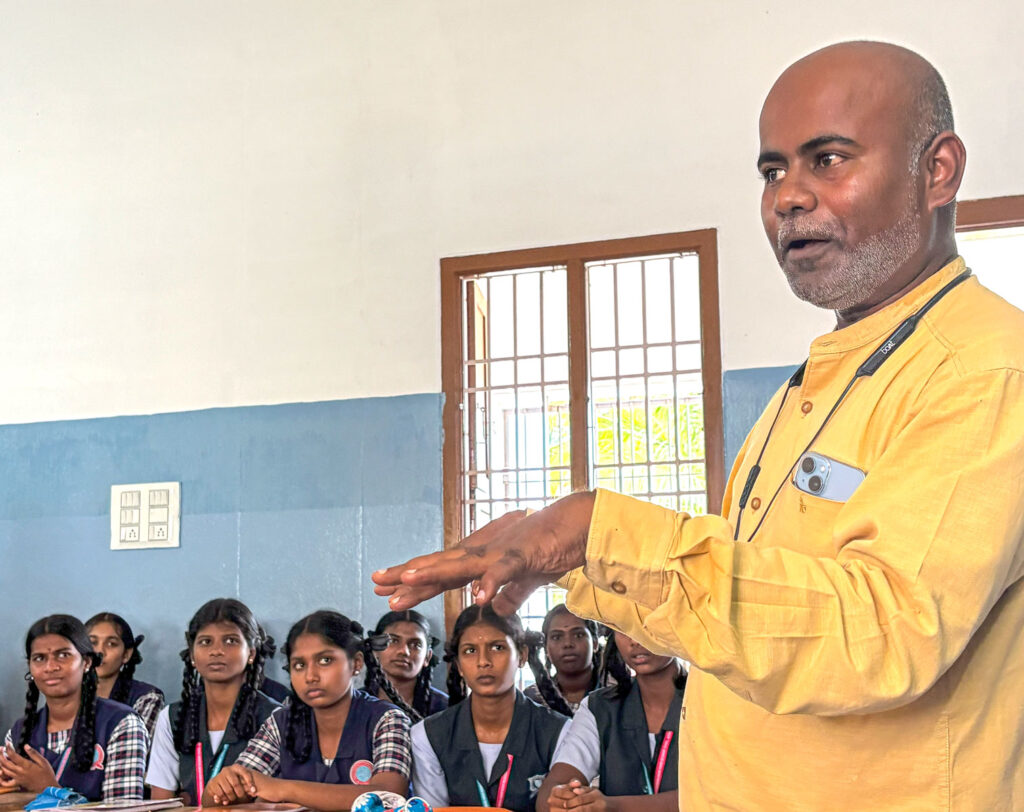
I next ask a question I love asking while talking to adolescent girls; their views on marriage and dowry! At first there is hesitation, but then a couple of girls come forward to say explicitly that they will not bow down to pressure from their parents for early marriage. “I will first finish my studies, get a job and take care of my parents.” There are nods and a chorus of voices saying they want to support their parents after completing their education and think of marriage only after that. What remains unspoken but is definitely in the air is the great Indian yearning for sons, and the determination of daughters to change the paradigm! There is a vehement ‘nay’ to dowry!
Shyamraj explains that over three days the students had undergone six structured steps integrated into the training programme to slowly gain courage and confidence to speak in English. PDG Muthu adds that the programme has been designed in such a way that the participants get “the fundamentals to start their journey in English speaking and the top performers receive special attention and booster sessions for further improvement”.
Every Project Punch session begins with an introductory talk by Shyamraj, project chair, who introduces the six steps integral to making a speech. These are interest, search, practice, implementation, failure and success. The students are split in three batches. A crucial aspect of this project is the “Toastmasters’ skeleton in speaking, which is considered the world’s best to practise public speaking in English. The participants are exposed to that exercise and are involved in peer learning and evaluation. Those hesitating to speak initially, advance to the level of evaluating others’ speeches by the end of the programme.”
As I hear some of the students deliver their speeches at the valedictory session, organised by RCs Spic Nagar and Virudhunagar, some with ease and confidence and one or two stumbling a little but soon picking up, I marvel at the transformation a mere three-day course can bring about. But behind this confidence and success is the carefully designed and crafted programme by expert trainers, led by Esthel, who guides, corrects and applauds the girls, giving a brief evaluation of what they did well, where they faltered and how they can improve. She urges them to continue speaking in English moving forward.
Both girls and boys have been beneficiaries of Project Punch; I ask Shyamraj, who does better. With a smile he says, “The answer is very easy and you know it — girls of course. And the reason is that the girls take everything taught to them very seriously, take in the lessons and implement the trainers’ instructions. However, the boys grasp the whole thing in their heads, and when the situation arises, they apply it, not necessarily at the platform that is given to them here.”
Is he saying they are lazy, cocky or overconfident, I prod him. “A little of all, depending on the person, so for the boys we change our approach a little and make it a group activity.”
Pictures by Rasheeda Bhagat and from Project Punch Library
Why Idhayam Oil supports Project Punch!
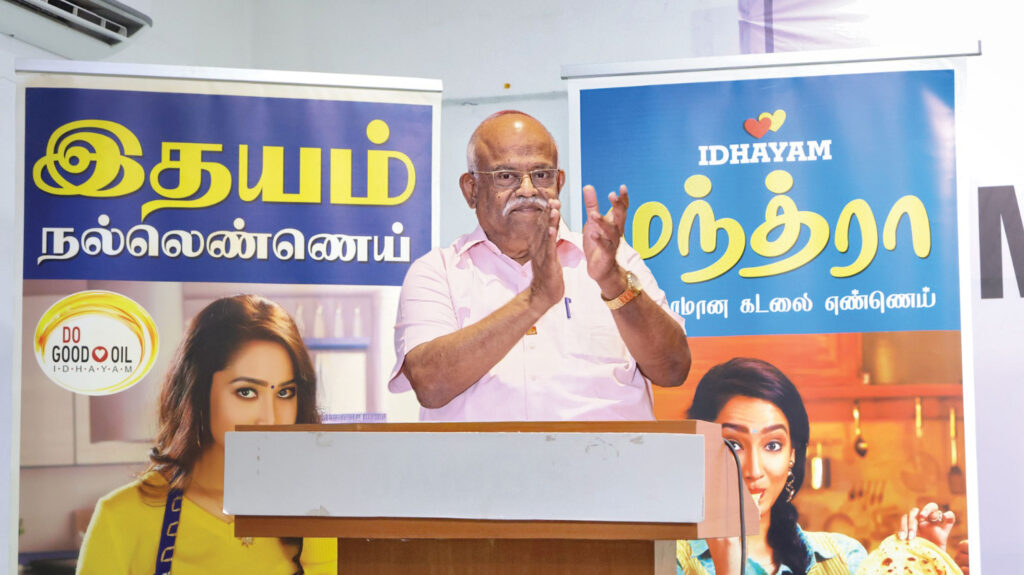
PDG V R Muthu’s passion for Project Punch is evident as he explains the diverse places where he has sponsored this project, beyond schools and colleges. He says that Beehive Communication Club caters to various corporates, schools and colleges “where trained teachers are sent for a fee. I approached Shyamraj and proposed a three-day programme for B Ed colleges, because if the graduating teachers cannot speak proper English, what are they going to reach the students?”
He began with his own city and his club at Virudhunagar, “but when I became DG, my geography extended to all the seven revenue districts of RID 3212… and the programme expanded there. That is the power and magic of Rotary,” says Muthu.
He adds, “After I finished my governorship, I simply couldn’t bring myself to stop this programme which was giving so much happiness and confidence to young boys and girls to speak in English, which is the aspiration of so many young Indians today.”
He says the transformation that Project Punch brings about in three days is “simply unbelievable. On the first day, most of them are not able to talk any English; they are not even able to come to the dais as they have stage fright. But in three days, at the end of the training sessions, you can see them confidently speaking in English. They might make grammatical errors, but they speak in English, and that is the objective of the programme.”
On the fees charged per student, he says: “Zero. To some extent, some funding is supported by the Rotary clubs associated with the programme. But the main sponsor is my company. This is a public image building exercise for our brand… our til and moongphalli oils! Our hoardings are displayed at the venue where these programmes are held.”
With a mischievous smile, Muthu relates the story of his wife wryly asking him the logic behind his sponsoring a Project Punch session for the nursing staff at the Rela Hospital (Rela Institute of Liver Disease & Transplantation) in Chennai, a renowned centre for liver transplants. “The place looks like a palace and gets patients from all over South Asia and has hundreds of nurses, many of whom can’t speak English or Hindi, which is required. So they requested us to do a training session; we did two, and they have asked us for more sessions.”
When he proudly related this to his wife, she asked a direct question: ‘Who is spending the money?’ “When she said why should you spend for such a big and popular hospital, I told her don’t you think it’s a matter of pride and privilege that we can support among the richest people in Tamil Nadu through our spoken English programme?”
Similarly, Chef Venkatesh Bhat, the culinary expert and entrepreneur, well known for his TV cookery shows and viral YouTube channel, Venkatesh Bhat’s Idhayam Thotta Samayal, requested Muthu for his support to train his staff in spoken English, “and we conducted one session at his Accord Metropolitan Hotel in Chennai free of cost.”
For Muthu, this project has created some unforgettable moments. He recalls how Radhakrishnan, a member of RC Spic Nagar, who was involved in organising more than 25 of these training sessions, was reunited with a student who had once helped him during an accident — “an unexpected and moving encounter that touched everyone present. Also at the Mohamed Sathak Hamid College of Arts and Science, Ramanathapuram, the principal was moved to tears after witnessing her students’ impressive performances, admitting that she discovered their hidden potential only through Project Punch,” he adds.
The feedback from the institutions where this programme was held is touching, adds Muthu. S Prakash, principal of the Thiagarajar College of Preceptors, Madurai, wrote to say “this was an enriching and transformative experience for our student teachers. The well-structured sessions, engaging activities, and expert guidance helped them to enhance their communication skills and confidence in spoken English. Four other college principals from Tuticorin, Sivakasi, and Ramanathapuram wrote to say their job placements had gone up by 200 per cent, thanks to this special training.”
Six steps of Project Punch
• Day 1 Orientation on skill building. Participants are divided into three batches and introduced to functional English, effective communication and impactful presentations.
• Day 2 Speech session in the Toastmasters style, with every participant receiving peer and master evaluation, followed by immediate awards and recognition. The afternoon session provides advanced English lessons and personalised improvement tips.
• Day 3 Another round of speeches, encouraging participants to outperform their previous attempts by applying their learning. In the final session, the best performers from each batch compete in a contest and finally 45 awards are given and all participants are urged to continue honing their skills.
• Follow-up: Close coordination is maintained with every institution, and students are given further opportunities by being invited to conferences and job fairs, to ensure their growth. Educational videos on communicative English are regularly shared to sustain learning momentum. Several institutions have reported a significant increase in student placements after participating in the programme.