



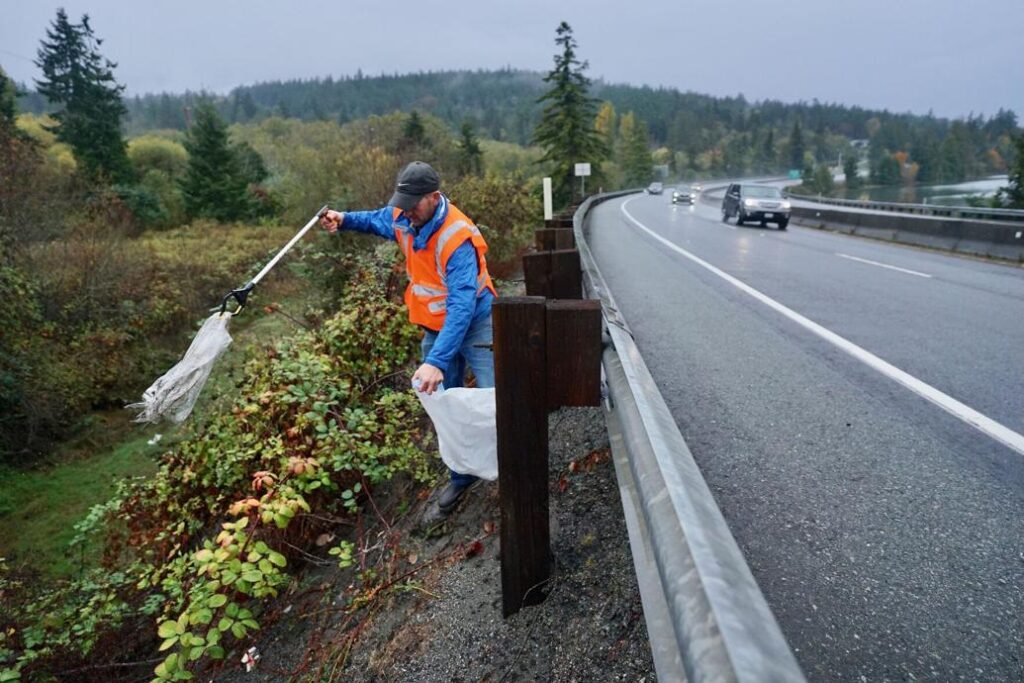
As rain falls and cars whiz past, people in brightly colored vests, carrying garbage bags and reach extenders, walk along the highway looking for litter.
This is no court-mandated community service.
No, these people chose this.
“It’s instant gratification,” said Dave Sem, a founding member of the Fidalgo Island Rotary Club and its current president.
“You can see the results right away and know that you’re doing something good for the community.”
About three years ago, club members asked the state Department of Transportation if they could adopt a 2.7-mile stretch of Highway 20 — from the Commercial Avenue roundabout to the Sharpe’s Corner roundabout — after noticing it was being neglected.
Last year, they signed a letter promising to pick up trash at least four times a year for four years along the scenic, primary route into and out of the city.
“We will clean it whenever it needs to be done, versus waiting on a season,” Sem said. “Our thought is: It’s our name on the Adopt-A-Highway road sign, so we better make it look good.”
At 7:30 a.m. Saturday, Oct. 11, five club members gather at Island Cafe to fill their bellies and prepare for what will be their fourth outing since adopting the scenic stretch.
Joining them from Surrey, British Columbia, is Isabelle Martinez Hayer, governor of Rotary District 5050, which includes some 58 clubs from Everett to Vancouver, B.C.
“Rotary clubs always feel like family,” she says while sipping on coffee.
Hayer is here as part of a required check-in on the Fidalgo Island Rotary club — a morning group that formed in 1997 as a complement to the Rotary Club of Anacortes, which meets in the afternoons.
“We’re for the people who can get up and actually do work,” says Sem, turning to the club’s community service officer, Steve Rutz, to begin making a plan for the day.
Before long, they’re filing out the door to meet up with other volunteers in the West Marine parking lot a few blocks away.
As Sem hands out reflective vests and garbage-grabbers, volunteer Pam Estvold exclaims, “How ‘bout those Mariners,” explaining that she’d only just heard about the team’s clinch postseason win after getting to bed early the night before.
Geared up, about a dozen volunteers pile into Sem and Rutz’s vehicles and head for the highway.
“The goal is to have about 12 of us,” Rutz says as he rounds the Commercial Avenue traffic circle. “We call it a dirty dozen.”
Pulling over just beyond the blue Adopt-A-Highway sign that bears the club’s name, Rutz makes sure everyone in his white minivan has enough garbage bags.
Volunteers jump out and get right to work as Rutz places orange cones and a “road work” sign just behind his van.
Then he jumps back in and heads down the highway, pulling off at South Fidalgo Bay Road to tackle that eastbound stretch to the Sharpe’s Corner roundabout by himself.
Across the highway, on the water side, three other volunteers are making their way along the westbound shoulder from the roundabout.
Working her way through the brush on the other side of the guardrail, Anna Connelly holds up a used Sterno canned-heat canister.
“We find a lot of these in this area,” says Connelly, who has volunteered to pick up trash twice before.
Taco Bell and Wendy’s fast-food wrappers are common on the westbound side, Sem said, while McDonald’s and Jack in the Box wrappers are often found on the eastbound side.
“Someone that travels eastbound likes to throw out empty vodka bottles, while another person throws out Fireball mini bottles,” Sem said.
More trash is typically found along the eastbound side, some of which Sem figures falls from vehicles traveling to the Skagit County Recycling and Transfer Station in Fredonia.
“Not everybody is littering on purpose,” says Rutz, who recalls finding lots of empty ice bags during their August outing. “Sometimes things just fly out of people’s cars.” Spotting a cardboard box near a small body of water, Rutz makes his way down a steep slope, undeterred by the unstable, rain-saturated earth beneath his boots.
“This isn’t for everyone in our club,” he says as he climbs back up to the roadway.
Jim English, an 83-year-old Air Force veteran, says he’s not bothered by the cars flying past on this rainy morning.
“If they’re going to hit me, they’re going to hit me,” he says. “I can’t control stupid drivers.”
Rutz, who’s been a Rotary member for the past 23 years, says he always reminds volunteers not to venture across the roadway to snag a piece of trash in the median.
“It’s just too dangerous,” he says, admitting that sometimes he’ll spot something and come back to get it later when traffic is light.
Back on the eastbound side across from the Anacortes welcome sign and pullout, which is maintained by the Kiwanis Club of Anacortes, Brigitte Ross is trudging through thick vegetation, reaching in deep to pull out plastic bags, cardboard boxes and broken-off pieces of cars.
“It’s really amazing all the things you can find,” she says, noting that earlier she found about 10 carpet tiles.
On previous outings, she said she found loose cash and a discarded Dungeness crab covered in maggots in a plastic bag.
“That was pretty gross,” Ross said. “But it’s all the styrofoam we find that really bugs me.”
Earlier that day, she and a couple of others came across a beheaded buck.
“I guess someone really wanted the antlers off that roadkill,” said Joe Sladich, a longtime cyclist who’s made a habit out of picking up empty aluminum cans during his rides.
“It’s amazing how much garbage you see when you’re riding your bike,” he said, “and it’s hard not to stop and pick it up.”
Elizabeth Johnson, owner of the Spine and Scoliosis Clinic in Anacortes, is carrying a large gas can as she works alongside Jon New, a retired Marathon refinery shift worker.
Both are newer to the club, having joined about a year ago.
“They’ve just been so welcoming,” Johnson said.
By about 11:30 a.m., Rutz is pulling up in his white minivan to pick up several rain-soaked volunteers, telling them sarcastically not to track any mud inside.
“You’re going to have to give this thing a deep clean,” Sladich says.
“I think I’ll just get a new van,” Rutz responds with a laugh.
The volunteers leave the roughly 100 bags of trash they’ve collected on the shoulders of the highway for state Department of Transportation workers to collect in the coming days.
“I think they like to have them sitting out there for a while to show people that this work is happening,” Rutz says.
Winded and wet like everyone else, Carl Bruner, the Anacortes School District’s interim superintendent, says he feels a sense of accomplishment and teamwork as he rides back into town with the others.
“Great job, guys,” Rutz says. “Great work.”
With the rain still falling, Rutz admits they could have called off the day’s outing due to the weather.
“But the district governor was here,” he said, “so we didn’t want to cancel and look like some wimps.”
The club, which meets at 7 a.m. every Tuesday at the Anacortes Yacht Club, will be back at it in January, if not sooner.
New members are always welcome, Sem said — especially those looking to get their hands dirty.