



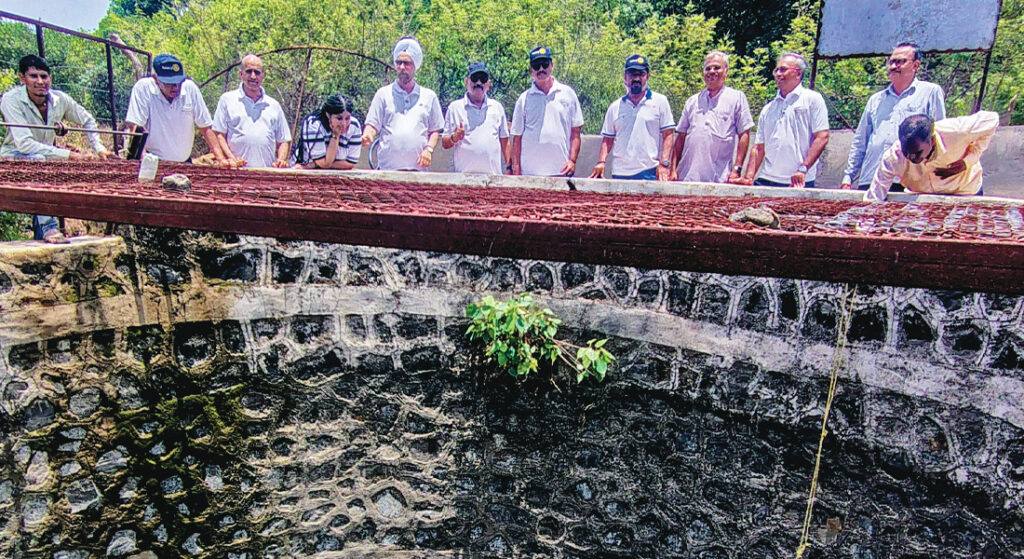
Members of the Rotary Club of Hiranandani Estate, RI District 3142, have brought smiles on the faces of around 3,000 villagers in the water-deficient region of the hills of Jawhar-Mokhada, barely 200km and a few hours’ drive from Thane, Maharashtra. With these village wells having sufficient water even during the normally dry months from Feb-May, the happiest among these villagers are the women, who no longer have to trek over 1–1.5km of hilly terrain to fetch pots of water, and the farmers who now have sufficient water for their crops.

It all began four years ago, when Sukumaran Nair, a very active club member when it came to doing his club’s community welfare projects such as building toilets and other work for the villagers, travelled deep into the interior villages. “At that time I saw that many check dams had been built by some Rotary clubs and others. This part of Maharashtra, even though it gets good rainfall because it’s a hilly region, experiences long dry spells between Feb-May, after the copious monsoon rainwater has run off. We found that the check dams did not serve their purpose as the water had run off, and as a result the village wells would turn completely dry.”

The saddest part was the hardship during this dry spell for the women, who had to cover long distances on foot to fetch water for the household’s daily needs. Even more tragic was the fact that to get some help in this difficult chore, the girl children were pulled out of schools and their energy was harnessed into fetching water. “All the time we say ladki padhao, but here the opposite was happening and that too for which a solution could be found,” he adds.

He, along with his club members, wanted to do some water augmentation/conservation project for these villages, but they thought no significant good would come from building more check dams. “Also, we felt that as in the earlier projects, the villagers were not made to contribute anything for the work, they felt no sense of ownership in the new facilities created by Rotarians and others. So we decided that whatever we do, we must make them contribute something, in some form or the other,” says Nair.

After a lot of brainstorming and discussion to “get a lasting and innovative solution, and taking the views and opinion of technical expert in water management and conservation Dr Umesh Mundlye, and in partnership with the NGO Pragati Pratishthan, the club decided to find a solution by building surface dams, which would capture and store groundwater beneath the surface, ensuring year-round water availability.”

The club decided to go in for a global grant to kick off the project under the leadership of the then incoming club president Sukumaran Nair and his predecessor Ravi Shankar Vobbilisetty. The first global grant of $51,600 was supported as international partner by the Rotary Club of South Forsyth County, US, RI District 6910, with the local execution done by Pragati Pratishthan, under the guidance of Dr Mundlye, says past president Vobbilisetty. In this project, ₹4 lakh was donated by AKS member and past president of the club D P Tripathi.

Another GG of $31,422 soon followed in partnership with the Rotary Club of Grapevine, US, RI District 5790 and Blossom Charitable Trust. This time past president Vobbilisetty donated ₹1 lakh. “Both projects were delivered on time, combining technical expertise and strong local collaboration and we have done a total number of 12 subsurface dams benefitting about 3,000 villagers. What we are happiest about is that the girl children in these villages are back to school, and we have saved the four precious hours these village women were spending in fetching water from long distance,” says Nair. Also, the farmers, who were hard-pressed to find enough water for their crops (mainly maize and different kinds of vegetables), are happy that there is sufficient water now available for their farming needs.

An immediate benefit of this project, completed in 2024, is that though the Rotarians were told by the water expert not to expect immediate results and wait for a year till the subsurface dams recharge the village wells, they found that this year itself the village wells were brimming with water.
Explaining the several advantages of subsurface dams, Nair points out that “unlike check dams, subsurface dams are constructed below the ground, storing the underflow from seasonal streams and recharging aquifers. Their benefits include zero evaporation loss, availability of clean, parasite-free water, and no maintenance, displacement or ecological damage. They can cause natural recharge of wells, especially in hilly terrains like Jawhar-Mokhada, to provide sustainable, long-term water security.”

The cost of putting up each of the subsurface dams varies between ₹4 and ₹14 lakh, depending on the length of the dam, with the average length being between 9 to 12 metres, though some of the dams are much longer. The length of the trench dug for the dam depends on the appearance of rocky terrain at which point the digging is stopped, and a wall is built to retain the water.
The Rotarians were happy that all the 12 dams thus built successfully managed to recharge the nearby wells. Asked about laying pipes to provide tap water in the beneficiaries’ homes, Nair says, “That is the next project we are considering. We want to build about 140 subsurface dams in this region in the long term. The next step will be to create a pipeline with the help of solar power to take the water to their homes. In one village the pipes were already there, but for much of the year they were not getting water in those pipes; now they do!”
He adds that the DGE Nilesh Jaywant (2026–27) is keen that efforts should be made to include and involve smaller clubs in the district in bigger projects, so once they find another international partner, “we are planning to do one more global grant for this purpose,” he adds.
Meanwhile he is happy that “this GG project has created such terrific local impact. Earlier people had to survive on 11 litres of water a day, whereas they are now getting 55 litres, enough to lead a life of dignity and good health. One local farmer told me with a big smile: ‘This water has brought back life — not just to our fields, but to our dreams.’”
He thanked IPDG Milind Kulkarni for extending his support for this project.