






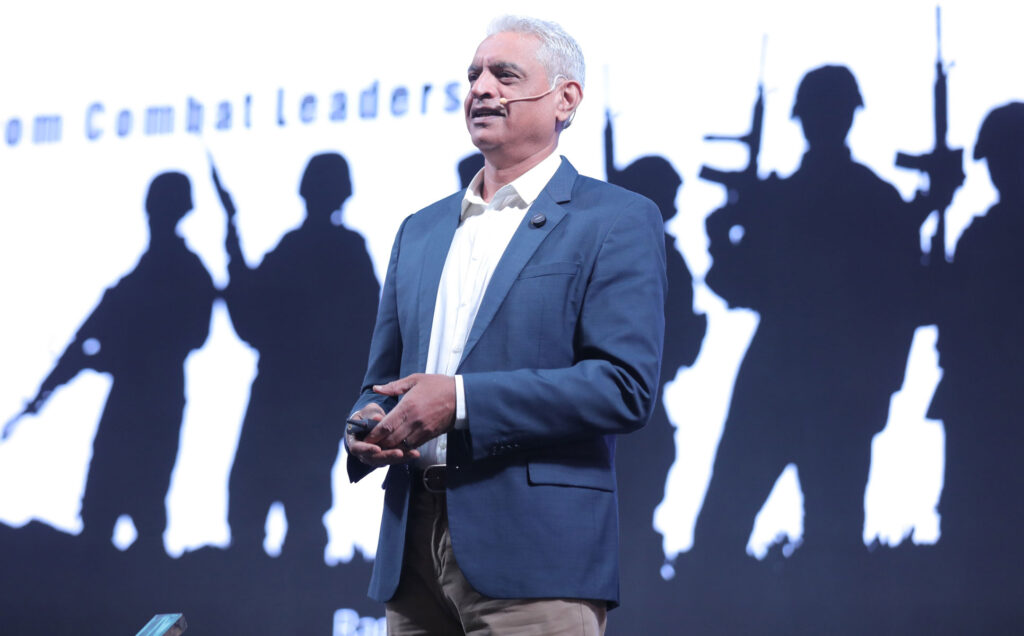
There was a stunned silence in the hall as Capt Raghu Raman from the Indian Army walked the delegates of the Tejas zone institute through the tough terrain of the Siachen Glacier in the Himalayas and described the nitty gritty of what it takes to exhibit leadership in one of the world’s most difficult terrains. He was addressing a session titled Leadership at 26000ft.
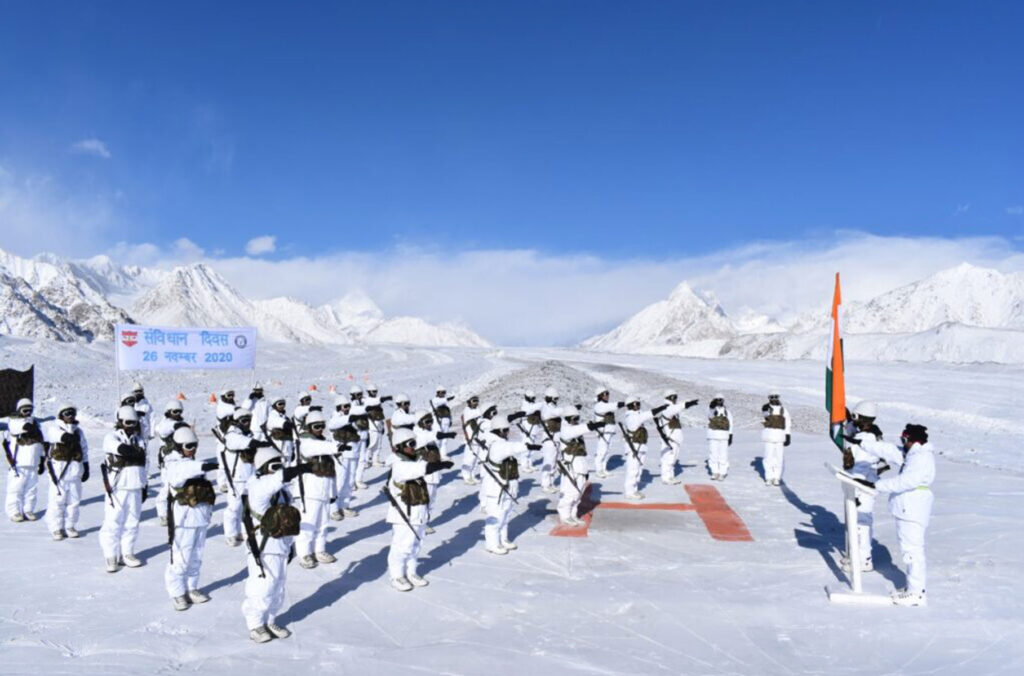
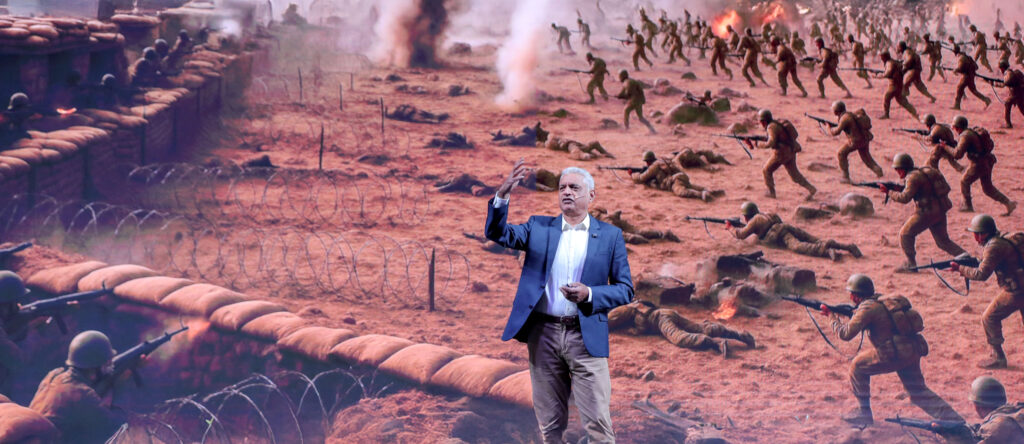
While on a flat terrain the attacker to defence ratio is roughly 1:3, in a place like Siachen it changes to 1:9; and if you have 100 people making the charge, “they know by the end of the attack, or the day, less than about 30–40 will be alive. The rest will be dead, or worse than dead, because they will be amputees for life.”
While delivering such lectures, when he quizzed the audience why soldiers fight, he got answers such as ‘patriotism, love for the country, discipline, uniform,’ etc. The simple answer is that troops don’t fight for a huge cause but for the leader who is leading them, he said.
Dissecting the group of soldiers who end up in Siachen, Capt Raman said, “More than geography, this is a lesson about reality. A boy who comes from Kerala does not know what the snow looks like. A boy from Kashmir doesn’t have an idea what deserts look like. Our troops come from tiny villages, and have no vision of the strategy of the nation. Their visibility is limited to the comrades who are with them in the trench and that young leader… lieutenant or captain who is leading them. It is limited to the izzat of the paltan, the honour of the battalion. There are no material tools with which military leaders can take their men into battle… no ESOPS, pay hikes, employee of the month award or bonus!”
There are no material tools with which military leaders can take their men into battle… no ESOPS, pay hikes, employee of the month award or bonus.
Through a short and grainy video, he showed the audience what the Siachen Glacier was like. Where helicopters had to carry each and every piece of material under the most challenging conditions… such as the helipad being “roughly the size of these two tables put together. For the soldiers posted there, there is no bathing, shaving, personal hygiene. You put a piece of cloth in cold water and wipe yourself with it. This is life at 18,000ft and higher.”
Capt Raman painted a vivid scenario to the stunned audience on what life is beyond 21,000ft, where temperatures can go down to minus 20 or 25 deg C, with the wind chill factor taking it even further down. Another video clip showed patrolling soldiers carrying packs weighing 15–20kg, and a rifle to boot! Whereas a patrol in normal conditions from Delhi to Dwarka takes 3–4 hours, in a glacier it can take 4 days, because when you put your foot in the snow, “it doesn’t go down to your ankle or knee, but all the way down to your thigh!”
He said leadership had to be provided in such an impossible terrain where to get a cup of morning tea, a soldier used a pick axe to break “pieces of concrete-like rock solid ice, heat it in a patila for an hour and half.” The soldier’s clothes were black, thanks to the abundant use of liquid gold of the glacier — kerosene. “You can survive without food or water for weeks, but without kerosene, you will not survive a single night, because if the bukhari in your enclosure goes off in the night, in the morning, you’ll wake up like an ice tray. Within days spent on the glacier, your eyes, nose and sputum that you cough out will have a black soot, because you’re constantly inhaling kerosene fumes.”
The size of the bunker was about the size of the stage he stood on, and 14–16 men lived in it! The entry is through a tunnel, which has been chiselled in, so God help you if you have claustrophobia. Inside, the walls are lined with steel to prevent them from caving in. “So, if a novice by mistake takes off his glove and puts his hand on that steel girder at minus 40, you can imagine what’ll happen.”
There’s no way a video can show you what it really is like to live inside a bunker that stinks of unwashed human bodies mixed with the smell of kerosene, gunpowder, vomit and rotting food.
Wryly, the army man said: “Now, through a five-minute clipping, I’m trying to show you what life is like for 12 months in Siachen. There is no way a video can show you what it really is like to live inside a bunker that stinks of unwashed human bodies mixed with the smell of kerosene, gunpowder, vomit and rotting food. You’ll have to extrapolate and imagine what it feels to live in that environment.”
Giving an example of combat leadership, Capt Raman next showed a picture of a winter cutout post, where once troops were inducted for six months, they couldn’t be de-inducted. The reason was the steep gradient of the mountain face where tonnes of snow fell every hour, and the slightest of vibration could start an avalanche. He related the tale of a 20-year-old lieutenant, who had taken 20 men into that post. Within two days they had a casualty, with a soldier dying of cerebral oedema. “They wrapped the body of the soldier in parachute cloth, kept it next to the post. You couldn’t throw away the body, it was one of your own soldiers, and nothing would happen to the body at minus 40 deg. Just visualise the grit required by that 20-year-old lad who had to then lead 18 men through the next 5 1/2 months. Compare that to the long face we get, or our morale breaks down when something goes wrong at work, or somebody steals our car parking, or when someone says ‘no’ to us.”
The Captain said that these men were not special forces or members of high-performance teams in various sectors. “They are very ordinary; what they do together becomes extraordinary because they are led in extraordinary ways, they are organised in extraordinary ways. The second rule of combat leadership doesn’t matter if you are a lieutenant who was minted just two weeks ago; now that you have command, you are accountable, period. There is no excuse.”
Showing a picture of soldiers wearing what is called an ‘anklet,’ a piece of equipment to cover their shoes to prevent the snow from getting inside, he said if a soldier got snow inside his shoes, “this squad cannot stop, no matter how exhausted they are, because if they stop, the ice will turn into water due to body heat, and will instantly refreeze.”
It’s easy to say cut the rope. But the soldier dangling there kept food hot for you when you were out on a patrol; who nursed you back to health when you had high fever in some godforsaken post, or who lent you money for your sister’s marriage.
Those who had gone to Leh would know that the travellers are warned to take breaks between long walks, or else the risk of getting pulmonary or cerebral oedema goes up by 800 per cent! “Here, one man’s negligence, one man’s bad karma, and the entire patrol’s life is in danger. The third rule of combat leadership, good teams are literally tied at the hips. Either the whole team wins or the whole team loses. There is no room for an individual gladiator.”
It is in “that state of mind that leadership is being called for. Anybody can lead when the economy is doing great, business is good, environment is good and funding is coming in. Real leadership is actually called for in tough times.”
Next, displaying a bunch of letters, he said, “This is the only thing that brings a smile to the face of a soldier…. letters from home. But these are censored because you don’t want the soldiers getting any bad news. So, if a soldier’s daughter has died of dengue, he won’t be informed, but you, as his commanding officer, will know that. You will have to bear and carry that burden of knowing that your subordinate’s daughter is dead, but won’t be able to tell him.”
Saying that there were no good or bad soldiers, only good or bad leaders, Capt Raman related an anecdote about the time he was posted at the Siachen battle school as an instructor. By a coincidence, there were two battalions there from the same regiment who were manning two different sectors of the Siachen glacier. While in one the soldiers appeared to be 7ft tall… “the way they carried themselves, the snappiness of their salute, the vibrance in their eyes, I almost felt if I touch a soldier, I will get a static, that’s the kind of vibration, vibrance they had.”
“But in the other unit, the men were slouched, their cheeks hollow and eyes vacant. It was the same army, same training, same equipment, same codes, everything was exactly the same, but their leaders were different and that made all the difference! One was kicking ass and the other was crumbling like a pack of cards.”
Through another visual, Capt Raman showed a man, who was visiting the region when the temperature was around minus 23 deg C, wearing no special clothing. “This is not just excruciatingly painful, it’s downright suicidal. So, why is he doing this? VIPs who come into the glacier, are covered from top to bottom as if they are going to meet some Eskimos! Of course, they need to wear those clothes, but they come mostly for photo ops… and they don’t listen to my briefing, they are only awaiting the sound of the chopper which will take them back! But when this man comes to my post, he is sending me a message… ‘Son, I am a brigade commander; I can’t be there with you for the whole 12 months. But for the 10 minutes I stay here, I’ll expose myself to the pain that you feel for twelve months so that you know that I know what your pain is. That is leadership, ladies and gentlemen! This is walking the talk.”
With this anecdote, he reminded the audience that “troops don’t expect you to solve their problems, they expect you to understand their problems.”
Patrolling woes
About 80 to 90 per cent of the bulk activity on the glacier is patrolling. The patrolling soldiers were attached to one another by a rope and to safeguard against huge crevasses which could swallow up the whole group, but which were covered with ice and hence not visible, the first soldier poked the path before him with a stick to test the firmness of the terrain.
Every soldier in the patrol is tied to the next one with a stick in the front, and the scout or the vanguard soldier, pokes the ground in the front to look for crevasses or deep holes inside the glacier… “sometimes they are so deep that if you take a chunk of rock and chuck it inside, you will hear it going kadak, kadak, but you won’t hear it hitting the bottom!” Because of heavy snowfall, the crevasses are covered with an ice bridge, which can sometimes hold the weight of dozens of men, but give way at other times. “The drill, in case a soldier goes down, is that the remaining soldiers are immediately supposed to hit the crampons and use their ice axes to arrest his fall and pull him out. But this drill works like most drills do… in theory. In practice, every soldier is exhausted beyond belief and barely has any energy. In that exhausted state, if a heavy load goes down, it jerks everyone off their feet and before they can get a grip in that powdery snow, the entire set of men starts getting dragged inside the crevasse.”
What do you do then, the captain asked the audience and got the response: ‘Cut the rope.’
What Capt Raman said next made many in the hall tear up. He said, “Yes, sitting inside this AC hall, it’s very easy to say cut the rope. But let me put this in context for you. The soldier who is dangling at the other end of the rope is the man who kept food hot and warm for you when you were out on a patrol. He is the man who nursed you back to health when you had 105 deg temperature in some godforsaken post. He is the man who lent you money when you had to marry your sister. And he is the man who went and met your aging parents when you did not get leave that year. That’s the man dangling at the other end of the rope… it takes a lot of courage to give the order to cut that rope.”
But the first rule of combat leadership is that the mission comes first. “Even if it is your own brother dangling at the other end of the rope, you are accountable to the mission. The mission comes first, always and every time.”
The pressure cooker temple
In Andhra Pradesh, there is a temple called the Chilkur Balaji temple, better known as the Visa temple, called so because aspirants for a US visa, come here after the application, and do 10 rounds of the temple. And another 110 rounds once the visa comes. “I don’t know why it works, maybe it’s a branch office or something, but it works!”
Similarly, in the central sector of the Siachen glacier, there’s a temple called the Pressure Cooker Baba Mandir. “Do you know why,” asked Capt Raghu Raman? Legend says that once from a Pakistani ridge when a heat-seeking missile was fired, it came to the hottest part of the post, which was a pressure cooker on top of a stove, and blew that up, saving the 28 men who were sleeping in the barracks close by. “Ever since that day, the fragments of that pressure cooker are kept in a shrine, and pooja hoti uski din mein do baar…subah shaam aarti hoti hei uski.” (Pooja of the pressure cooker remnants is done twice a day, complete with aarti).