






One of the most awaited sessions of our Zone Institutes is moderated by past RI President K R Ravindran, known for his incisive conversation with senior RI leadership. The recent session at the Tejas Institute in Delhi upheld this tradition of rigorous and engaging dialogue.

Titled In the Crosshairs, the session raised some tough questions such as why not move the Rotary headquarters out of the US and who really runs Rotary — the RI Board or the staff. The first question, directed to RI President Francesco Arezzo, was about the present US regime coming out with adverse decisions/comments on issues such as DEI, need for environmental protection, laws on corruption, suspension of funding for USAIDS, withdrawal from WHO, etc. Since these were in direct contrast to the core principles and work done by Rotary, “why are we still sitting in the US; why don’t we get out,” asked Ravindran.
Thanking his interlocutor for “a really comfortable question,” Arezzo replied: “RI was founded 120 years ago in the US and for all this time we’ve stayed in Evanston with liberty, freedom of communication and investment of our funds. Now there are some decisions that bring some difficulties for the organisation, but Rotary has 120 years of history.” So its judgement has to be based long-term; “we don’t take decisions on immediate problems, but see far ahead and judge everything for the long period. So it is too early to think about change.”
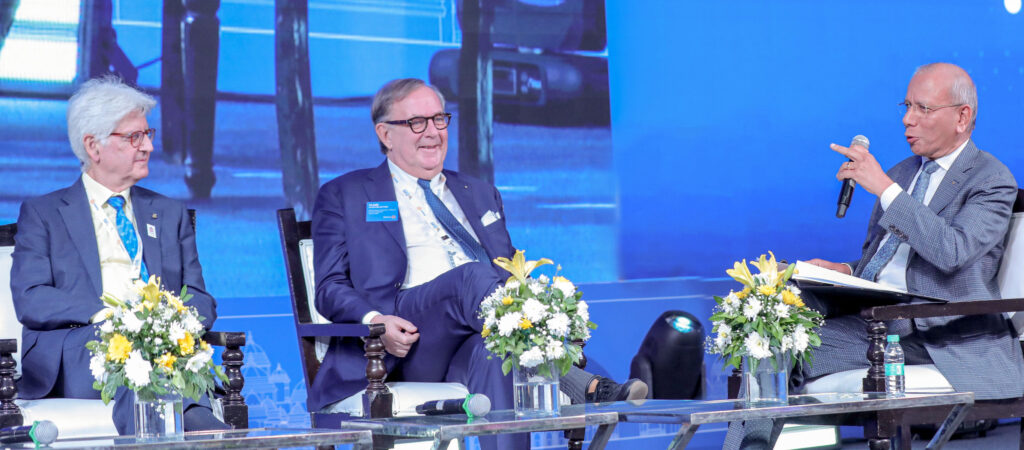
Next Ravindran asked RI vice- president Alain Van de Poel why the International Assembly should continue to be held in US considering that getting a US visa was so difficult. “This year 64 governors have been refused visas. I understand the President’s answer about moving our headquarters. But why go to the US for our training? If you come to India, I guarantee that our two directors (K P Nagesh and M Muruganandam, who were both in the firing line) will ensure every single person gets a visa.”
De Poel, who is from Belgium, said visa difficulties were not confined to the US. Last month there was a summit in Brussels which brought together about 1,500 Rotarians from Europe, Middle East and Africa. “We had the same problem; 200 friends coming from Africa, Nigeria, Uganda, etc didn’t get a visa. I think in the next year, visa will be a problem globally for Rotary.”
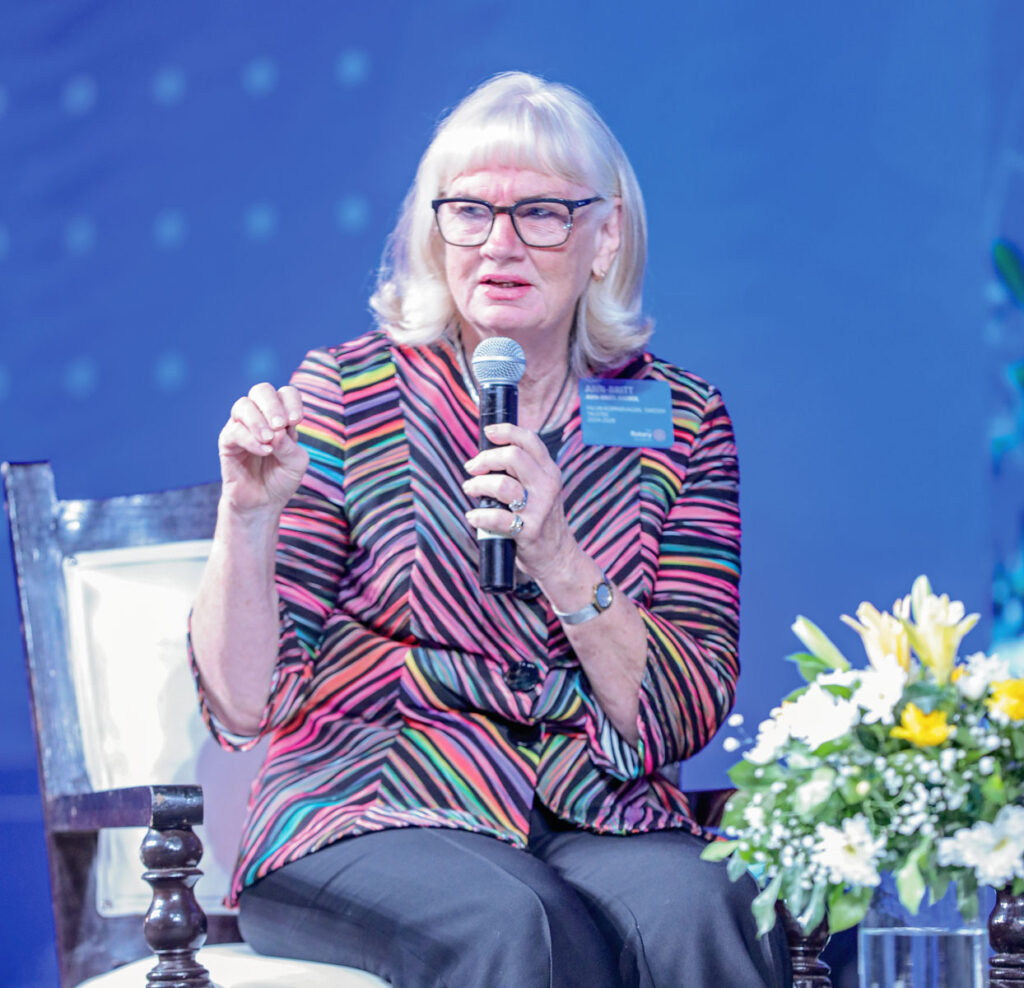
Ravindran then asked TRF trustee Ann-Britt Asebol that considering it took 200 years for the last case of small pox to be detected after the discovery of its vaccine, would it take 200 years for polio to be completely eradicated?
She said she was certain that “just like all of a sudden polio had disappeared in India,” it would end at some point, and it wouldn’t take 200 years. “But till that happens, we need to be there, vaccinate every child, and remember that every child is not born in a hospital where we can easily vaccinate them. They are also born in villages, so we need to fulfil our promise to the children of the world to vaccinate them, including in villages.”
Muruganandam shared her optimism and added, “One thing is clear, we must take care of the next generation; we are there 99.99 per cent. In India we eradicated polio 14 years ago; let us all support this programme till it is done.”
R avindran next quizzed Arezzo on the election complaints that the RI Board receives; “some Rotary countries are riddled with politics at the DG election level, sometimes even at the director level. Why don’t you just allow canvassing and campaigning to take place, and make it free for all,” he asked.
Ruling out the idea, the RI President said Rotary was an organisation with strong ethics and “allowing a free campaign or canvassing, as in politics, is not positive for our organisation which is rooted in core values like integrity, fellowship and friendship. We are leaders and we must be leaders also in integrity, fellowship and the correct way to compete.”
Directing the same question to the two directors from India, Ravindran added that when “we moved to electronic ballot… I was director then… I thought at last we have solved this problem and you can’t beat this. But it took only one cycle before they learned how to beat the electronic system.”

Addressing the query, RID Nagesh said that it was true that the highest number of election complaints came from India. “There are multiple reasons for that; one, many aspiring to become leaders, some say it is part of our culture. In Lions, it is the other end…canvassing, campaigning, everything happens. But we don’t allow it; yes, there is a little confusion here and there. Even though we love to play cricket, we are also good at playing chess. It is a matter of time. In the end, Rotary is going to win by checkmating all these things, and the complaints, already on the downward trend, will reduce and come to zero.”
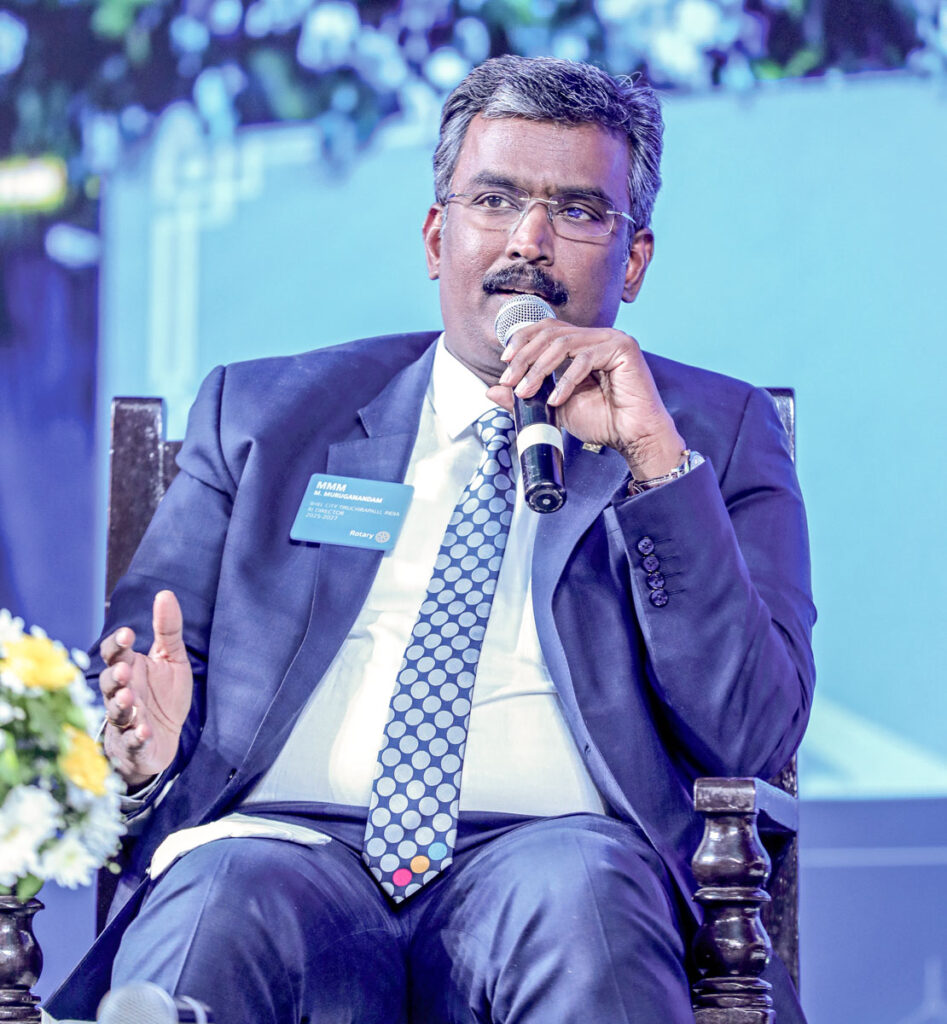
RID Muruganandam said two things had to be considered. Out of Rotary’s 34 zones, our region had only four, which was dispropotionate to the higher number of Rotarians our zones had. Giving numbers, he said Rotary, with a membership of 1.12 million, had a total of 34 zones, our zones — 4,5,6, and 7 — had a membership of 170,000 or 0.17 million. District-wise, Rotary has over 550 districts, so the average number of Rotarians per district is only 1,900.
But in our four zones, the number per district is much higher at 3,900, or double.
“This means we have lost 45 governors, four RCs, four RRFCs. Please understand, we are talking about 1.4 billion people. While everywhere, there is a drop in membership, here there is growth. We are balancing the rest of the world, but missing 45 leadership positions.”
While this shortage in leadership positions could be the reason for election complaints, the complaints themselves are going down; four last year, and zero so far. Our zones were “No 2 in membership, No 1 in adding members, and No 2 in giving (to TRF).” And yet, when this region was mentioned, only election complaints were talked about. “But we are moving ahead; under our policy Vision 2030, we want to go for a total of 250,000 Rotarians and 125,000 Rotaractors.”
Also, “going around and talking to Rotarians, I don’t think qualifies as electioneering,” he added.
To this answer Ravindran responded: “Mr Director, India is not the only country where there are complaints. There are complaints from South America, Philippines and other places. My question: what is the Board doing about it? Both of you are directors on the Board.”
To this Nagesh replied: “The Board is very clear. No canvassing, campaigning allowed. But Muruganandam has made it very clear — more demand, less supply. We are planning to create more supply by uniting to grow, dividing to multiply. That’s a solution from our side; but the Board is very clear on the policy… No election campaigning and canvassing.”
Muruganandam added, “We will follow up on proper complaints. There is no doubt about that.”
The next question directed to de Poel was about the policy of working from home post-Covid. “Most companies I know have reverted to normal work. But we find in our building (in Evanston), there are still lots of empty spaces.”
The vice-president responded that this was related to changing culture in many countries, where people had got used to working from home, and new recruits were asking how many days would they be allowed to work from home. But even though this might have become the culture of American companies, “I feel we are not a normal company. We cannot accept that only when the Board meets, we have 10 people who are aware of the meeting and who are there in the offices.” There were also delays in getting answers to questions asked to the RI staff, “and if you try to phone somebody in Evanston, I wish you good luck. Yes, we cannot accept this.”
Ravindran then asked the RI President: “Who really runs Rotary, the Board or the staff?”
Arezzo replied that while the RI President and directors were volunteers, who stayed in office for one and two years respectively, the staff stayed much longer, sometimes even for 10 to 20 years. “So they know everything in a very detailed way. The rapport between staff and volunteers was important.” While the volunteers lay down the policy, the staff implement it. “And I must say that the quality of the staff is really very high, and they are all very experienced.” This was also true in Zurich and Delhi. The problem was that often “the staff complains that the volunteers have very high expectations. They want to change the RI rules too much and too quickly. Our aspiration to change very quickly, very rapidly to see the results during our year very often gets frustrated by the staff who say: ‘No, we have to think, we have to decide slowly, probably it’s not possible.’ So I’d like a bit more enthusiasm and readiness to change from the staff.”
But at the same time, Arezzo added, “Rotary is a very old organisation and change is always difficult and we cannot change without good preparation, study and planning. The balance between these two attitudes, one more conservative, one more active, is the key to success. We have had some presidents, as you know, who were fighting all the year with the staff. But for the other years, the report was very good. So far this year, I have a very good relationship with the staff and I am trying to push to have a more enthusiastic answer to my requests.”
De Poel added that to sort out several such issues, “a new business plan and model were required. We need to take some risks and to prepare for it we might need 3 to 5 years! But I do believe each Rotarian is waiting for this.” The irony was, he noted, “we talk about change but we also do not want to change. My personal view is that we need support from external people to make a full analysis about this business model and what would be needed in five years.”
Ravindran then quizzed Muruganandam on the huge demand for a GST sum from the Indian government. “So how did it come to this proportion? Who messed up on this? I know you asked a very strong question at the Board and Trustees meeting, very bravely. How did we get into a situation like this, all of a sudden?”
The RI director replied that GST had been introduced in India only in 2017, and there were several dimensions to the problem, including GST not being paid properly and taxes related to CSR funds. Being a chartered engineer by profession, he understood the intricacies of indirect taxation. “We are clear that this issue has to be handled properly, and we have to comply with the laws of the land. We are in the process, and have initiated legal proceedings, and will come out of this.”
To the question whether like directors, trustees should be nominated zone-wise, trustee Ann opined that rather than have a “geographical perspective” the best people should be chosen as trustees, so that the Foundation’s money could be invested prudently.
On why allow only a past RI president to become trustee chair, she said it was a good practice “because when you are president, you get a lot of knowledge about the whole Rotary world, having travelled a lot during your year.”
Ravindran then asked Arezzo about the rationale behind the RI President and directors having only a one and two-year terms. “In our management structure, every one year, two years, everything changes. Now, can you imagine Mercedes-Benz or BMW changing their manager every year? Is it the right thing that we are doing? Should we not extend the directors’ terms for three years and reduce the trustees’ term from four to three years, so it balances off?”
Agreeing with this perspective, Arezzo replied that as director he had spent the first year “just to understand what the machine does, how it functions and to know the people. The second year was more active; you can express really what you want to do.” He agreed that a two-year term for directors was too short, and “moves the balance in the direction of the staff. So when you have a director who stays for three years, the board will get more powerful with people who know the machine much better.” The problem would be that three years might be considered “too long by people who are still active in their professions. And so we risk to lose some of the best Rotarians. But I do think that for the directors, probably three years is a better term.”