



In 2019, a six-member team from the Rotary Club of Bombay Mid-Town, RID 3141, led by the then club president Abuzar Zakir and project chair Ashwin Shah, visited 150 municipal schools (Mumbai Public Schools) for a spot study on their classroom facilities, atmosphere and the quality of teachers. “Our field survey broke the social myth among the Mumbaikers who prefer to send their children only to private convent schools. Even the lower middle-class families believe that municipal schools are not fit for their wards as they lack basic facilities and good teachers,” says Zakir.
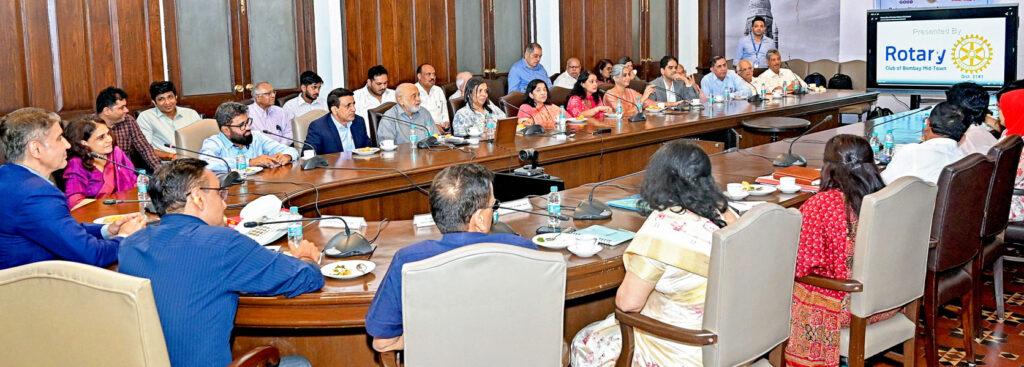
Contrary to the widely-held belief that public schools are meant only for students from extremely poor families, “our study found that these municipal schools have excellent classroom facilities, spacious grounds and highly motivated teachers. They provide free uniforms, textbooks and noon meals.” All these add-on features encourage students to perform well in their public exams, says Zakir.
The Rotary team found that all the teachers were well-paid, motivated and “highly qualified to teach and inspire students.” After brainstorming among members, the club zeroed in on “introducing digital learning to students in municipal schools which will give a boost to their public image, thus attracting more students and change the false mindset of the public.”
Now as the chair of Project E-Learning, he is happy that his club has distributed 360 digital panels (75 inch-smart TV) to 16 municipal schools, benefitting 10,500 students across Mumbai, in the last six years. “Each smart TV comes with a pen drive that has subject curriculums in Marathi, Hindi, Urdu and English for students to easily understand concepts through audio-video-graphics,” he explains. Even intricate concepts and difficult subjects are made easy and simple, “thanks to the digital panels.”
The facility has been installed in schools in neighbourhoods such as Dharavi’s Transit Camp, Imamwada, Colaba, Goregaon East, Khetwadi, Kamathipura and Wadi Bunder: “places synonymous with struggle, where students battle not just for marks, but for any opportunity to learn.” During the Covid times, when schools were shutdown, 200 tablets were given to five public schools to help teachers hold online classes.
Great support
All the 120 members of this 57-year-old club support Project E-Learning
in one way or another. Two corporates — Ion Foundation, owned by club member Rajesh Sharma, and PPFAS, a mutual fund company owned by Gita Parikh, also a member, are its major contributors.
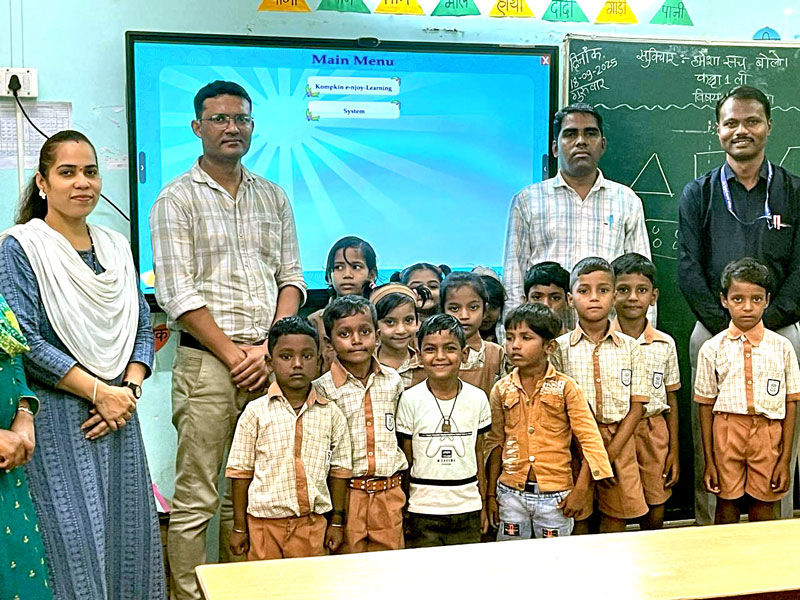
The education officials of the Brihanmumbai Municipal Corporation (BMC) extend their wholehearted support to the digital initiative at the public schools. In a widely circulated note among the school department officials, BMC deputy commissioner Prachi Jambhekar points out that the “pass percentage of students from the beneficiary schools in public exams has risen from 72 to 98 per cent after the introduction of digital panels.” There is a dramatic increase in new admissions each year after the launch of digital panels at the Mumbai Public School, Balaram Street, on Grant Road, Mumbai, says its headmaster Ishtiak Ansari. “Now, parents attend meetings with teachers regularly and profusely thank our faculty for improving the educational standards of their wards,” he says.
The school dropout rate “has stopped completely at our beneficiary schools. Earlier, when children reached Class 8, they quit schools and did household chores, as they came from low-income families with meagre resources. But now there are no dropouts in the schools that have got digital panels, smiles Zakir. In the current Rotary year, his project team is planning to distribute at least 100 digital panels (each set costs ₹1 lakh) to five more public schools. “There are 1,200 municipal schools run by the BMC, and we will be expanding the digital project in the coming years.”
During a felicitation event, BMC commissioner Bhushan Gagrani complimented the Rotarians for doing the noble task of building the future of the nation. Additional commissioner Amit Saini has also assured support to the club for extending the project across all schools.
In a buoyant mood after praise from civic officials, club president Svetlana Toshniwal says she will go all out to raise funds so that the e-learning project is continued for many years to come. “In these classrooms, a single digital panel can open up the world. We’ve seen shy girls become confident speakers, reluctant readers discover science videos, and teachers are able to reach larger, more diverse groups quickly and effectively,” she says.
Zakir is now keen to expand this digital classroom project into a district-level initiative.