



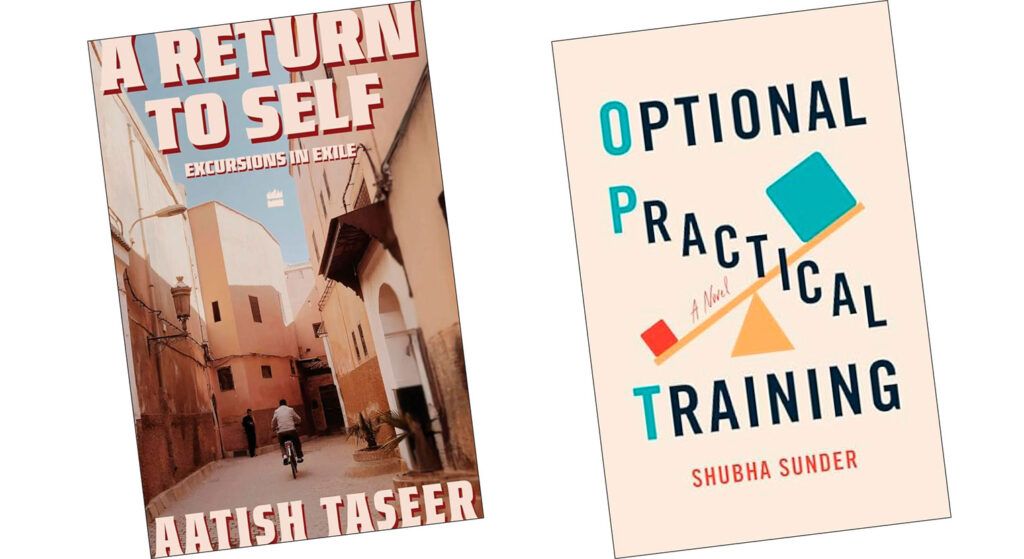
A travelogue-cum-memoir and a novel; both experiencing and evoking ideas of identity and otherness at this time in different ways, different places.
There is a point in Aatish Taseer’s recently published travelogue-cum-memoir, A Return to Self: Excursions in Exile, where he describes travelling in Bolivia to attend the Feast of the Virgin in Copacabana. He examines the spirit and nature of pilgrimage in three countries — Bolivia, Mongolia and Iraq — while reflecting on the past upon which the political present of each is constructed. As he leaves behind the capital city of La Paz and catches his first glimpse of the Andes, he recalls a message sent to him by a friend familiar with South America. “They are the true Hindus,” his friend writes. “They absorb everything and remain themselves.” The reference is “to the hybridity he (the friend) had witnessed in the Altiplano,” a high plateau next only to Tibet in size. Much of the Altiplano is in Bolivia, while the rest is in Peru, Chile and Argentina. In the north lies Lake Titicaca, and in the south are the Salar de Uyuni salt flats. More importantly, this is a region where many cultures existed.
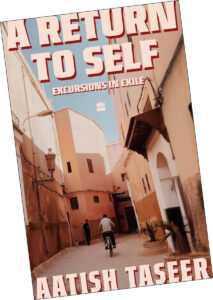
Absorbing everything and remaining themselves — Is this the definition of a true-blue Hindu? There is plenty that prods and prompts and evokes in this remarkable collection of writings that is at once vivid in description and analogy, philosophical in rumination, and sensitive to the human condition. Which is why it’s not something you can simply “read off” despite being barely 200 pages long. It demands mindfulness.
The writings emerge from a space unique to Aatish Taseer’s life. His father, the Pakistani politician Salman Taseer, who was assassinated by his bodyguard for taking a stand against blasphemy laws in Pakistan, was practically a stranger to him; he was raised by his mother, journalist Tavleen Singh, one of the first Indian women to cover conflicts, and his grandmother, in India; he studied in India, the UK and the USA; his OCI status was revoked by the Government in 2019, banning him from ever returning to his country, despite his having, by then, written five books, four set in India. This was a body blow to Taseer who was just short of 40. About this, he writes: “To lose one’s country is to know an intimate shame… Your country is so bound up with your sense of self that you do not realize what a ballast it has been until it is gone. It is one of the few things we are allowed to take for granted, and it is the basis of our curiosity about other places.”
He carries this loss of home right through recent journeys recorded in this book; however, it runs like a silent cry reconciled beneath the surface as he explores other lands, other people, and weaves together their histories. The book’s journey begins in Istanbul where “one lived in a perpetual state of cultural whiplash.” He speaks of the unresolved differences within himself when he had visited the city 15 years earlier, and quotes Oscar Wilde: “A man whose desire is to be something separate from himself…invariably succeeds in being what he wants to be. That is his punishment. Those who want a mask have to wear it.” This time round in Istanbul, the mask is stripped away and he is in “a true place of transparency, a place where the inner and outer lives were one.” It would seem that Aatish Taseer managed a return to self.
To lose one’s country is to know an intimate shame… Your country is so bound up with your sense of self that you do not realize what a ballast it has been until it is gone…
The Istanbul chapter is the most personal piece in this collection. As he travels through Uzbekistan, Morocco, Spain, Mexico, Sri Lanka, Bolivia, Mongolia and Iraq, he attempts to experience each journey through a particular prism, and, in a fascinating account, even makes a socio-political journey of the senses through the medium of perfume. He goes to Mexico “in search of what was perhaps the quintessential, post-Hispanic ingredient — rice — and, almost immediately, I was confronted by the most reasonable question in the world: ‘Why rice?’ ”
In Sri Lanka, he follows the lotus, which you see everywhere in that country, although the national flower is the waterlily. In M’hamid, the last town in Morocco near the Algerian border, he is sitting in an orchard of olives and date palms with Paru, the hotel proprietor, who directs him to a door: “I opened it, and there, in the crude doorframe, was the boundless expanse of crescent dunes edged with sharp black lunettes. It was arresting, unspeakably beautiful, and yet I felt an odd sense of trepidation at finding myself in this empty hotel on the edge of desolation almost the size of the United States.”
Travel, they say, enables you to understand yourself better. Through Aatish Taseer’s elegant, pellucid unravelling of his thoughts and feelings, we too are inspired to journey outside and within ourselves. Take time to linger and ponder as you slowly, mindfully, turn the pages of A Return to Self.
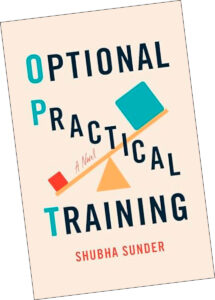
Shubha Sunder is back in this column with her debut novel, Optional Practical Training, after she appeared with her first book, Boomtown Girl, a collection of short stories (Rotary News, March 2024). If the title sounds like a self-help manual, nothing could be further from that impression. OPT, as it’s called, refers to a year of temporary employment in the US that international students can apply for after they complete their degree. In an online interview with Sarah Anjum Bari for Electric Lit, Shubha says “…this is an immigrant story but it’s not so much an immigrant telling her story, as it is a story of America being reflected in the things Americans tell this young woman. She’s very young … and the things that people say to her are really going to form her sense of identity in this new context. And they also reflect back on who America is.” In this novel-in-voices, as the interviewer calls it, the protagonist Pavitra, regularly faces “microaggressions, cultural stereotyping and misunderstandings” throughout the time she spends the year teaching in a school in Boston.
In fact, Shubha herself comes to the novel with some 25 years of teaching experience and this informs the characters she presents, many of whom are teachers, and their teaching methods. Unlike the situation in India, she points out that in the US “Education is an entitlement that society provides with the view of turning out an educated citizenry, someone says that in the book too. I think a lot about how these two things are at odds. And I think this makes teachers quite stressed out.”
In the novel, Pavitra observes that “…what made Olga such a good teacher was not so much her efficiency but her charisma, her brand — how unique it was to her and therefore alluring to others. Marissa had made me realize that one’s teaching self is a character one slips into — and the more the character is an extension of one’s personality, the more natural the performance.” Pavitra justifies this by saying “You get up in front of an audience, often a hostile one…” adding that she finds that the character she “…performed — a character not of my choosing but the result of my efforts to simply do my job — was one my audience seemed reluctant to accept.”
Taut, lucid, unambiguous, resonant — these words aptly describe this neat, well-constructed novel that traverses a whole year in the protagonist’s life, ending when her visa expires, and then… What?
The columnist is a children’s writer and senior journalist