


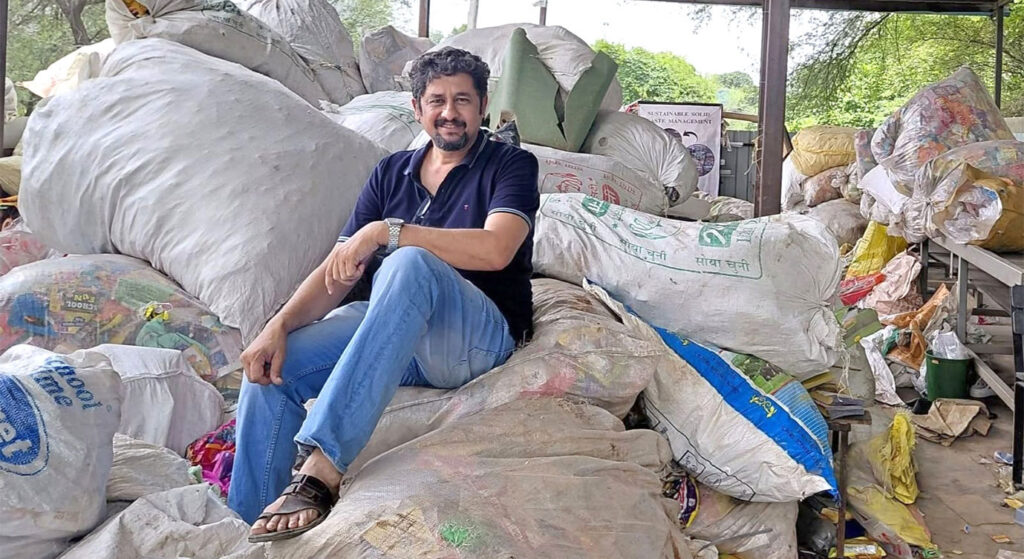
There is a sense of urgency and enthusiasm in his voice when you ask Suneet Dabke, a waste management expert, about the project his club, RC Baroda Greens, RID 3060, and his Kachre se Azadi Foundation are carrying out in Asoj, a village 30km from Vadodara, Gujarat.
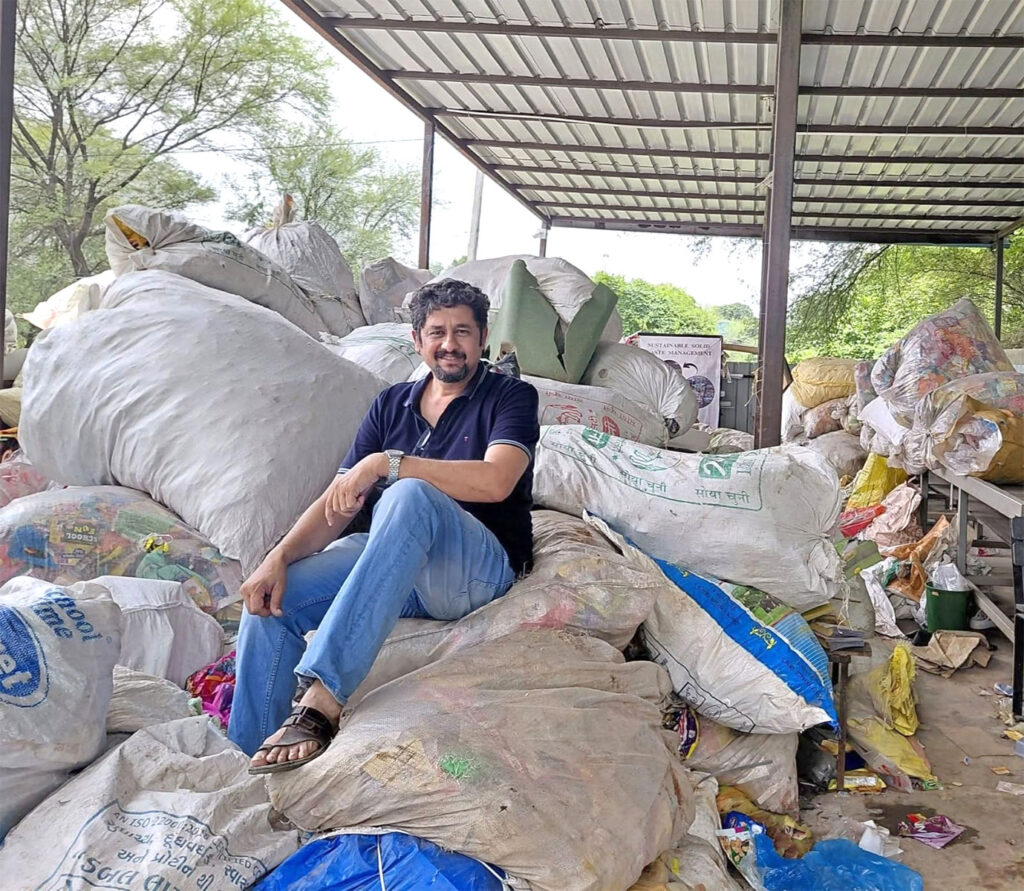
Dabke, who holds a doctorate in Waste Management and has worked with the government, found that policies for environmental conservation were neither strict nor comprehensive, “a gap that made community-led initiatives all the more vital.” His foundation works to “liberate villages from the burden of unmanaged waste by promoting segregation, recycling and sustainable community practices.”
“This is more than a project to preserve the pristine soil of our villages and keep their environment healthy,” he says. Urban cities are deeply dependent on villages for agriculture. “In recent times, people have even begun migrating back to villages, seeking a simple lifestyle and peace of mind. In cities, we have small green patches in the form of parks, but the very character of a village is green. The air quality is great and the food is fresh. We have a responsibility to preserve this pristine environment. Villages are the soul of our cities,” he says.
Plastic waste (shampoo sachets, chips and biscuit wrappers, PET bottles) has steadily crept into rural spaces. “Waste is a leading cause of greenhouse gas emissions, and while urban waste management struggles to cope, most villages have no system in place. People simply dump garbage in their backyards, creating piles that have multiplied over the years. The plastic piles near their homes occupy the surroundings like an uninvited guest, creeping into every corner of the village. What began as a few discarded bags and wrappers soon became a stubborn problem that no one knew how to solve,” says Dabke.
Determined to address this, he launched a pilot waste management project in Manjusar village in 2014 under Swachh Bharat Abhiyan, with support from Banswara Syntex. The pilot began with door-to-door waste collection, simple waste segregation at home, and composting, creating a low-cost, community-friendly model that others could follow.
In 2016, he set up his Kachre se Azadi Foundation to scale-up this approach. The model expanded, through partnerships, to villages such as Dumad, Sakariya, Narmadpura, and Gulabpura. In 2019, an incentive-based programme in Dumad by L&T Technology Services to promote wet and dry waste segregation, with ongoing support from ESRAG (Environment Sustainabilty Rotary Action Group) of RID 3060 to strengthen sustainable practices, and efforts by Indian Oil Corporation at its Gujarat Refinery to address residual oily sludge and polymer waste disposal, led to the village being recognised as Gujarat’s number one village in waste management.
RC Baroda Greens also joined as an awareness partner, organising campaigns in schools, setting up village stalls, and engaging residents directly in conversations on waste segregation. CSR support from companies such as Polycab, NISOL and Apollo Tyres further extended its scale. To sustain operations, his foundation invested in a ₹34 lakh e-vehicle for waste collection, “ensuring the system was as future-ready as it was community-driven,” he says.
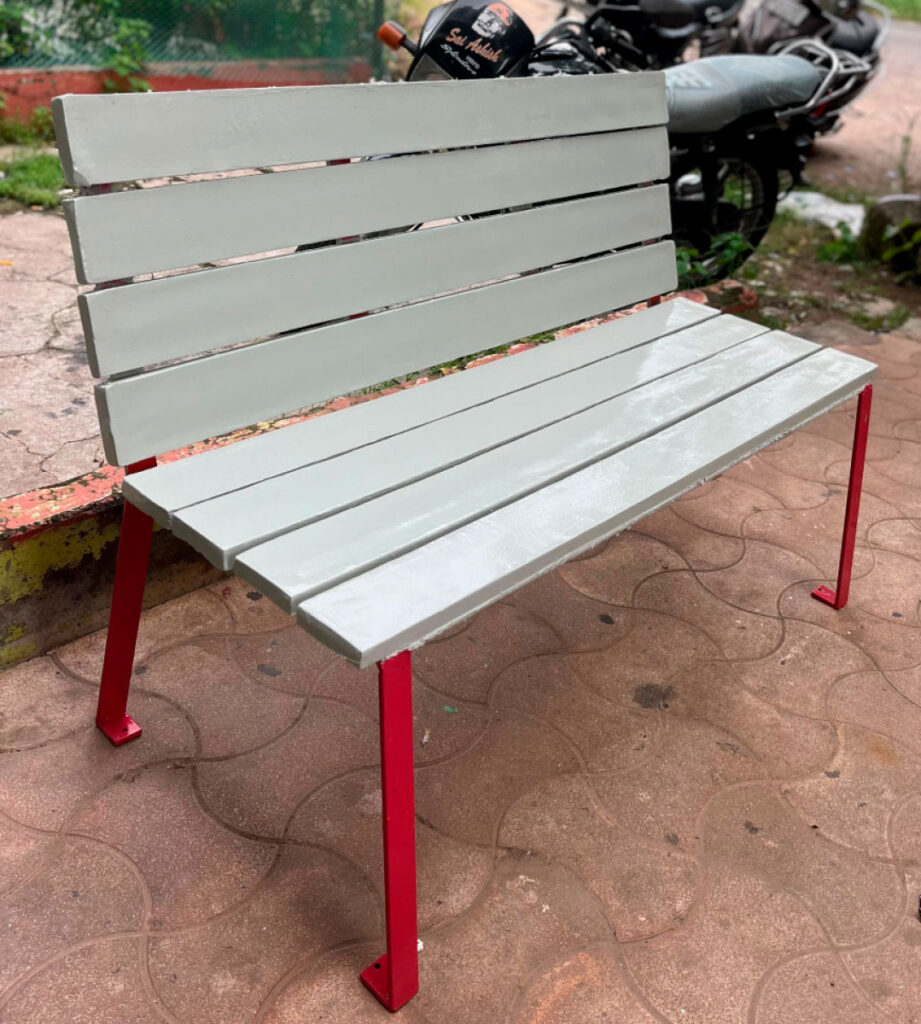
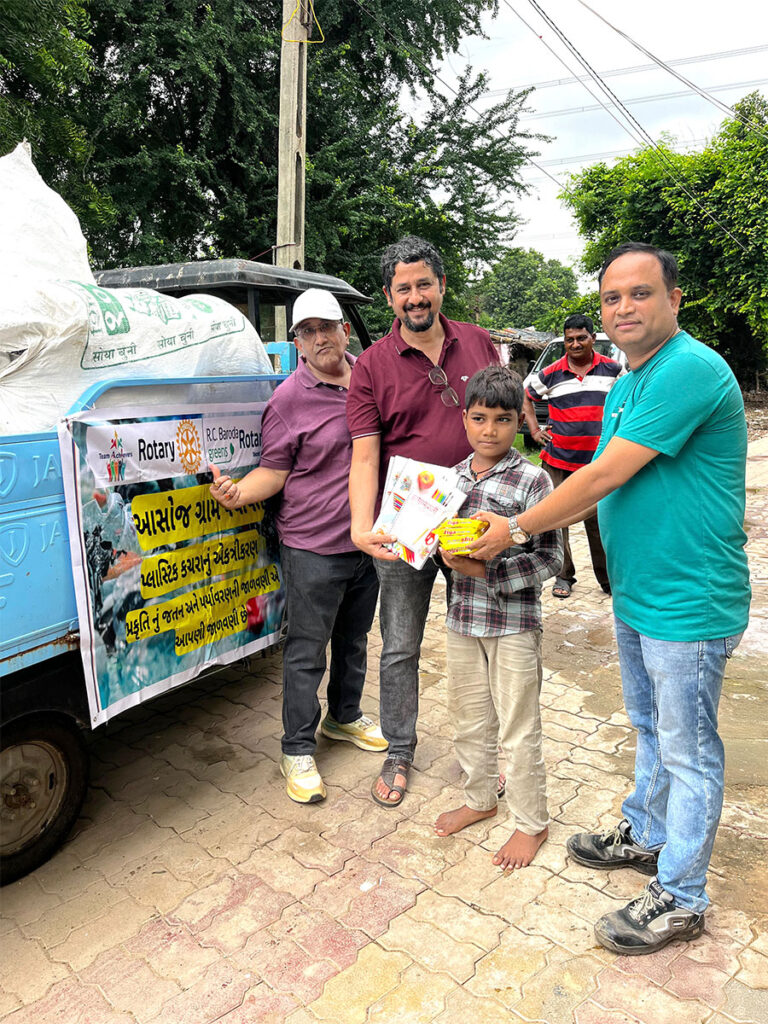
This model was applied in Asoj last year in partnership with his club. Villagers were encouraged to exchange their segregated plastic waste for soap, detergent and notebooks. Every 500kg of the collected plastic was then transformed into benches and chairs, which were donated back to the gram panchayat for schools and community spaces. Asoj is now plastic-free. The club is also extending this initiative to Kunpad village.
“Villagers are now partners in shaping waste-free communities,” says Dabke, adding how practices such as traditional composting, local repair solutions and incentive-driven segregation keep the model practical and scalable. His ability to adapt solutions locally even won him a Fullbright Scholarship to the North Carolina State University in 2010, where his thesis explored bioconversion of industrial sludge into non-toxic manure using vermi-technology.
His Rotary journey started in 2014, when RC Baroda Sayajinagari sponsored him for a VTT programme in the Netherlands, which eventually drew him to become a member of the club. He later joined RC Baroda Greens for its environment-focused initiatives. “Our club’s projects go beyond just planting trees. Planting saplings is only the first step, but real sustainability depends on their survival and the community’s involvement. If the trees are left uncared for, or if the fallen leaves are burnt, we lose the very purpose of planting them, as burning releases methane and carbon dioxide. Instead, those leaves can be used for compost or mulching, which enriches the soil. Don’t plant and forget; include people to care for the trees and make sure the cycle is complete.”
Pointing to global studies and the Netflix documentary Carbon, he stresses that soil health is directly tied to climate resilience and food security.
“Start with your own home. Segregate your waste before disposing. When we do that, we stop treating everything as garbage. Food scraps become compost, recyclables turn into new products, and only a small fraction goes to the dump. It is the easiest step an ordinary household can take to keep our city cleaner, greener and healthier,” he insists. The club has even encouraged its members to practice this with a quirky incentive of a plate of free pani puri at specific stalls. “Who wouldn’t want free pani puri in Baroda?” he smiles.
At the Lead25 Conclave in Chennai this August, the club showcased its project, drawing strong footfall and sparking genuine interest, “a promising start for a cause that turns waste into worth.”