


The years I spent in Interact and Rotaract taught me that service is beyond projects. It is about opening your heart and standing up for those who need it most,” said Sujith Kumar, founder of Maatram Foundation, at the Lead25 Conclave. Those formative experiences, he said, laid the foundation for a life devoted to education and empowerment, especially for girls.
Alongside service, those years also honed his public-speaking skills, for which he credited PDG C S Ramachandran (then RID 3230). This gift eventually carried him to classrooms and auditoriums, where he spoke on career guidance, often without charging a fee. On one such occasion in Madurai in 2013, he met Malar, the girl who changed his destiny. She stood outside the hall, hesitant to enter. Kumar went out to meet her, and her story moved him deeply. “That day I told myself, with the money I earn, I can sponsor one child’s education. But then another question struck me: what about hundreds of other children like her?”
That question became the spark for Maatram Foundation. He requested a college chairman to give him one seat, but was surprised to get 20 free seats every year. What started as a small gesture soon expanded into a movement.
Today, the foundation supports over 4,000 students across 52 institutions in Tamil Nadu, Andhra Pradesh and Bengaluru. Among the first was Malar, now an Amazon employee in San Francisco, who has built a home for her family and educated her siblings. Some alumni now sit on the foundation’s board; others have started NGOs. “That’s the true cycle of giving back,” he said with quiet pride.
The foundation prioritises orphans, children of single parents, transgender students and differently-abled youngsters. His journey, he said, was powered “not by wealth but by willpower. People often say, I’ll learn, then earn, and after retirement, I’ll return what I can. But Rotary taught me something different… you don’t need to wait until 60. You can start giving back at 25.”
He traced this philosophy to his first project as Interact president in Class 9. Initially, his club did little beyond tea and samosas. That changed when a Rotarian nudged him to take up community service. Inspired by the Kanchi Sankaracharya’s Pidiyarisi Thittam (a handful of rice movement), he and his team went door-to-door asking for rice. People responded generously giving much more, and they collected 232 bags.
Not knowing where to donate, they turned to their Rotary sponsor, who led them to a leprosy sanatorium. “For a Class 9 boy, the sight of bandaged limbs and disfigured faces was too much. I left early,” he said. Weeks later, a leprosy patient recognised him at a traffic signal and told his father, “Because of your son and his friends, we now eat three meals a day.” That blessing, “left a huge dent on my heart. It was the moment I understood the power of service,” Kumar said.
Today, Maatram champions not only girls’ education but also the rights of the marginalised. He cited India’s first transgender nursing student, who fought a seven-year legal battle up to the Supreme Court to secure the right for transgenders to study nursing. Her victory mandated every nursing college to reserve a seat for a transgender student. Now pursuing her Master’s, “she embodies the sheer power of education to change destinies.”
Kumar urged the audience to see education as one of the most powerful forms of service. “Planting a tree is important, it will outlive us. But if you educate a child, you transform an entire family. Education has no gender or boundaries. Talent has no gender either. When you give the most deserving access to quality education, miracles happen.”
Service, inclusivity and the future of Rotary…
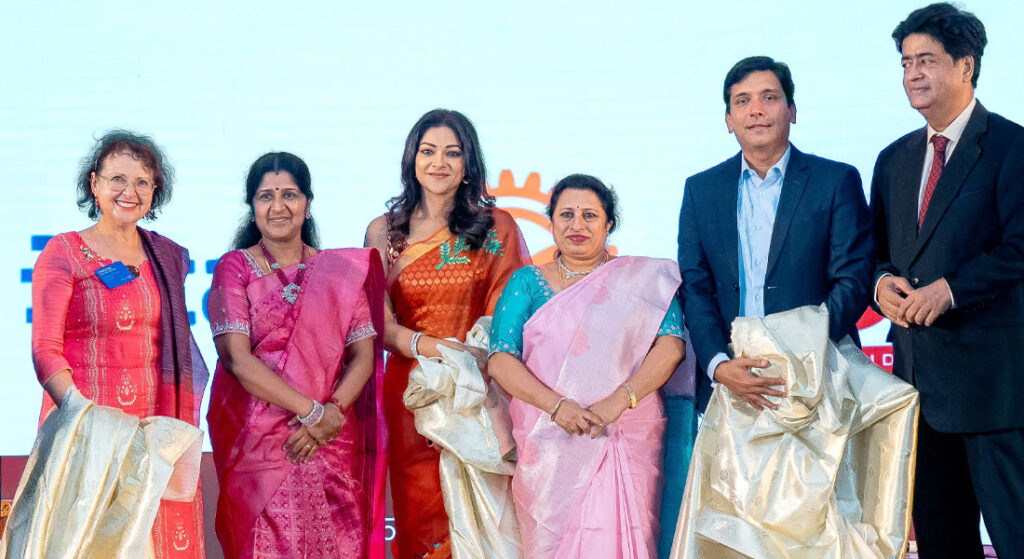
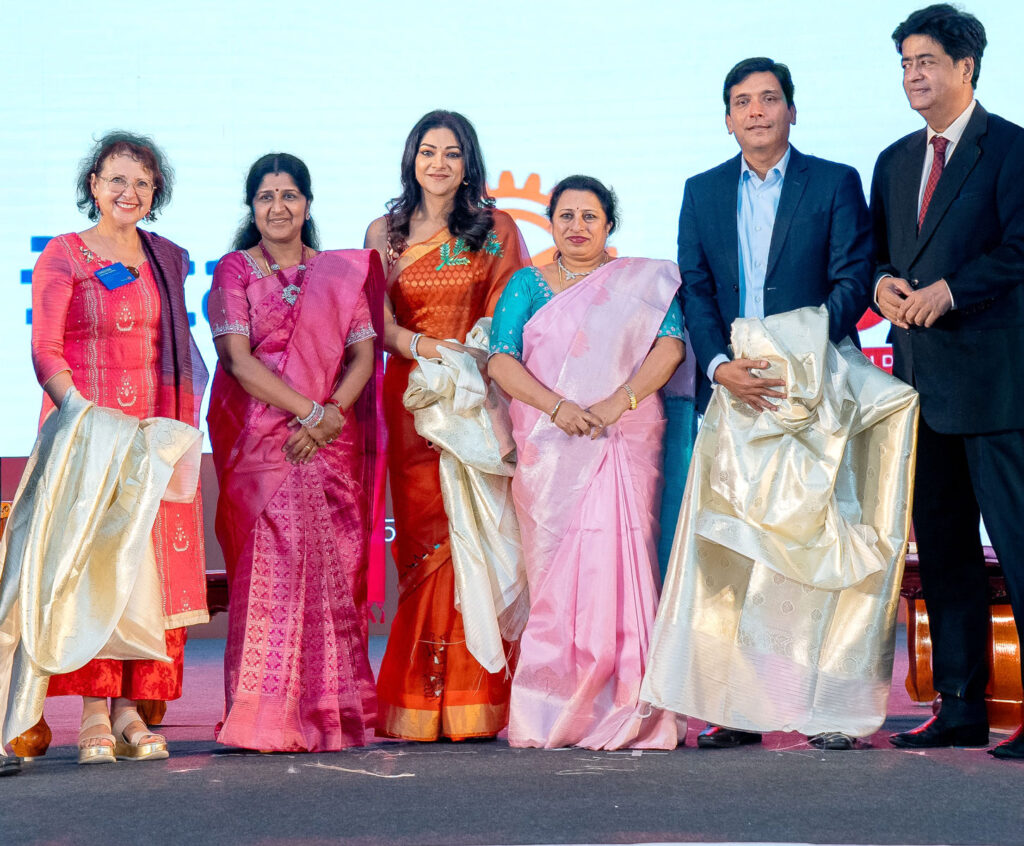
PRID A S Venkatesh engaged Sujith Kumar, Christine Buering, the first woman RI director from Germany, and film artiste Abhirami in a Q&A session.
“If I start serving my community, won’t I deplete my own resources? How do I balance service with securing my future?” asked Venkatesh. Kumar, who is associate VP, HR, at the tech giant Infosys, replied: “Work and service are two distinct identities. If I confuse them, I’ll fail in both.” He referred to the “four-burner theory,” where career, family, health and service all draw from the same gas cylinder. “Sometimes your cup is empty. You can’t be an eternal giver. That’s when you need to say no, and focus on what truly matters.”
Asked to define happiness, he said: “Seeing my children succeed.” By “children,” he meant the 4,000 students supported by his foundation — 99 per cent first-generation graduates, 80 per cent girls, nearly a thousand orphans. He shared stories that tugged at the heartstrings: one girl dreamed only of a cupboard of her own; another rejoiced at ordering food without checking prices. Many now work at Infosys, while their parents still serve as housekeeping or security staff. “If you can help someone move from one stage of life to another, that is happiness.”
On whether his model could be scaled up, he explained that donor-dependent model collapse in crises like Covid. Instead, he preferred long-term partnerships with institutions that provide fully sponsored seats. “It’s zero cost, and scalable,” he said.
The early years were full of lessons. “When hostels closed, where would orphans go? For long, the third bedroom in my house was theirs. Now we run hostels.” Today, the foundation has documented every process, creating a “plug-and-play” model that other NGOs are adopting. He is mentoring NGOs in Dehradun who want to replicate this model.
The conversation turned to inclusivity in Rotary — how to welcome people of different identities. Christine said, “Look at the person, not the gender. Gender is private. What counts is the individual’s value.” She urged clubs to “integrate people as equals. Nobody wants to be showcased. They all want to belong.”
On gender parity, she noted Germany still has only 14 per cent women in Rotary. Post-war West Germany expected women to return to homemaking, while East Germany created childcare systems that let women pursue careers. “Society changes when family care changes. That, to me, is equality.”
Where does she see Rotary ten years from now? “In a world where people have unlearned to communicate, Rotary still brings people together. We can be the ferment for a new society — diverse, creative, respectful. What makes Rotary special is its human connection. When 10,000 people still choose to meet in person, when they could just have a Zoom call, that’s our strength.”
Abhirami spoke about how she planned her career and the challenges she faced. Her goal, she said, “is to grow through each experience while staying true to herself, and to inspire others by showing that success comes as much from resilience and faith as from planning.”