





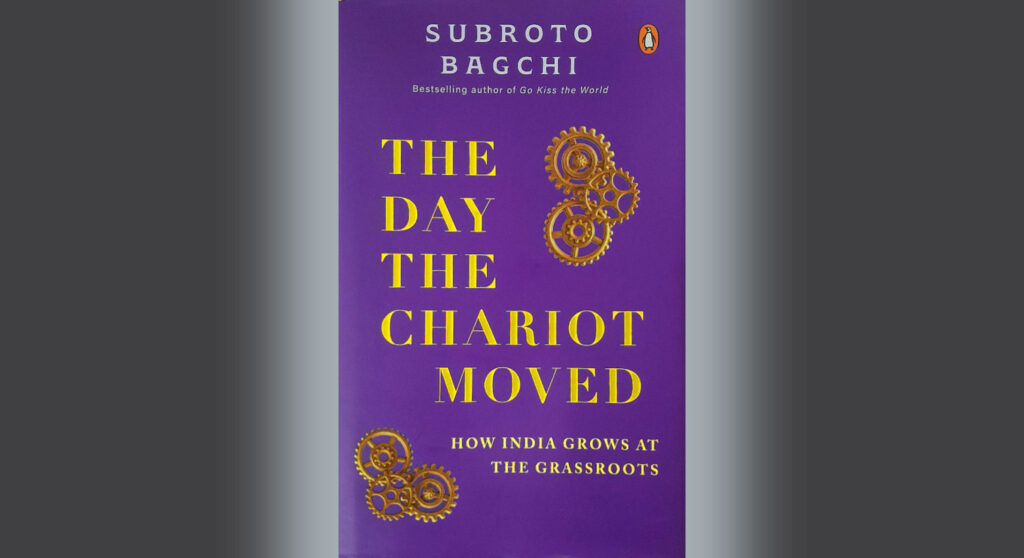
Accounts of how tardily various governments run programmes in education, healthcare etc abound. Hence it is like a breath of fresh air to read Subroto Bagchi’s account of how he undertook the challenge of skilling Odisha in 2016 at the invitation of the then chief minister Naveen Patnaik.
Always a good storyteller, he packs his latest book The day the chariot moved with interesting anecdotes of how he set about skilling Odisha’s young using the existing ITIs and other government and private training and vocational educational institutions.
In April 2016, after stepping down from Mindtree as executive chairman, and anticipating a life of retirement filled with reading, teaching, travelling, and spending time with his family, he got a call from Bhubaneswar. CM Patnaik was on the line with a simple request: “Come and help us with skill development for our youth.” On offer was a post as chair of the Odisha Skills Development Authority, complete freedom and rank of a cabinet minister, reporting directly to the CM.
Exhaustive reading and startling numbers on India’s skills gap “took me beyond the bubble of the IT industry to a world of millions of young people in India who fell off the traditional educational system for whatever reason and could not get skilled in any vocation but desperately needed employment. These were the people who became welders, mechanics, plumbers, electricians, cab drivers, security guards, sales associates in malls, janitors at airports and bedside attendants in hospitals.” He found there was a huge gap between demand and supply of trained hands; here was an opportunity to create these skilled hands, and make a difference.
Wife Susmita gave the green light saying take this chance to do something for your place of birth. Infosys cofounder Nandan Nilekani advised he should accept but with the condition of “assured and visible” access to the CM at all time. He had done the same when Manmohan Singh as Prime Minister invited him to set up the UIDAI. Also, Nilekani asked him not to create new infrastructure; “you’ll be surprised how much infrastructure a government already has.”
Bagchi took up Patnaik’s offer, seeking only an annual salary of ₹1 against the normal ₹20 lakh for a minister. The transition from a four-decade corporate life to one in government began with an exhaustive 30-day, 3,000km tour across 30 districts. Odisha has a few hundred ITIs and polytechnics, he tells us, and an equal number of short-term skill development centres in government and private sectors.
The passages on his endeavour to “humanise the skill development narrative”, his initial struggle in transition from decades in the private sector to a government setting and get a sense of his mission; what was already existing on the skill development roadmap of Odisha and what he needed to do to expand it exponentially, are both humorous and insightful. When during his first exhaustive drive through the ITI landscape of Odisha in blistering summer heat, the principals eagerly spelt out the acres of land on which the ITIs stood, the lathe machines they owned, and the vacant positions of “clerks and peons” that he should fill, he clearly spelt out his needs. The names of 10 past successful students, four of them girls, their socioeconomic and present status. Of these ten, he wanted six names of those who had made a mark outside Odisha, and two who had set up their own enterprises.
“Numbers have magic. They simplify things by cutting to the chase. You can bullshit me for hours with narratives, but numbers seldom lie. The job of a leader is to simplify things so that people can rise above the bullshit, the clutter and the maze. It makes it easier for them to comprehend the leader’s strategic intent. Numbers are easy to remember, which is critical because people follow a leader only when they can remember what she wants and finally numbers create clarity on the next steps in any endeavour.”
Having four names of girls is important, they can be showcased to nearby high schools in a bid to improve female enrolment. The examples of two micro-entrepreneurs can be used to multiply that number. If we “put people at the centre of everything… when we put a name and a face to the work we do, suddenly everything becomes aspirational, uplifting and worthwhile, work finds purpose,” says the author.
An interesting anecdote in the book is about Muni Tigga, who had trained at the ITI Bargarh and was working as a loco pilot in the Indian Railways. When he wanted to talk to her, he “realised the power of the government. If the government wants, it can track down any individual under 10 minutes, even in a country of 1.4 billion people. It takes just 4–5 phone calls to the district administration and local police. Muni Tigga was on the phone with me in less than 10 minutes.”
“She had no clue who I was except that I was some big guy visiting her old ITI and was at quite a loss that her Alma Mater was suddenly getting in touch.” She told him in Hindi that she worked at the Main Bhubaneswar Station and her task was to drag (kheench) the Intercity Express from Khorda to Palasa and back.
Muni became his star among stars and an icon for the state. “She was the lens through which I began understanding the difference between skill development and human transformation. Six sisters, one brother, small piece of land, few cows and goats were part of her universe. As a girl she was not required to go to school, but she did. Whenever she had to take the animals to graze, she carried her books with her. She was ready to go to high school, but the village was not ready for a girl to do so and that too far away from the village. She needed to get up early in the morning, cycle down a dirt road, and by the time she came back, it was dark, the villages haunted her.”
But her mother encouraged her and she passed high school; the father said she was on her own now. She ended up at an ITI where she dreamt of being a locomotive pilot. After training, she cracked the competitive entrance exam of the Indian Railways and got the job. “You could not imagine her hauling a locomotive engine and running an eight-hour shift up and down every day in a good weather and bad. To put things in perspective, the most abiding image of machismo in our society is a Bullet motorcycle engine which generates between 20 and 47HP.” In contrast Muni dealt with a loco with a 6,125HP engine whose top speed can hit 140km to 160km an hour. “Two years at the ITI had not only given money and employable skills, they had given her an identity that no one could ever take away. A girl skilled is power delivered to the universe.”
Anecdotes fill Bagchi’s narrative, making it an engaging and easy read. He hit the ground to find out all about the demand for sewing machine operators from Haryana to Tirupur; he was told women trained in stitching leather in Odisha were employed in shoe factories in Haryana. He visited one only to find them working as glorified rubber slipper makers, living in abominable conditions with no potable water.
Two years at the ITI had not only given money and employable skills. They had given her an identity that no one could ever take away. A girl skilled is power delivered to the universe.
He found that the textile industry in Tirupur is mainly powered by Odia workers, who work here to pay for the treatment of a sick parent, run their homes in Odisha, and to save for their own marriage. A harsh truth: “At the bottom of the pyramid, a girl cannot stay unmarried for a long time. It is neither acceptable nor safe.” A couple of years in Tirupur and she could save up to ₹1 lakh to pay for her wedding… “but only if the money survives her father’s drinking, mother’s sickness, brother’s demand for a new mobile phone or two-wheeler, or investment in a scam chit fund promising to double her money.”
Bagchi also met Basanti Pradhan, a village girl and daughter of a goatherd and third in a family of seven daughters. From an entry-level sewing machine operator, she became a line supervisor. She gave him a lecture on how to go up the success chain, pausing briefly once to ask him if he understood what input and output were, as she explained the supply chain logistics to him!
Another inspiring story is of Sumati Nayak who he met at Westside in Bengaluru; the general manager of the store said one day she will take my job. Same story, small village, 10th-fail, training at one of the skilling centres selected by Trent. Initially she could speak only Odia and a little Hindi but was now fluent in both English and Kannada. Eventually she was transferred to a new store in Coimbatore. Her new name tag read: Department manager.
Wanting his position to be non-political and non-partisan, he met the leader of Opposition to brief him about his first exhaustive tour and findings. The sceptical man said this was “too little too late. What will you be able to do when the education system itself is broken? When a Class 5 kid cannot write and Class 9 student can’t do simple arithmetic meant for Class 5. What skill development can be done when these kids do not even go to school?” After listening quietly to this lecture, Bagchi said, whether the kid knew or not how to read and write, “that kid is a reality. It does not matter whose fault it is. From now on, that kid is my kid.”
There are several bitter pills to swallow in this book, which often tugs at your heartstrings. Spelling out the reasons for dismissing many underprivileged children who do not shine in schools as “not intelligent or smart,” Bagchi says a crucial reason is a poorly developed brain due to malnutrition in early childhood. Two clear indications of malnutrition are stunting and wasting — which cause poor height and low weight. “Both severely impact brain development… and the child can’t pay attention and follow instructions, remember things, build language proficiency through reading and writing, do math and develop logical thinking, and finally as a teen, is not able to judge a situation and make the right decisions on what is good or harmful.”
Such children don’t do well in school, drop out, never to go back. According to the 2024 Global Hunger Index, 35.5 per cent of Indian children are stunted and 18.7 per cent are wasted. Among 127 countries on this index we are all the way down at 105. Where do these children study? Government schools of course!
During his eight-year stint in government, Bagchi fought the social system which has scant respect for the skilled worker, translating into low self-esteem and closing doors for them further. Read the book for an understanding of unicorns — companies valued at $1 billion and more — and nano unicorns; while the former are cutting jobs, the latter create more jobs.
Post the May 2024 elections and change in government when Bagchi left, he is happy that the new government “has taken forward many things we co-created.” Such as the World Skill Centre; its nano unicorn programme was embraced and expanded. Also, the ITI as an institution continues to flourish, with 10 of the 100 best in India being in Odisha.