



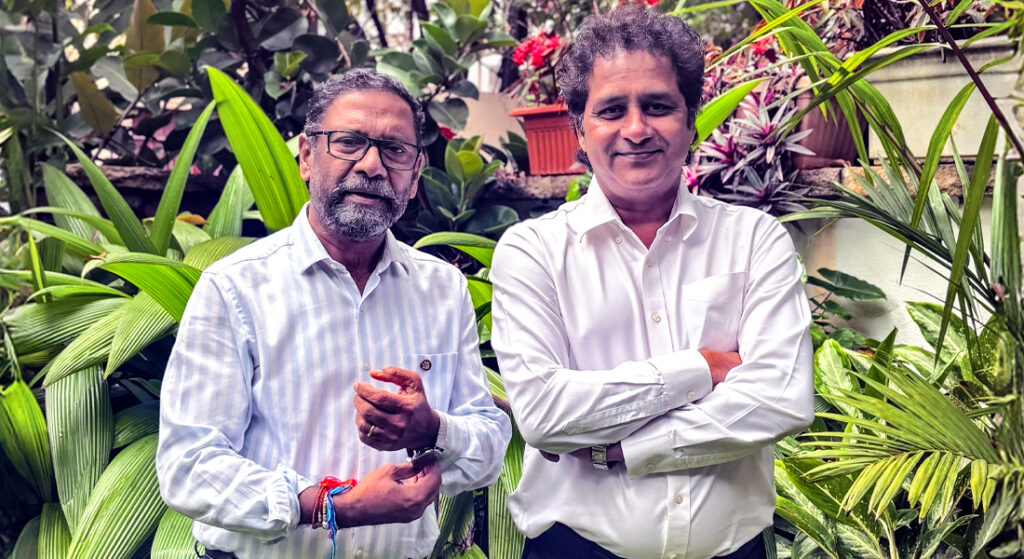
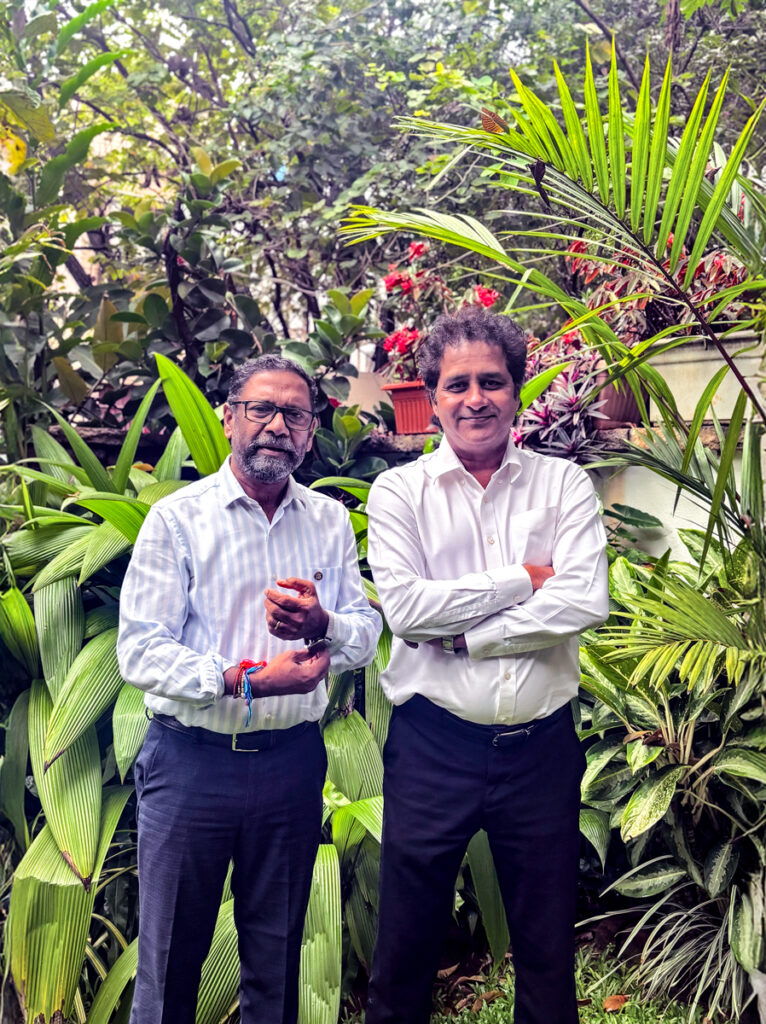
It is his honesty and plain speaking which set apart Ravishankar Dakoju, DG-elect, RI district 3192, from many others in the Rotary world. After getting a number of alerts in my mailbox on projects such as Dakoju Dhanyavad, Rotary Koti Nati, Narahari Dhanyavad, all of them associated with planting of trees in different places and different states, and with one common factor — Dakoju’s involvement, I reach out to him to clear my confusion.
From the other end I get a barrage — expected of course — of salvos on how our generation, through sheer greed and thoughtless indulgence, has caused an environmental disaster and messed up our planet. A good portion of his bumper donation of ₹100 crore to The Rotary Foundation, pledged in 2018, is going towards greening our planet.
The ongoing 1,501-acre afforestation project at Challakere will cost upward of ₹8.5 crore, of which ₹6.5 crore comes from the Paola Ravishankar Dakoju Foundation grants of TRF.
The title Koti Nati translates to planting one crore saplings; so what kind of a transformation has this endeavour brought in the lives of individuals, I ask Dakoju. He says candidly, “You can’t expect magic or life transformation through such a project in just two or three years. We have planted various kinds of trees… fruit trees, and a special kind of bamboo which is used for making agarbattis and which is now being imported from China. One tonne costs around ₹8 lakh. We want the tribal women to benefit through the massive ongoing 1,501-acre afforestation project at Challakere in Chitradurga district, about 195km from Bengaluru. Self-help groups will be formed, and livelihood activities such as beekeeping will be introduced. But for all this to happen the trees, including fruit trees, have to grow… animals have already come in… about 100 deer, as well as peacocks, rabbits, wild boar etc, but the impact on human life and its transformation will take a few more years.”
In the cyanide dumps of the Kolar Gold Fields near Bengaluru, Dakoju, along with the other passionate advocate of environmental protection Neil Michael Joseph, has already carried out a massive greening project, over the last few years. There is palpable benefit here through the improvement of health of the residents. Earlier the cyanide dust being blown across the township was causing havoc by triggering adverse health effects like kidney failure, lung and other types of cancer, acute asthma etc. But through an arduous and exhaustive process the Rotarians of RC Bangalore Orchards, headed by Dakoju (who has since shifted to RC Bangalore) and Joseph, did the Herculean task of planting across 100 acres, trees, bushes and grass to ensure that the moisture is retained by the earth, so the dust from the extremely dry dumps didn’t blow across to the town. “It has now been documented that the incidence of lung cancer has come down and people’s general health has improved,” says Joseph, who hails from KGF.
He adds that under this project started in 2018 — titled Koti Nati — where one crore saplings will be planted across India, 48.2 lakh saplings have already been planted, along with disbursal of three lakh seed balls (the success rate of these is around 25 per cent). In KGF alone, 52,000 trees have been planted.
Let’s now return to Challakere, where many changes are now visible at the 1,501-acre afforestation project. It will cost upward of ₹8.5 crore, of which ₹6.5 crore comes from the Paola Ravishankar Dakoju Foundation grants through TRF. This is now being hailed as one of Rotary’s largest ecological interventions in India. Here around 100,000 trees have already been planted over 720 acres, or nearly half of the total project area. In what was totally a barren land and rain-deficient area, thanks to largescale planting of trees, three lakes in the 1,501-acre plot, which had been bone dry for 40 years, are now overflowing. Wild animals such as deer, wild boar, peacocks and rabbits have returned to this area thanks to the greenery already created. “That to my mind is some magic at least… don’t you agree,” asks Dakoju disarmingly.
To understand this project, he takes us back to the era when the erstwhile Mysore Maharaja had gifted some 18,000 acres of land in Challakere to the local tribals to protect and rear a particular breed of local cows that had helped him in the guerilla-type fighting with the British. “But the tribals being tribals, gradually chopped away all the trees and used the timber for firewood, so the land eventually became totally barren. Subsequently, the government gave away big chunks of land to ISRO, Indian Institute of Science etc. When only 1,501 acres of land was left, Justice Saldanha, a brilliant judge in the Karnataka High Court, asked the government: ‘Who gave you the right to distribute the Maharaja’s land like this? Put a halt to this distribution; if you don’t stop, I’ll give a judgement taking back all the land you’ve so generously given away.’ He came as a true saviour of the environment,” beams Dakoju.
This land was then given to the Karnataka Horticulture Department which gave the mandate for greening the land by planting trees to the local Dheena Bhagath Seva Trust, run by Dheena Bhagat Swamiji, to ensure sustainability and create livelihood for the tribals living in the area. “The Swamiji heard about our project to rejuvenate the Palar river and approached us to work in partnership to convert the barren land into a thriving ecosystem.”
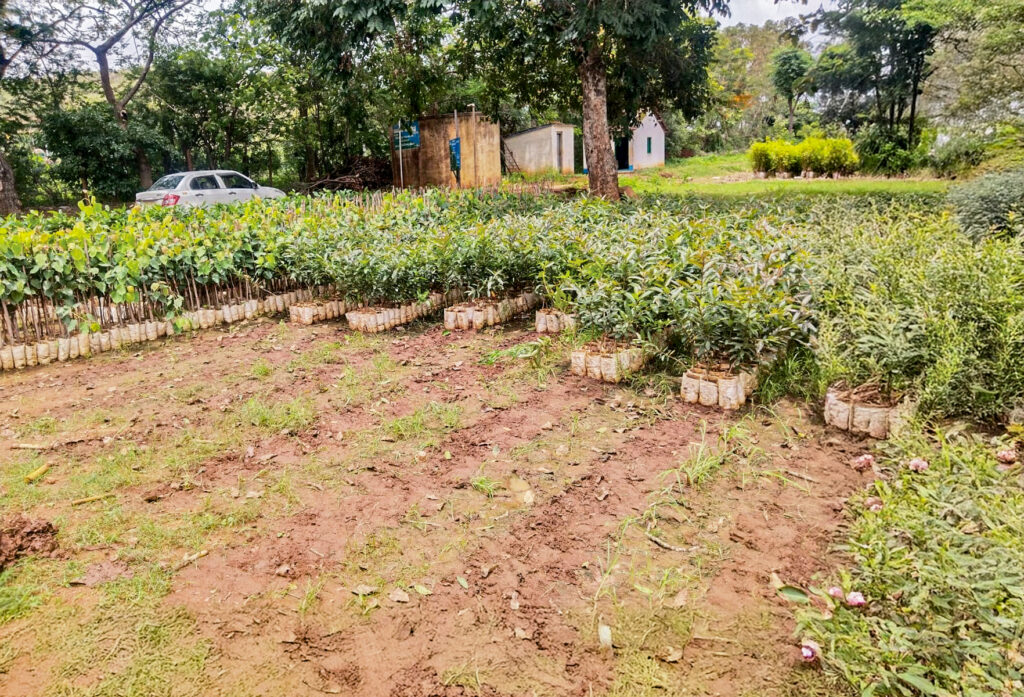
Subsequently an MoU was signed between the Seva Trust (which runs a vidyashram, teaches yoga and makes ayurvedic medicines for the local tribals from medicinal plants and herbs) and the Rotary Environment Foundation (REF) started in 2020 by Dakoju, Joseph (who is one of its trustees and secretary) and RI director K P Nagesh. RC Bangalore Orchards and Joseph’s own organisation Happiness in Transit, which transports schoolchildren, are involved in this greening project.
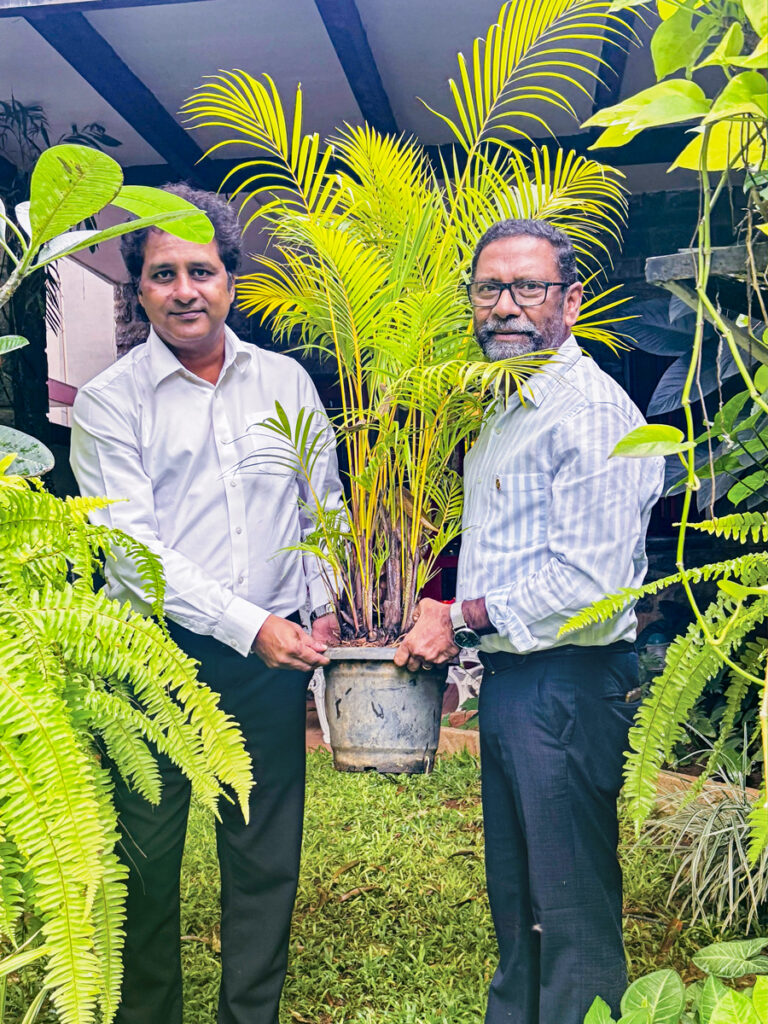
About the one lakh trees already planted over 720 acres, Joseph says these are all native species, fruit trees such as guava, mango, gooseberries, sitaphal and traditional medicinal plants. Part of the project cost came from a GG of ₹1.41 crore that RC Bangalore Orchards did with Dakoju’s TRF contribution, and another ₹1.3 crore from REF, which is a joint contribution from Dakoju and Joseph’s enterprise, “which he has actually started to plough back the profits into causes related to environmental activities,” says Dakoju.
Explaining the dhanyavad (thanks) part of the project, Dakoju, who has always been passionate about greening the areas we inhabit and creating sustainable ecosystems says, “In 2024, a simple yet sincere idea began to sprout in my head… planting trees is not merely an environmental act, but a heartfelt expression of gratitude to mother earth for her countless gifts. As also to the community that nurtures each of us from the moment we are born.”
This idea blossomed into Dakoju Dhanyavad. Working along with him in this greening mission are a bunch of passionate Rotarians. The journey that began with the revival of the cyanide dumps in KGF, where poisoned, mining-ravaged land was brought back to life through sustained afforestation, grew into a thriving partnership that translated into the ambitious venture of Rotary Koti Nati (one crore saplings across India), in a large-scale effort to combat desertification and restore 8,000 rural livelihoods.
“It’s a movement that kept growing; last year the afforestation drive spread to Goa and Maharashtra, and along the way Dakoju’s business partner Narahari joined too. So one component became Narahari Dhanyavad which is also a greening mission, mainly in the spiritual centre of Mantralayam, Kurnool, AP,” adds Joseph.
I actually call him prakriti purush (nature’s child); not everybody can do the kind of initiatives that he is undertaking… only once in a long while, such individuals are born… for a specific purpose.
— Swami Dheena Bhagat on DGE Ravishankar Dakoju
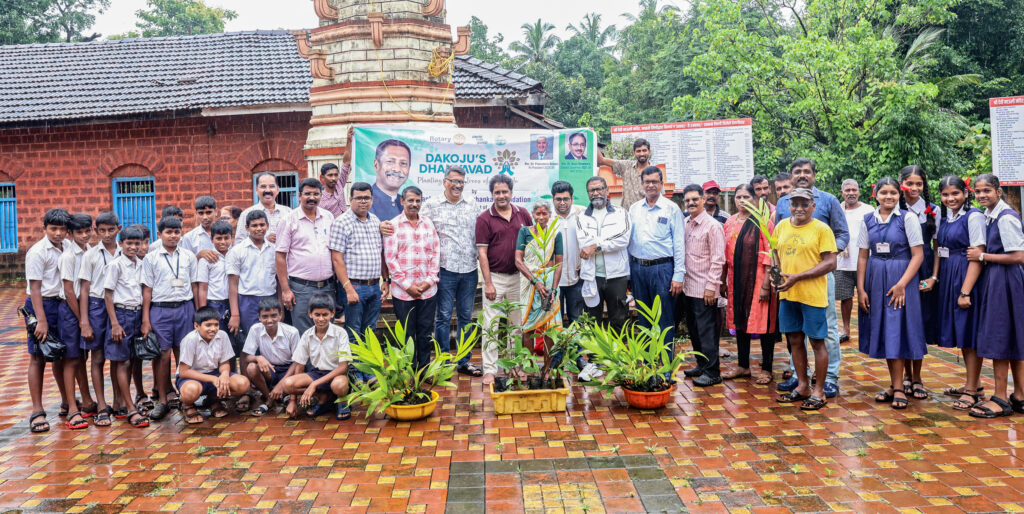
In his quest to green as much of the world as he can, Dakoju has found another fellow environment enthusiast in Gajanan Kandelgaonkar, past president of RC Kudal, who along with his club member Rajan Bobhate, has given roots to the Dakoju Dhanyavad movement in Goa and Maharashtra. In 2024, RCs Kudal and Sawantwadi (both in RID 3170) in Maharashtra planted 11,000 native saplings in remote tribal areas.
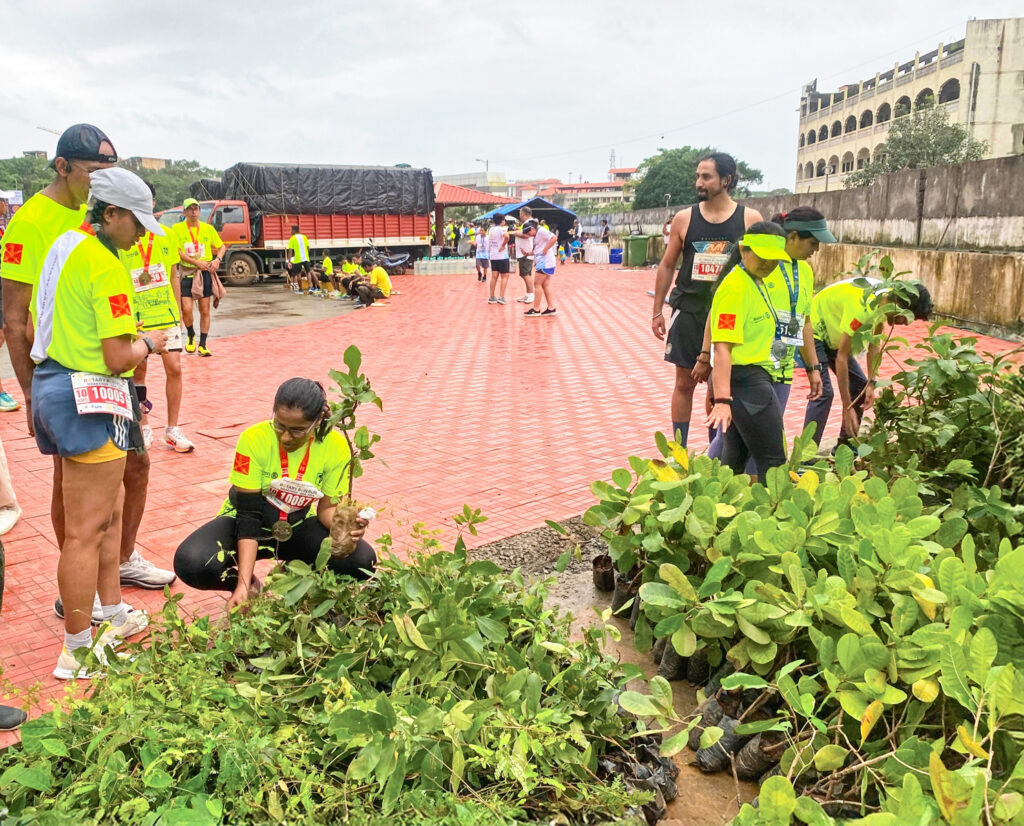
Soon after, the green movement reached Goa, where Rotarians of RCs Panjim and Margao under the leadership of PDG Gaurish Dhond organised a huge community marathon titled Rotary Rain Run, engaging thousands of participants. At this event, 10,000 saplings were distributed to runners, encouraging them to take this green mission forward.
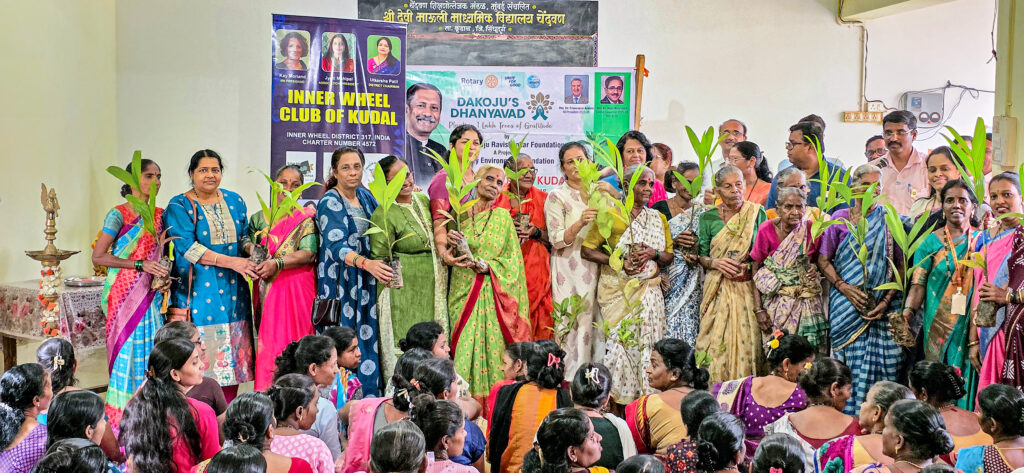
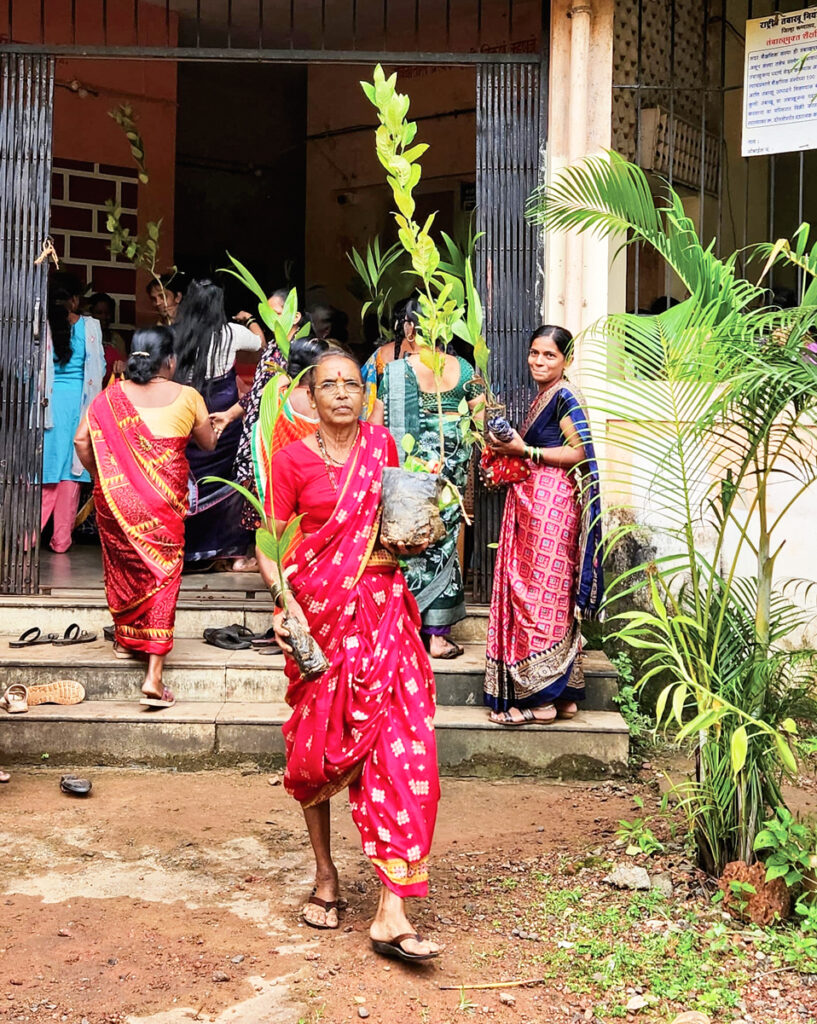
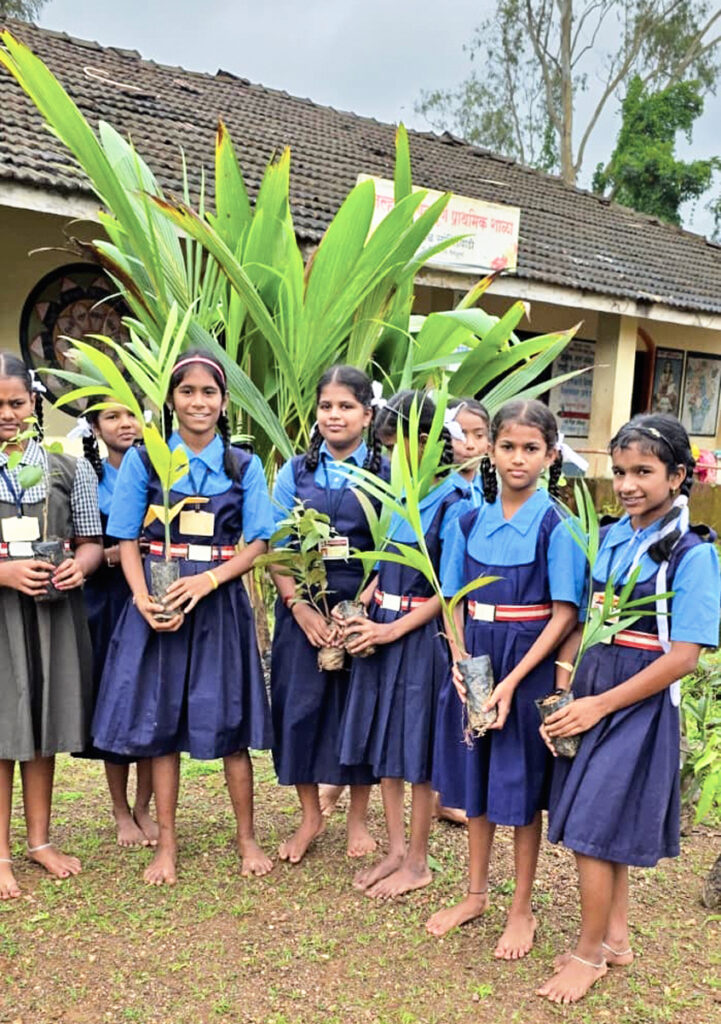
Says Kandelgaonkar, “Of the 11,000 saplings we distributed last year, most were fruit plants, with some spice saplings, and these were given to remote schools where all the students are from farming families. “Nobody knows better than a farmer the value of a fruit tree, and the saplings distributed were of coconut, mango, guava, cashew and spices. This year, we are distributing around 10,000 saplings of fruits and spices directly to the small and marginal farmers in Sindhudurg. Each farmer is getting 3–5 saplings.”
The saplings are reached directly to the farmers with the help of dairy and self-help groups. Asked if women farmers were benefitting too, he smiles and says, “Two days ago, we distributed saplings to 600 farmers and 300 of them were women.” They plant these saplings, each of which costs between ₹100 to ₹200, in their farms extending to an acre or less.
On how he got involved in the movement, he says, “Around five years ago I got introduced to DGE Dakoju, and was impressed by his passion for the environment. He himself comes here often for our events, and participates in the planting. The farmers are very happy because in 4–5 years they will get an income from these trees.”
A group of students from the Sant Rawool Maharaj College, Kudal, has been involved in this movement. “We are planning a plantation drive in the wetlands of Sindhudurg. We will give them saplings which they will plant in wetland areas, tag and monitor the growth of these plants. The idea is to sensitise and involve the younger generation in saving our planet from largescale environmental degradation,” says Kandelgaonkar. The same group of youngsters are also involved in planting trees around temples. “Near some of these temples, the locals have cut down trees and sold the timber to raise money for the temples. We are identifying such places and will plant trees around them.”
RC Kudal, led by its president Rajiv Pawar, assistant governor Sachin Madane, and others, are involved in the sapling distribution project.
In rural Karnataka, 13,000 coconut saplings were given to needy women through two passionate environmentally conscious Rotarians — Akshai Mallapa, RID 3192 district agricultural committee director, and Shivkumar from RID 3191. Around the same time, around 1,000 saplings were given to students in Belgaum (RID 3170) under the leadership of IPDG Sharad Pai. In Maharashtra, another 6,000 saplings, of a total 150,000, have already been distributed.
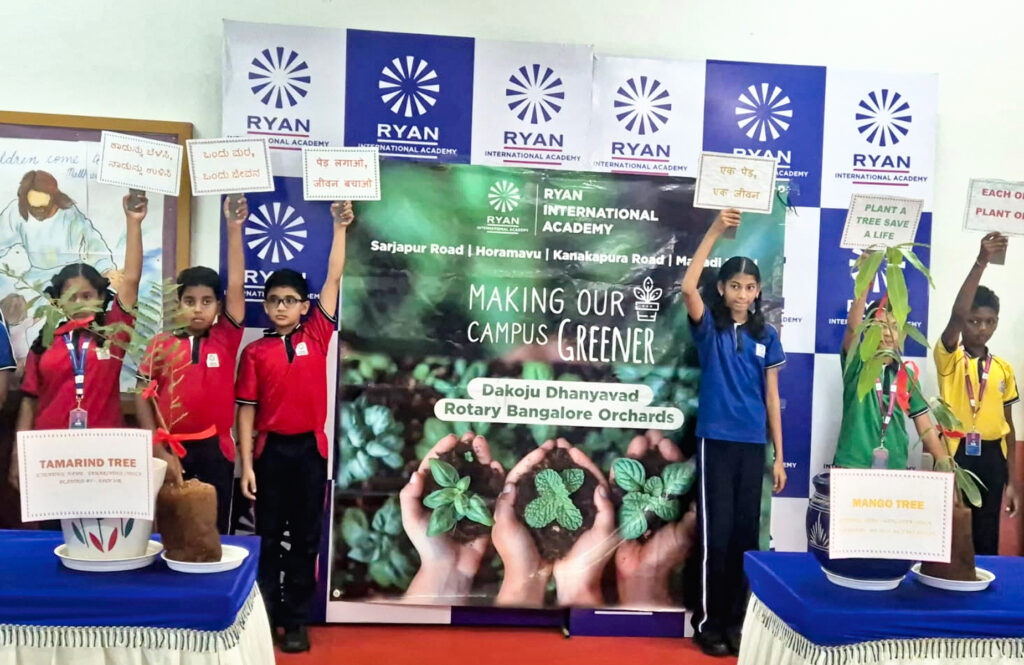
A major milestone of the movement was reached with Ryan International Schools coming on board. “They are present in 22 states with 165 schools, which cater to the middle segment; the annual fees are less than ₹1 lakh. It is a chain of schools which is focused on the environment and since I am in the business of transporting schoolchildren, I came into contact with them,” says Joseph.
The result is a partnership between the CEO Ryan Pinto and vice-president (Business and Operations) John Alex, and RCs Bangalore Orchards, Pune Laxmi Road and Pune Far East. The tree planting mission in the Ryan International Schools has begun with seven schools in Bengaluru and Pune, where 2,400 fruit-bearing trees have already been planted. In the next step, schools in Hyderabad, Mumbai, and more campuses in Bengaluru, will be taken up.
Says Ryan International chairman A F Pinto, “I have always envisioned a world where every child learns to care for the environment, which is why we started the ‘Each One, Plant One’ initiative in Ryan Schools. To celebrate our 50th anniversary in 2026, the Ryan group and Rotary will join hands to plant over 10 lakh saplings across all our schools in India. Our aim is to create responsible young global citizens.”
On July 1, 2026, to commemorate Dakoju’s installation as DG, and to celebrate Ryan School’s golden jubilee, a Guinness World Record will be attempted by planting 50,000 trees in a single day across all 165 Ryan schools in India. “The event will be live-streamed, with thousands of students and Rotarians uniting in this monumental effort. The next goal is even more ambitious: one million saplings over the next year, with the dream that every one of Ryan’s 2.5 lakh students will participate. Isn’t this a beautiful way to thank Mother Nature — not just with words, but with roots,” asks Dakoju.
What about CSR partnership; after all many corporates in India are keen about the ecosystem, I ask him. “Of course, REF is keen to develop such a partnership for CSR funds. But we have to first create a credible record of substantial work already done on the ground. Without an impressive background or record, they will see us with suspicious eyes. So we want to show them what we have already done, and then forge a partnership.”
One MNC, which is “infamous for polluting groundwater has already approached us but we are wary of partnering with a questionable entity,” he adds.
A prakriti purush
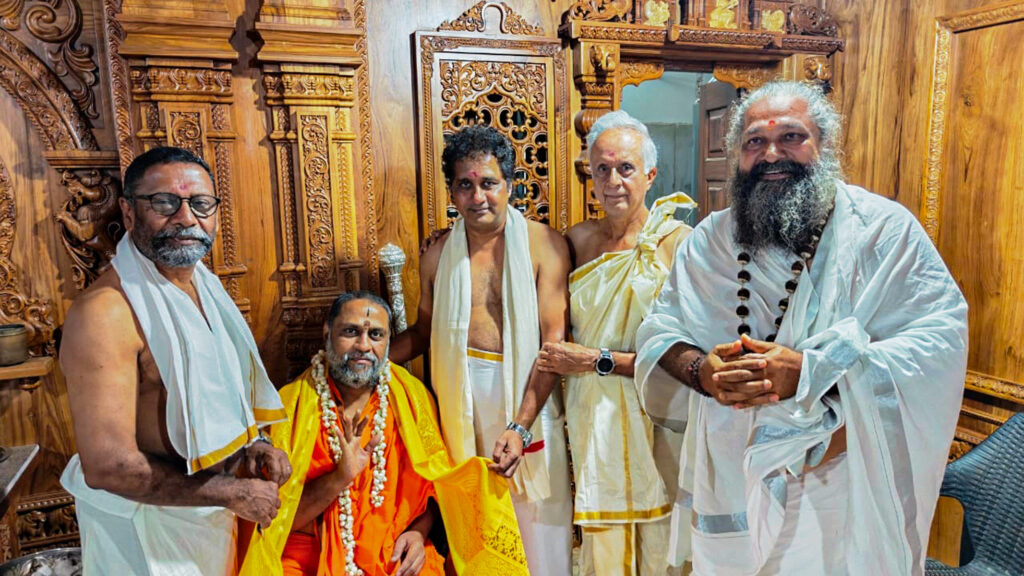
When I ask Swami Dheena Bhagat why he teamed up with DGE Ravishankar Dakoju for the Challakere land, he smiles and says, “I actually call him prakriti purush (nature’s child); not everybody can do the kind of initiatives that he is undertaking… only once in a long while, such individuals are born… for a specific purpose.”
The Swamiji, who has been working with the local tribals for a long time, teaching yoga, making and distributing ayurvedic medicines, says, “As this was barren land and there was no rain, thanks to the total absence of greenery, families with their children were migrating to nearby cities and towns to work as labourers. But in the last two years we have seen good rainfall, thanks to the trees planted by the Rotarians; even last night, there was good rainfall, and all the three lakes, which had remained dry for over 40 years, are brimming with water.”
“So much so the Swamiji’s jeep was stuck in the moisture-laden land near one of those lakes and had to be pulled out with a lot of help,” grins Dakoju. He adds that across the entire area, under this project, a bio-fence equivalent to 30km is being created by digging trenches that are 5–6ft deep so that animals will not get in, and planting of cacti.