





Our bodies are designed to fight disease, whether from a viral or bacterial infection or an injury that causes tissue damage and bleeding. As soon as the body is attacked, its army of white blood cells (WBCs) rushes to the affected area. Some WBCs engulf and destroy invading organisms, while others release protective chemicals that help eliminate viruses and bacteria. The body also activates clotting mechanisms to stem blood loss following tissue damage.
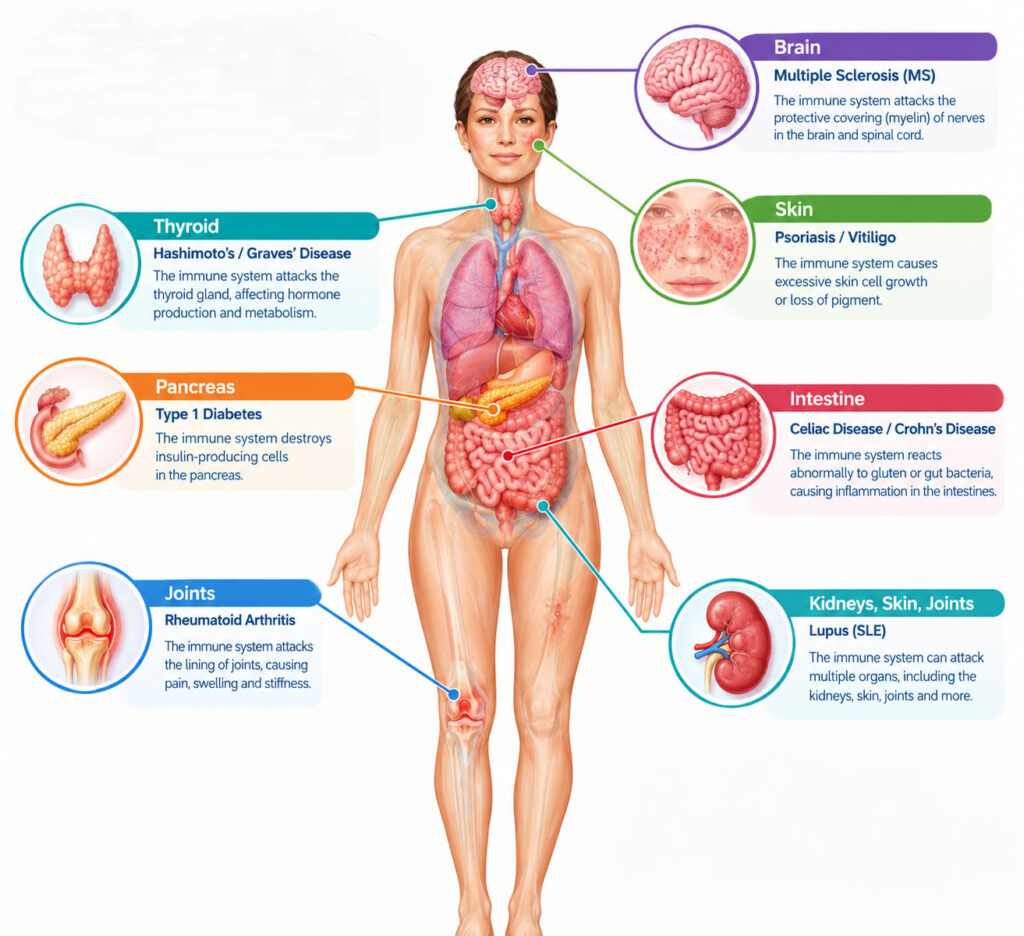
Sometimes, however, the body’s own army can turn against itself, rather like soldiers turning around and attacking their own country, or a football goalkeeper kicking the ball into their own goal. In autoimmune disease, the immune system fails to distinguish adequately between ‘self’ and a foreign invader. It begins to attack the body’s own tissues.
This is not as rare. Autoimmune diseases collectively affect 8 per cent of the population and can occur at any age. More than 100 autoimmune diseases are recognised.
Around 70–80 per cent of people affected by autoimmune diseases are women. The reasons are complex and probably involve genetic, hormonal and environmental factors. Women have two X chromosomes, whereas men generally have one X and one Y chromosome. Differences in X- chromosome activity, along with the effects of hormones such as oestrogen, may partly explain women’s greater susceptibility.
70–80 per cent affected by autoimmune diseases are women. The reasons involve genetic, hormonal and environmental factors, and the two X chromosomes women have.
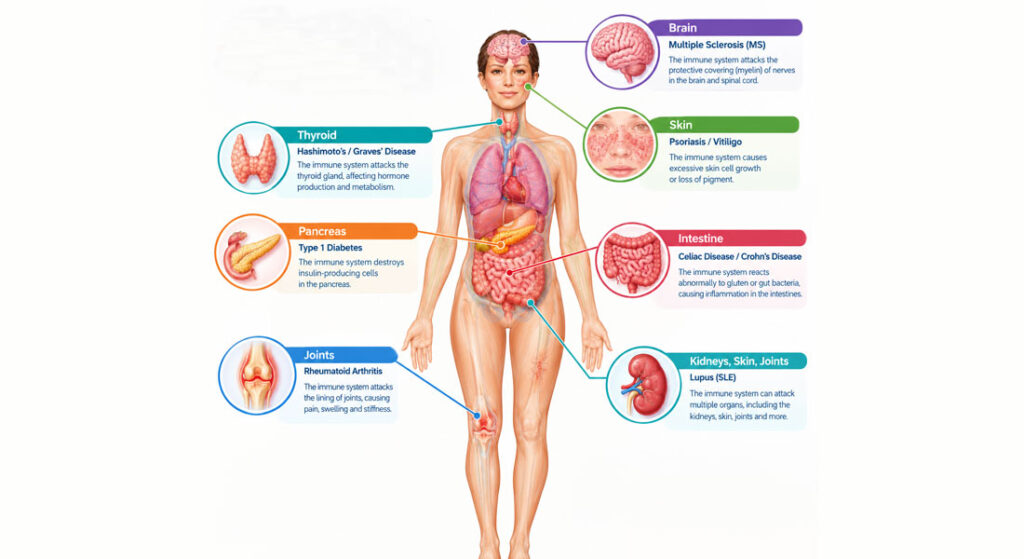
The perceived ‘invader’ may be part of the body’s own skeletal system, nerves and brain, blood vessels, endocrine glands, digestive system or skin. Common autoimmune diseases include rheumatoid arthritis, systemic lupus erythematosus, myositis, psoriasis, dermatomyositis, scleroderma, vasculitis, ulcerative colitis, atrophic gastritis, type 1 diabetes, and Hashimoto’s thyroiditis.
Autoimmune symptoms can vary and be nonspecific, depending on the system the body targets. If the joints are attacked, there may be pain, swelling and stiffness. If the insulin- producing beta cells of the pancreas are destroyed, type 1 diabetes develops. The attacks can also occur in waves, with long or short symptom-free intervals between episodes. This may cause patients to erroneously attribute a flare-up or remission to an unrelated event, such as a dietary indiscretion or the use of herbs and supplements.
A person may feel weak and tired for no obvious reason. At first, there may be no specific signs such as skin changes, muscle weakness, swelling, or pain. This can make the diagnosis difficult and may lead to ‘doctor shopping’ while searching for a diagnosis or permanent cure.
Physiotherapy is important when joints and muscles are affected. It helps maintain mobility, balance, flexibility and muscle strength.
Environmental factors can also influence the risk of autoimmune disease. Living in an urban environment with prolonged exposure to air pollution, diesel fumes, or industrial pollutants may contribute to chronic inflammation. Cigarette smoke is particularly harmful, and passive smoking may also increase exposure to these toxins.
Autoimmune diseases are not usually inherited in a simple manner, where a single gene is directly passed from parent to child. Instead, they may involve a polygenic predisposition, similar to that seen in type 2 diabetes. Having siblings or first-degree relatives with an autoimmune disease does not mean that you will automatically develop one. Even among identical twins, if one develops an autoimmune disease, the other may remain unaffected. A genetically susceptible person often needs an environmental or biological trigger. Infections, particularly some viral infections, may trigger an abnormal immune response.
Obesity may contribute because excess body fat can promote persistent low-grade inflammation. Diet also supports overall health. A balanced diet containing fresh fruits, vegetables, whole grains and adequate protein is preferable to one dominated by highly processed foods, excess sugar and trans fats. However, no single food or special diet can prevent or cure all autoimmune diseases.
Diagnosing an autoimmune disease can be challenging because no single test identifies every condition. Blood tests such as ESR (Erythrocyte Sedimentation Rate) and CRP ( C-Reactive Protein) measure inflammation but do not identify its cause. The ANA (antinuclear antibody) test looks for antibodies that react against components of the body’s own cells. A positive ANA alone does not establish a diagnosis, as positive results can occur even in healthy people.
More specific tests may be required. Rheumatoid factor (RF) and anti-CCP antibodies can help diagnose rheumatoid arthritis, while anti-dsDNA and extractable nuclear antigen (ENA) antibodies may help diagnose lupus and related disorders. X-rays, ultrasound scans or MRI scans may be used to look for joint and tissue damage. Occasionally, a tissue biopsy is necessary to confirm involvement of a particular organ.
Treatment depends on the disease and its severity. Non-steroidal anti- inflammatory drugs (NSAIDs) may relieve pain and inflammation. Corticosteroids such as prednisone can rapidly suppress severe inflammation and are often used during acute flare-ups. Disease-modifying medications such as methotrexate can control abnormal immune activity and prevent progressive tissue damage.
Newer treatments include targeted biological drugs and monoclonal antibodies. These act on specific components of the immune system rather than broadly suppressing the entire immune response. They have transformed the treatment of several autoimmune disorders.
If an autoimmune disease destroys the body’s ability to produce an essential hormone, clinicians must replace it. People with type 1 diabetes require insulin, while those with autoimmune hypothyroidism may require thyroid hormone replacement. In selected severe autoimmune disorders, treatments such as intravenous immunoglobulin (IVIG) or plasma exchange may also be used.
Physiotherapy is important when joints and muscles are affected. It helps maintain mobility, balance, flexibility and muscle strength. Continue the exercises taught by the physiotherapist regularly. Walking, yoga, tai chi and appropriate strength training can also help maintain physical fitness and independence.
Many autoimmune diseases cannot be permanently cured, but they can often be effectively controlled. They may have cycles of flare-ups and remissions, sometimes lasting for years. Early diagnosis, appropriate medication, regular follow-up, a balanced diet, avoiding smoking, adequate sleep, and regular physical activity can help prevent complications and maintain quality of life.
A positive attitude, adherence to treatment and remaining physically active are important cornerstones of successfully living with an autoimmune disease.
The writer is a paediatrician and author of Staying Healthy in Modern India