


Student protests, leaked papers, and police lathis have occupied our mind space in recent days. Leaving aside who is wrong and who is right, let’s examine the core issue at the bottom of this whirlwind sweeping across our country. A single word that sums it all up beautifully is ‘aspiration’! An aspiration that cuts across caste and community, class, religion, rural, urban, and whatever other classification you can think of. Both our young, and their parents, aspire to get the best possible education they can get. To do so, parents, especially from poor backgrounds, are willing to stretch their resources to incredible levels.
In my 45-plus years in journalism, I have travelled across small and big villages across India where families of small and marginal farmers, daily-wage labourers, women in self-help groups, and so on, have proudly said their children go to private schools. They are happily willing to sacrifice a meal a day, or squeeze down their meal to the bare minimum, in order to educate their children in private schools, because both the perception and reality of government schools are not too great. Most of us have heard this adage from our domestic helpers, casual labour we have employed, etc: “Pate kaatke bacchey ko padhaya (we sacrificed our basic needs, including food, to educate our child.)”
I can think of no better example to illustrate the huge importance Indians give to education and high marks, than the famous book The World is Flat, written in 2005 by eminent American political commentator and writer Thomas Friedman. In this book, written during the onset of globalisation, he tells his two daughters: “Girls, when I was growing up, my parents used to say, ‘Tom, finish your dinner — people in China and India are starving.’ My advice to you is: Girls, finish your homework — people in China and India are starving for your jobs.”
The context is that while travelling through Bangalore, Friedman was amazed by the way in which young, educated Indians had embraced technology, to provide a wide array of services, outsourced by developed countries such as his own, the US, at a much lesser price. The book talks about how, in a flattening world, well-educated youngsters in the poor or ‘developing’ countries such as India and China, armed with technological knowledge and expertise, were competing with American youth for well-paying jobs. And technology and digitisation allowed them to do so sitting thousands of miles away, in Bangalore or Beijing.
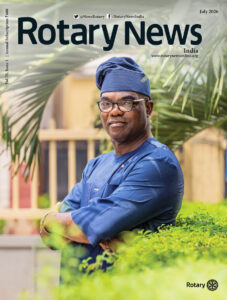
To cut to the chase, education means jobs; good education means better jobs and a bright future. Small wonder that our Rotarians place so much importance on literacy and education, particularly for the less privileged. You are putting up digital classrooms, libraries and swank laboratories, as done by RC Bombay in our cover story this month.
But compared to 2005, the job market is shrinking; too many contenders and AI is making youngsters insecure and jittery. Those in positions of power and influence have to do the utmost to fulfil the aspirations of our young… for they deserve an education system that is fair, transparent and promises a future filled with hope, prosperity and success. Thankfully the GoI has now appointed an exam reform task force headed by technology pioneer and Aadhaar founding chairman Nandan Nilekani. Let’s hope for the best, for our children deserve nothing less.
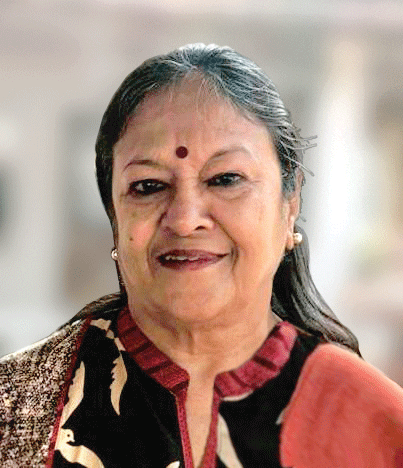
Rasheeda Bhagat