
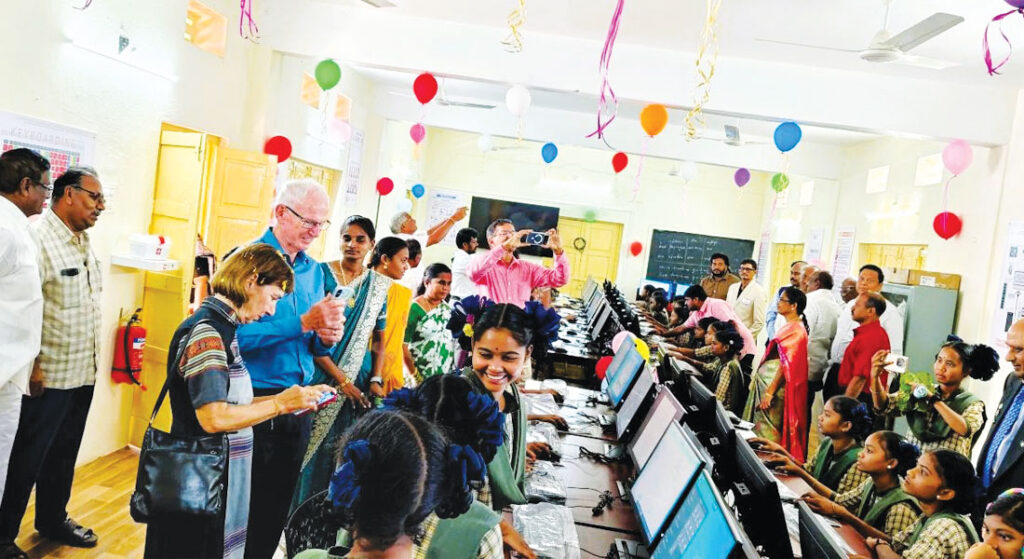
Imagine 640 impoverished girls in a remote corner of Andhra Pradesh opening a computer for the first time and discovering a digital world filled with opportunities for a better education and a better life.
Today, these girls have access to digital educational tools that can help them pursue higher education, compete for university admissions, secure meaningful employment, and achieve greater financial independence — all made possible through Rotary and global grants.
For generations, many girls living in remote tribal areas of Andhra Pradesh had access to only basic education. Without modern educational resources and exposure to technology, they faced significant barriers to higher education and gainful employment.
The consequences were severe: early marriages, economic dependence, a life of servitude and, in some cases, abuse.
Recognising these challenges, the Andhra Pradesh government established residential schools specifically for tribal children. While the government provides the resources to build and operate these schools, access to modern digital education and STEM resources remained a major gap. Students were unable to adequately prepare for competitive, computer-based examinations required for admission to higher education.
These four GGs are worth $674,000. The Rotary investment has been further strengthened by $400,000 in CSR contribution from Reddy Labs.
Rotary decided to help bridge that gap. In 2024, Rotarians from RC Vijayawada Midtown, RI District 3020, in partnership with RC Burlingame and Hillsborough, RI District 5150, executed a GG to establish two digital learning centres and two STEM laboratories at a tribal girls’ school and junior college in Vissannapeta, Andhra Pradesh.
The project had a budget of $90,000; generous support from RID 5150 which contributed $35,000 in DDF; RID 3020 contributed $10,000; and RID 5330 contributed $5,000. The Rotary Foundation provided an 80 per cent match of $40,000, making the GG possible.
The project was implemented in partnership with the Kakinada Engineering Alumni Trust for Service (KEATS), which worked with the host club to implement the project and monitor student performance.
The initiative also involved the Andhra Pradesh Tribal Welfare Residential Educational Institutions Society (APTWREIS), the government agency responsible for tribal residential schools, and the Andhra Pradesh Non-Resident Telugu Society (APNRTS), which coordinates the strategic use of resources from Telugu people living abroad.
The Vissannapeta school was equipped with two servers, 80 smart computer terminals, 80 computer tables and chairs, four digital boards and digital educational content, two STEM laboratories for Physics, Chemistry and Biology experimental equipment, and teachers’ training.
The impact went beyond computers and laboratories.
The school also faced several infrastructure challenges, including inadequate internet connectivity and power, lack of clean water, and monkeys routinely entering the campus.
These challenges were addressed through an additional $100,000 in CSR support from Reddy Labs, which helped provide solar power, clean water and protective monkey grilles.
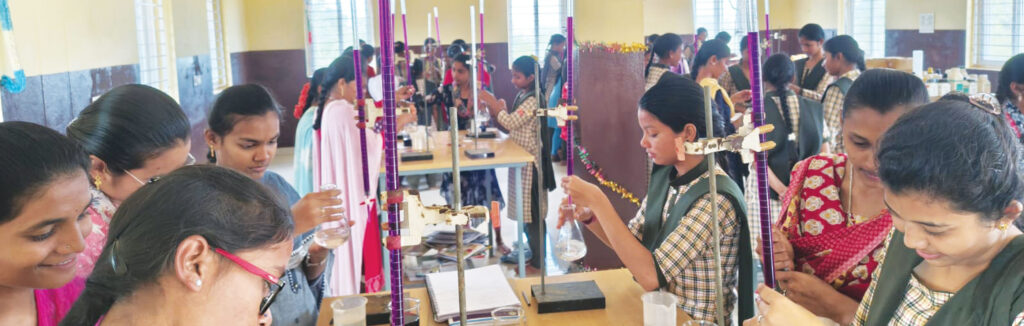
As the Vissannapeta project progressed, the Rotary team realised that the same model could provide educational opportunities to thousands of other tribal students.
In 2025, RIDs 3020 and 5150, together with KEATS, APNRTS and APTWREIS, launched a second initiative. Another GG worth $117,000 provided two digital learning centres, two STEM laboratories, nine digital boards and teachers training for a tribal girls’ school and junior college in Busarajupalle, benefitting 779 girls.
The success of the first project had become a model for expansion.
In 2026, the partnership took another major step forward. Another GG totalling $250,000 was approved to provide similar digital education infrastructure to two additional tribal schools and junior colleges in Bhadragiri and Paderu, Andhra Pradesh. The project includes the establishment of STEM labs, installation of 14 digital boards, and comprehensive teacher training to strengthen digital learning and improve the quality of education for around 2,000 tribal students.
Also in this year, Rotarians from RIDs 3020 and 5150 secured approvals for another GG ($217,000) for an additional 1,000 orphan students at the HEAL School near Gannavaram, Andhra Pradesh.
Thus, what began as one project for a single tribal girls’ school has evolved into a much broader digital education movement reaching thousands of disadvantaged students.
The Power of Partnership
These four GGs are worth $674,000. The Rotary investment has been further strengthened by $400,000 in CSR contribution from Reddy Labs, which supported with essential infrastructure such as solar power, renovation of toilets and dining halls, clean water facilities and other campus improvements. This demonstrates how Rotary’s global grant model can leverage strategic partnerships and significantly multiply the impact of every dollar invested.
Together, these initiatives have provided digital education to more than 4,400 students, who have demonstrated improved performance in maths, physics, chemistry and biology. The girls are now regularly using the computer and STEM laboratories and are demonstrating greater enthusiasm and confidence about their future. They face an opened door to higher education.
Through the power of GGs, Rotary is opening doors to education, opportunity and a better future for thousands of young people in Andhra Pradesh.
The writer is PDG of RID 3020