

Monisha Rajesh shares the delights and discoveries of travelling by sleeper all over the world.
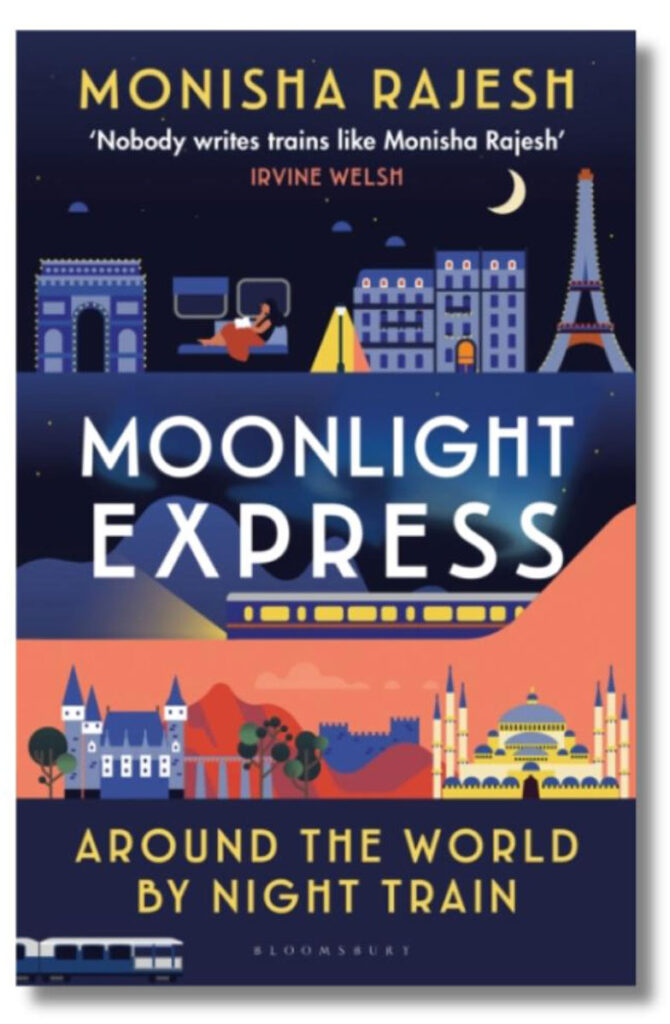
If you like to travel, Monisha Rajesh’s latest is for you. If you like trains, in fact, if you prefer to take it nice and slow, looking out of the window, and are not intimidated by conversations during which you can sometimes lay bare your soul to strangers, then her first two books, Around India in 80 Trains and Around the World in 80 Trains, are up your street. And if you love, simply love train travel, her latest, Moonlight Express: Around the World by Night Train, is absolutely the best thing you could read. It’s a journey in itself around the world, in the course of which it’s very likely that many unknown, undisturbed corners of your consciousness will be shaken awake forever. (Incidentally, her first two books found passing mention in ‘Weaves of Words,’ WW, February 2024.)
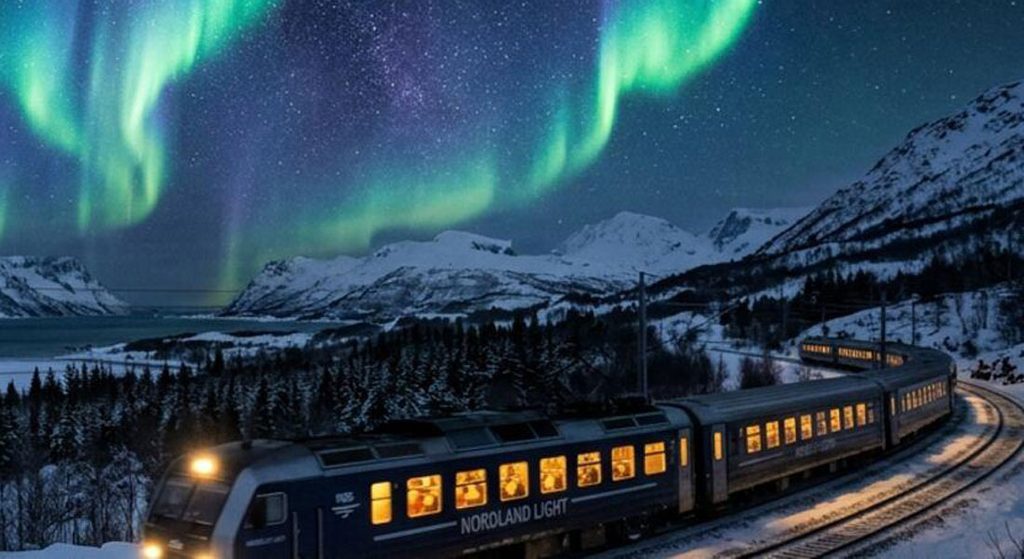
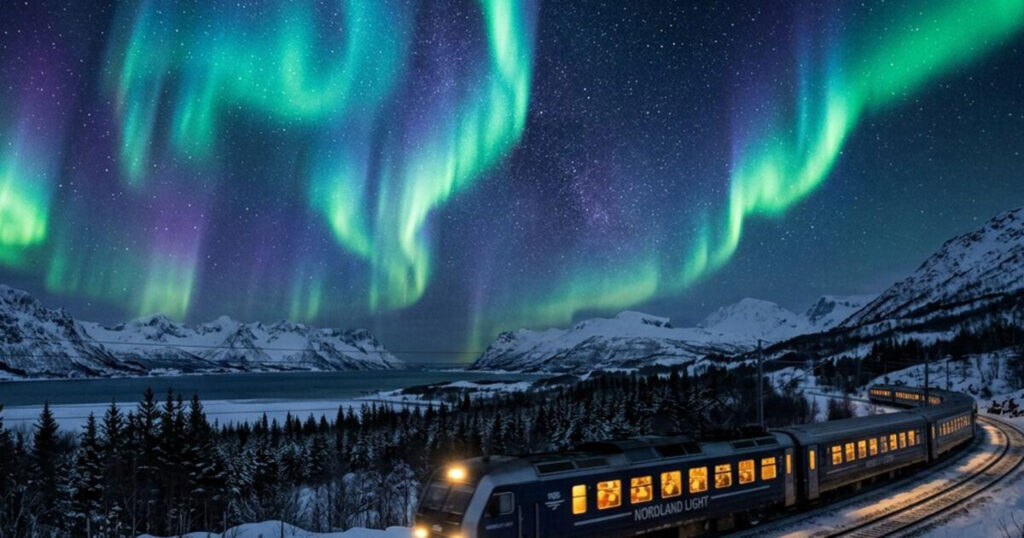
The word ‘hemmablind,’ for instance. Bed down on “the Dovre railway, a 300-mile stretch from Oslo up to Trondheim. From there … transfer onto the Nordland railway and ride the 500-mile line to Bodø — pronounced boo-der — just north of the Arctic Circle”. We know about the northern lights of the Arctic Circle, the aurora borealis. Our geography textbooks also tell us that countries like Norway, New Zealand and Greenland have a dense cross-section of fjords, narrow and deep inlets from the sea. Monisha, berthed on the Nordland line, crossed 293 bridges thanks to the fjords, between sleep and wakefulness, engages in conversation with the pony-tailed Ludwig from Sweden now living in Norway. “The winter is long and it is dark,” Ludwig tells her, “but we have a really nice twilight for four hours every day, it’s punk and orange and you have the Northern Lights as well.” At this, Monisha sits up because she’s chasing the aurora borealis. Lights all the time? “Most of the time,” says Ludwig. Looking thoughtful, he continues, “We have this expression hemmablind. It’s a Swedish word, it’s like ‘home blindness’. You don’t have it in English? It means when you stop noticing the beauty of something where you live.”
Monisha who is British writes: “I couldn’t imagine what was naturally so beautiful in the UK that I’d become used to it, but perhaps that was Ludwig’s point.” Precisely. Such a profound observation garnered from a casual conversation. That was one little ray of light finding its way into my brain. Moonlight Express lit up my mind and heart with many, many slender rays; sometimes it reinforced an understood but perhaps insufficiently acknowledged fact. When Monisha and photographer Marc Sethi are travelling on assignment on the Shalimar Express two months after Norway, Sethi rips his one and only pair of trousers. A fellow traveller, Mohan, offers him a pair of his own. Commenting to Monisha that he cannot imagine someone in London lending him their trousers, Sethi goes off to change. There, Monisha writes: “I wondered for a moment if our foreigner vibes had made Mohan more inclined to help, but overall Marc had a point. There was a unique spirit of generosity about Indian train travellers. Whether it came to sharing food, shifting to make space, or offering advice — unsolicited or otherwise — the railways usually brought out the best of human nature.”
Those of us who have taken and still take trains know this for a fact. Many of us have also forged friendships with strangers we met on train journeys, apart from ‘kindly adjusting’ to the nth degree particularly in the unreserved compartments of old: there was always, always room for one more person.
The book begins on what is perhaps the best-known train, the Orient Express, marking its 140th anniversary. We learn that the Paris-Istanbul (then Constantinople) connection originally began as a sequence of journeys by train and ferry and rolling stock. The last meant detached carriages being loaded on to ferries and then re-attached at the other end to continue the journey! The original (and the rescheduled) service was stopped in 2009, but luxury services such as the Venice Simplon- Orient Express and the Orient Express La Dolce Vita run by private operators are available at certain times of the year.
Overnight travel makes stopovers for exploration and recreation that much more comfortable. The Dacia (dat-sya) takes Monisha from Vienna to Bucharest, Romania, where she takes a break. The word ‘bulldozing’ in the chapter ‘Bucharest to Sofia,’ caught my eye. It appears that a powerful earthquake in 1977 had devastated Bucharest, after which “President Ceausescu set about bulldozing Bucharest’s beauty to rubble, demolishing entire neighbourhoods, schools and synagogues, replacing them to Soviet bleakness.
To my amazement, however, I discovered that a number of monasteries and churches had been preserved at the time by engineers who’d dug beneath them and laid railway-style tracks that allowed the buildings to be rolled away to safety!”
With curious and curiosity-inducing names such as The Caledonian Sleeper, The Royal Scotsman, The Good Night Train, The Silver Meteor, The Andean Explorer and The Santa Claus Express, the trains take us on journeys that dip into history, geography, politics, society, food, fashion and attitudes. Sometimes comfortable, sometimes peculiar — as when passengers are literally folded into capsules or hatches in the hi-fi Nightjet from Vienna to Hamburg — sometimes noisy, sometimes eerie, on these journeys made in good company you learn about each other in two days what you didn’t know in years.
Midnight Express easily ranks among my top three travel books, the other two being Chasing the Monsoon by Alexander Frater and Land of the Dawnlit Mountains by Antonia Bolingbroke-Kent. The vivid, lucid, nuanced writing takes the book far beyond people and places. It is free, frank, generous and feeling. Monisha was in Ankara, having arrived on The Ankara Express and scheduled to proceed to Kars on The Dogu Express, when Turkey experienced two of the most destructive earthquakes in recent times: “The region was already home to refugees from north-west Syria, many of whom were living in makeshift accommodation, and the brutal cold was exacerbating the punishing conditions in which rescue teams were attempting to pull out survivors. I couldn’t understand the depth of my grief. I had no family or friends in the region, but hearing the primal screams of parents, their faces contorted with pain, was making me unravel.”
Other experiences are magical, some are eye-openers. In Sicily, her husband gets to sit reverentially on Don Corleone’s chair (remember The Godfather?) and her two little girls get to play in an extraordinary promenade in Parco della Salute: “It was fitted with ramps in the playhouse, had a large swing to accommodate a wheelchair, and inclines on the merry-go-round. Palermo’s history of inclusion (of Arab and Greek culture) was still going strong.”
This last comment makes me realise that this book is for everyone because it encompasses the senses, the elements, life itself.
So, in that spirit, here’s a quiz. This is a list of names, mostly rivers and a couple of lakes. Follow them on a world map and discover some places Monisha Rajesh’s train journeys took her through and to: Olt. Prahova. Yantra. Danube. Iskar. Küçükçekmece. Kizilirmak. Çalti Suyu. Karasu. Torneträsk. Exe. Teign. Almond. Firth of Forth. Tay. Spey. Urie. Messina strait. Spree. Vorma. Mjøsa. Lågen. Gaula. Nid. Ranfjorden. Saltfjorden. St Mary’s. Potomac. Van Sciver. Kachimayu. Urubamba. Titicaca.
Open your third eye now.
The columnist is a children’s writer and senior journalist