





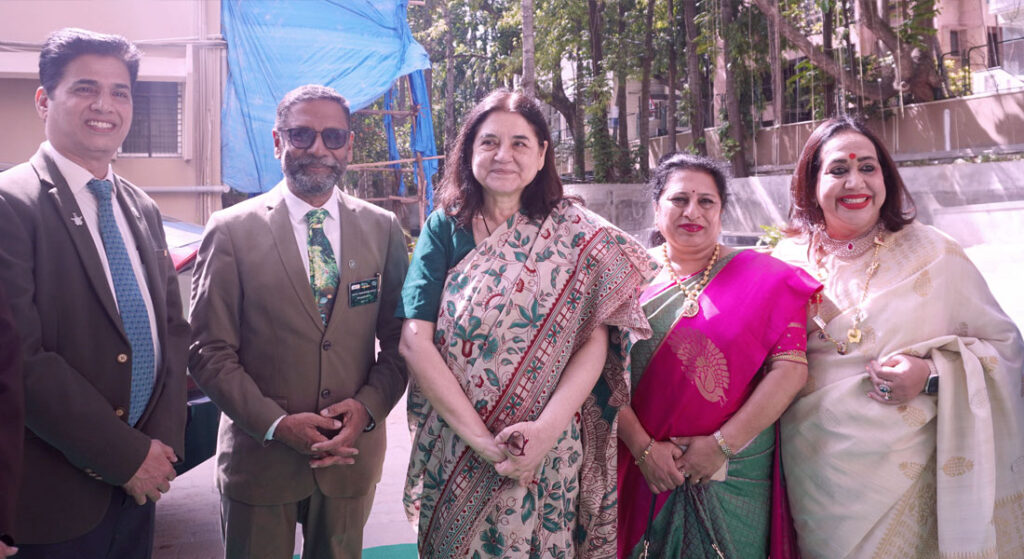
For over four decades, former union minister Maneka Gandhi has been one of India’s prominent voices for animal welfare and environmental conservation. Speaking to Rotary News on the sidelines of the installation of Ravishankar Dakoju as DG of RI district 3192, she shared her views on protecting forests, reducing meat consumption, managing stray dogs, and what continues to inspire her work.

What first sparked your commitment to animal welfare, and what keeps you going after all these years?
Maneka Gandhi: I’ve always had a strong sense of fairness. I believe all living beings are equal. Animals experience fear, pain and emotions just as humans do. Step on an ant, it will also run. Fish have the highest pain receptors of all beings. Just as human beings, they too feel emotions. We’ve all seen elephants mourn the loss of their young. Once you recognise that, you cannot justify treating them differently. Throughout my years in Parliament, I’ve believed that someone must speak for those who cannot speak for themselves. Every one of us has a responsibility to make the world a better place.
Among India’s environmental challenges, what concerns you the most?
The loss of forests. Forests are the foundation of our water security, rainfall and biodiversity. When forests disappear, everything else follows. If we are serious about addressing climate change, protecting forests has to become a national priority.
One of the major pressures on forests comes from large-scale meat production. It also contributes significantly to methane emissions and environmental degradation. There’s another aspect that can’t be ignored — slaughter house effluents and the leather industry pollutes our waterbodies with hazardous chemicals.
But studies indicate that a majority of the global population (80–85 per cent) is non-vegetarian. How can they be convinced to stop eating meat?
It is important both for the environment and for public health. We need much greater awareness about how food choices affect our health and the planet. Meat production has environmental costs that many people don’t fully understand. We have made meat aspirational, whereas many successful people today are choosing vegetarian diets. Public awareness can gradually influence these choices.
In the US, when meat faced a backlash due to its environmental and health impact, it was called ‘protein’. We keep disguising things.
You also believe nutrition deserves greater attention in medical education. Why?
Doctors are trained primarily to treat diseases, but nutrition receives very little emphasis. Better understanding of nutrition can help prevent many health problems before they require medical treatment. I also believe many commonly accepted dietary practices, including the widespread belief that milk is essential for good health, need to be re-examined in the light of scientific research. We need to educate both doctors and the public on the relationship between food and long-term health so that people can make informed dietary choices.
Stray dog attacks continue to worry many cities. What is the solution?
The answer is the ABC (Animal Birth Control) programme through scientific sterilisation and vaccination. It has worked successfully in many countries. Unfortunately, in India it has suffered because of inadequate funding and poor implementation. Dogs are often relocated instead of being sterilised, which makes them frightened and more likely to bite. If the programme is implemented honestly and adequately funded, it can effectively control stray dog populations while reducing rabies.
Looking back on your journey, was there one defining moment that changed you?
Not one moment. I learn every single day. My thoughts evolve as I continue to study, understand and apply what I learn. There are always new challenges that demand attention. It has truly been a lifetime of learning.
Pictures by Jaishree