
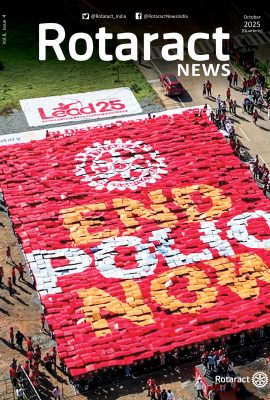
With bigger service projects, like the Programs of Scale, driven by data-based study having a measurable impact on the communities, “Rotary is transforming the world. In India, Rotary clubs have taken up CSR-funded projects in a large scale which other countries like Brazil and the Philippines are trying to adopt, but without much success,” said TRF trustee chair Holger Knaack.
Delivering his address after inaugurating the IIT Madras Rotary Centre for Social Development at the Humanities and Sciences Block of IIT Madras, he complimented the partner clubs and the premier institute for setting up this joint initiative “which will create lasting change through clubs across India in the years to come.” RCs Madras Mid-Town and Madras Central Aadithya, RID 3233, are in the process of arranging ₹30 lakh as corpus for the Rotary centre which “in due course will generate income by taking up project assessment studies, impact reporting, project consultancy, creating white papers on sustainability, and helping the Rotary clubs across South India to design need-based global grant and CSR-funded projects. This will make the new centre a self-sustaining resource body for Rotary,” said PDG Muthu Palaniappan.
Global grant projects have touched millions of lives in India, “as Rotary clubs take up around 275–300 global grant programmes worth ₹180–190 crore every year,” said trustee Bharat Pandya. Now IIT Madras joining with Rotary will become a transformative initiative in the next 10 years with clubs doing research and data backed projects, he noted.
DG D Devendran said RID 3233 clubs are doing annual projects worth $1 million, and “during the Covid years, we did service initiatives worth $2 million including Project Orange that fought against preventable blindness.” While the annual CSR funded projects stood at ₹30 crore, “with the help of IIT Madras, we can scale this up to ₹300 crore in the next 4–5 years,” he said.
DGND M Ambalavanan, the project chair, said “it was a dream come true moment for me with the setting of the IIT Madras Rotary Centre. As businessmen, we lack knowledge of ground realities and situations at the grassroots of our communities. But it is imperative, that our projects are backed by raw proven data with studies on the needs of our communities, and the new centre will fill this gap for Rotary clubs.”
In the last five years, Rotary clubs in Chennai have done global grant and CSR-funded projects worth $14 million; and across the country, CSR projects alone would be $1 billion last year, with majority of funding from the MSME firms, he noted.
UN’s 17 SDGs
The IIT Madras Rotary Centre will design social growth projects for global grants and CSR-funding by involving the faculty and students who will create a knowledge data bank across Rotary’s seven areas of focus, said Ambalavanan. As a resource centre, it will “assess, design and execute critical humanitarian projects in TN, Kerala, Karnataka, Andhra and Puducherry to begin with.”
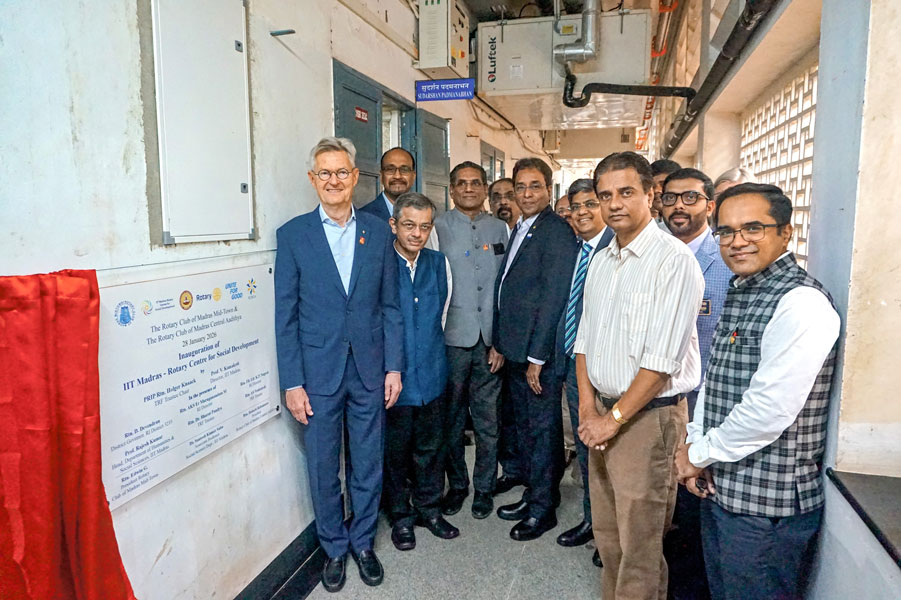
DGND M Ambalavanan, PDG S Muthu Palaniappan, DG Devendran and DGE Duvvuri at IIT Madras.
For the first time, the Rotary centre would create a “dashboard of information related to the UNDP’s 17 SDGs (sustainable development goals) aligned to Rotary’s areas of focus.” PDG Muthu Palaniappan said the centre will be a powerhouse for social change across Tamil Nadu. The centre will take up the state government’s pilot health project on hearing-impaired babies in Thoothukudi district, and “see how it can come out with effective solutions for treatment, and scale up the treatment model for the entire state through Rotary clubs.” Prof Rajesh Kumar, HoD, Humanities and Sciences, IIT Madras, said they are looking forward to work through the new centre in “tech innovation for visible impact in rural communities.”
Recalling the work done since the MoU was signed with Rotary in October 2024, followed by a soft launch by IIT Madras director V Kamakoti in Feb 2025, associate prof Santosh Sahu pointed out the IIT Madras Alumni Charitable Trust was generous in giving resources and donations. “We will hold certificate courses on SDGs, publish white papers on social, rural issues, offer internships, conduct hackathons to brainstorm on specific problems, create a wide database for Chennai, and then gradually engage with rest of India,” explained Sahu.
The IITM-Rotary Centre will design
social growth projects for global
grants and CSR-funding by involving the faculty and students who will create a knowledge data bank across Rotary’s seven areas of focus.
To begin with four IIT professors led by Sahu will be involved in the Rotary centre’s activity, and they will be guided by a three member advisory board. Similar Rotary centres will be set up at the IITs in Hyderabad, Mumbai, Delhi, Bhubaneswar and Guwahati with the help of respective Rotary districts and clubs.
In his video address, Kamakoti said the IIT Madras Rotary Centre will be a “policy umbrella body for SDGs in Tamil Nadu with interventions through Rotary clubs for TN Green Mission (mangrove restoration), children’s healthcare, and other state rural schemes.” The centre will strive for industry-academia linkage for sustainable growth, which will be taught as a curriculum in schools and colleges with the help of state government, he added.
IIT Madras is developing a 100-acre sustainability campus at Auroville village near Puducherry, where the centre’s best practices would be acted upon and showcased as model growth parameters for the entire nation, said Kamakoti.
Hi-tech medical equipment
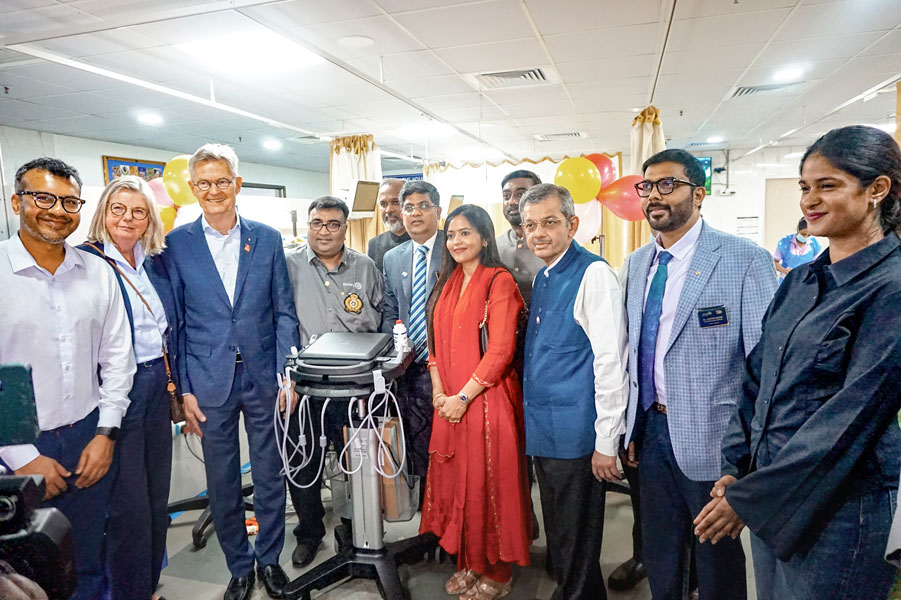
In the medical front, RC Chennai Capital handed over ultrasound and HFNC (high flow nasal cannula) equipment to the paediatric ICU ward at the Sri Ramachandra Hospital through a global grant project of ₹45 lakh. RID 5330, US, and RC Melawati, RID 3300, Malaysia, were the global partners.
Knaack and his wife Susanne inaugurated the project in the presence of trustee Pandya, DG Devendran, DGE Shriram Duvvuri, DRFC L Neelakantan, and club president Apoorva Modi. PDGs N Nandakumar and Palaniappan, and Ambalavanan were also present.
Ultrasound and HFNC device would reduce the treatment period of critically-ill babies, said Modi. With these high-tech donations, “the hospital can do life-saving critical interventions without moving fragile infants, a critical factor in neonatal mortality,” he said. In March, the club had donated two C-arm x-ray machines (GG: ₹40 lakh) to the orthopaedic ward at the Kilpauk Medical College and Hospital; and apply for a global grant of ₹50–60 lakh for donating either a mammogram or Echo cardiogram to a charity hospital.
In his speech, trustee chair Knaack said the “long lasting cooperation between the hospital and Rotary has looked into the needs of the communities.” Since inception, TRF had funded global projects of over $4 billion through global grants and other programmes. “Ending polio is still our main priority and it is now endemic in only two countries — Pakistan and Afghanistan. Being a neighbouring country, India must ensure that polio is eradicated from the world,” he said.