



Does my child hate me?’ was one of the most heartbreaking questions asked by a mother at our autism awareness workshop,” says Pradeep Khamkar, secretary of RC Dharashiv, RID 3132. The mother had spent years trying to understand why her child cried for hours, threw tantrums at family gatherings, and seemed impossible to comfort. “Nothing worked. Scolding didn’t help. Neither did punishment. The behaviour continued, leaving her and the rest of the family exhausted and convinced the child was acting out on purpose.”
But that wasn’t the reason. “The child wasn’t being stubborn or defiant. They were on the autism spectrum,” explains Khamkar.
For Dr Abhay Shah, a paediatrician and member of RC Dharashiv, such conversations had become “painfully familiar. Parents often arrived at my clinic overwhelmed and confused, unable to understand why their children behaved differently from others their age. Some blamed themselves. Others believed their children were deliberately misbehaving. It wasn’t lack of love, it was lack of awareness.”
After dealing with multiple cases of parents complaining about their child’s behaviour, “asking for medicines to calm the child, I was tired and wanted to do something about it.” So he approached his Rotary club “to look beyond individual cases.”
Working with government hospitals and the district education department, the club found that nearly 6,000 children in Dharashiv district (formerly Osmanabad in southeast Maharashtra) fall somewhere in the autism spectrum. Yet awareness of the condition remained strikingly low, particularly in the district’s rural communities.
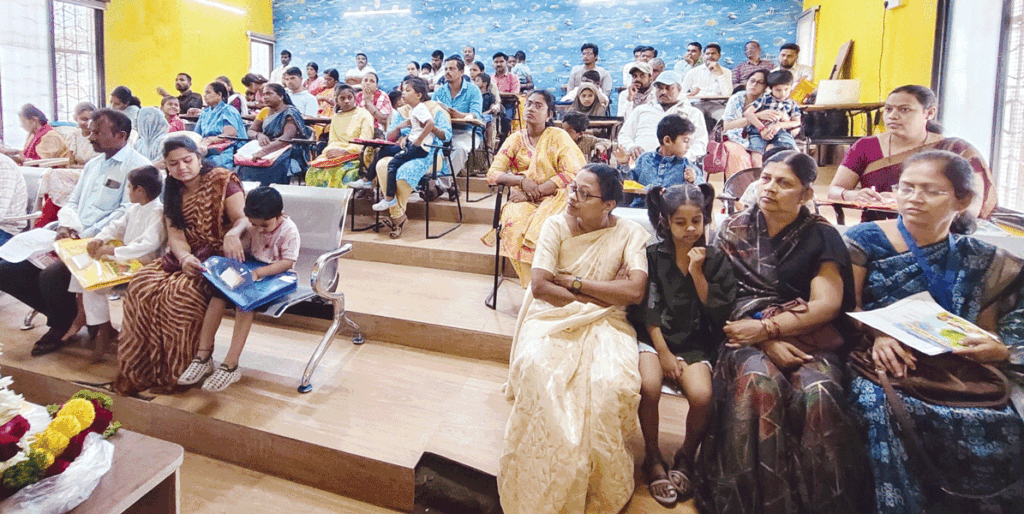
The findings led to what Khamkar describes as Dharashiv’s first parenting workshop dedicated to autism spectrum disorder (ASD), bringing together 70 parents and autism specialists from the Tata Institute of Social Sciences (TISS) to help families better understand the condition.
Rather than limiting the programme to lectures, the club invited parents to come along with their children. Some children rushed to the stage to grab the microphone. Others cried inconsolably or wandered around the hall, seemingly uninterested in what was happening.
“Instead of trying to stop such behaviour, the autism specialists calmly responded to each child, using those moments to demonstrate practical ways parents could comfort, redirect and communicate with them,” says Khamkar. For many parents, “this was the first time they had seen someone respond to their child’s behaviour without frustration or judgement.”
Through case studies, demonstrations and conversations, the experts explained that children with autism express themselves in different ways, and that no two children on the spectrum are alike. The TISS team came prepared with activity kits and used the children’s response and behaviour during play to demonstrate practical ways parents could support and communicate with them.
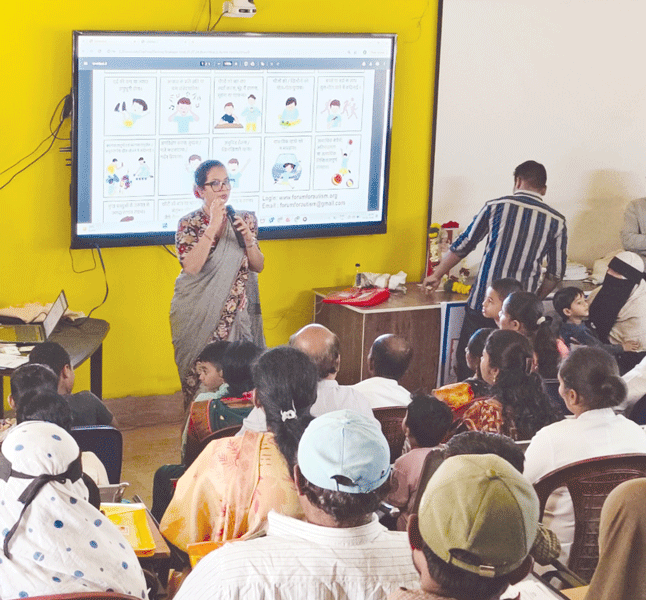
Khamkar says the most rewarding moment came when anxious parents watched their children gradually settle down, engage with the experts, and enjoy the activities from the therapy kits. “Many parents realised for the first time that their child wasn’t being difficult, she simply needed to be understood differently. Every child with autism deserves to be treated with dignity and, above all, to be understood,” he says.
Beyond autism
For nearly two decades, the J F Ajmera Rotary Eye Hospital and Rotary Vision Care Centre have been bringing affordable, high-quality eye care to people across Dharashiv district.
Established in 2006 as Rotary’s centennial service project and managed by Rotary Seva Trust (run by RC Dharashiv), the hospital has grown into one of the region’s most trusted charitable eye care institutions. In 2023–24 alone, it conducted 1,010 village eye camps, examined more than 94,600 patients through outreach programmes, and treated over 1.18 lakh outpatients at the hospital. The team performed nearly 28,000 eye surgeries, including more than 12,000 free cataract procedures, while school screening programmes covered over 6,000 students across 28 schools.
The club, in partnership with the Gramin Women Trust, is helping women from self-help groups become financially independent through training in record-keeping, digital banking, government schemes and entrepreneurship. The initiative has connected nearly 1,000 rural women, with more than 700 completing online documentation required to access government benefits and financial services. The programme also encourages women to explore self-employment, agriculture-based livelihoods and micro-enterprises.