


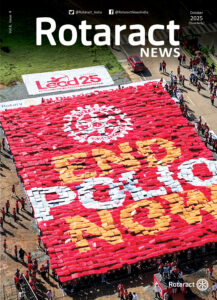
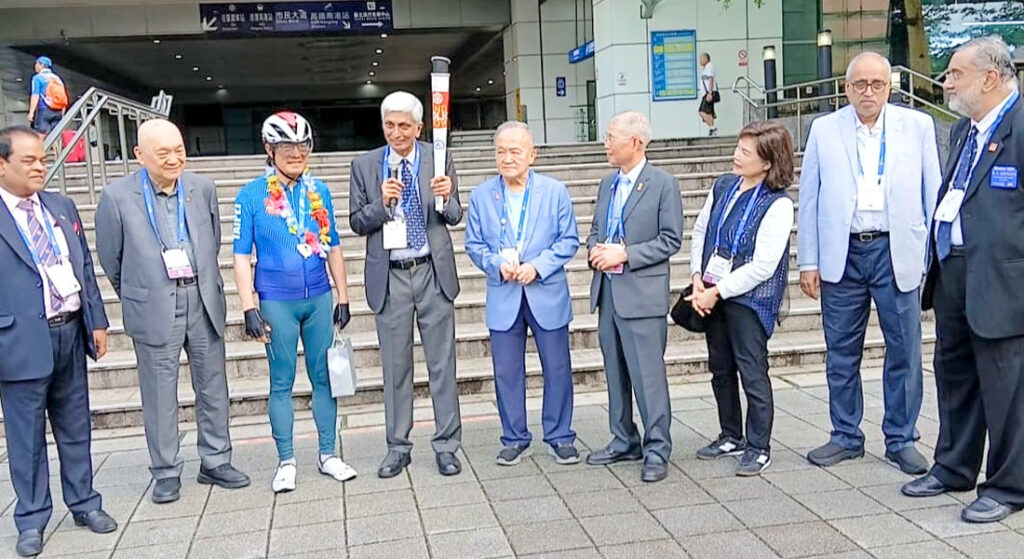
The End Polio Flame, initiated by the Rotary Club of Madras, RID 3234, in RY 2014–15, when the club was led by S N Srikanth, and launched in Taipei, Taiwan, when Gary Huang was the RI President, returned to the same city that hosted the RI Convention this June.
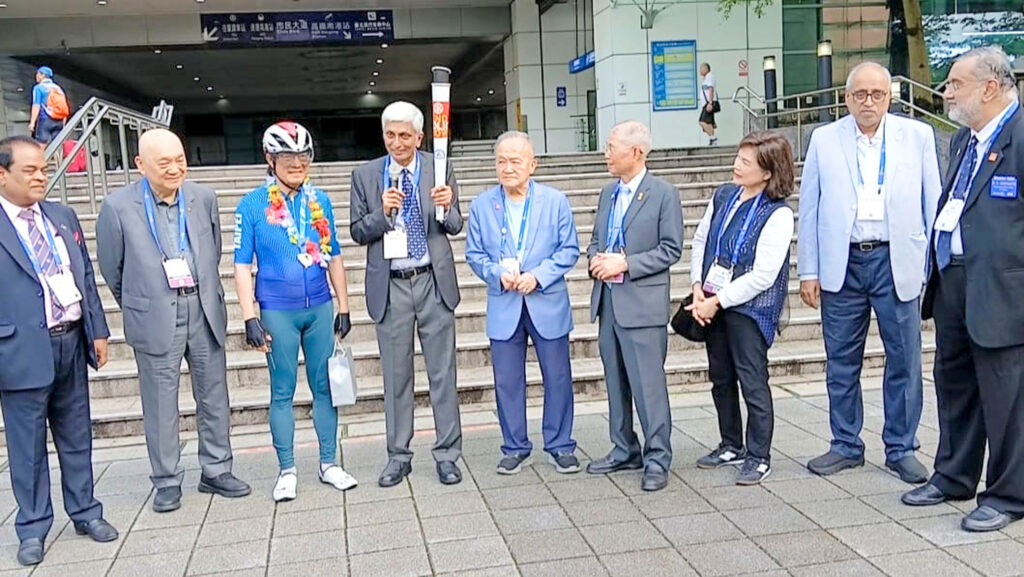
The man behind the project, past president Srikanth, who is also chair of End Polio Flame project, said the flame’s return to Taipei this June was part of the seven-day, 540-km End Polio Now Taiwan Cycling Tour from Kaohsiung to Taipei, which ended in the city on June 13, 2026. During the ceremony, lead cyclist PDG Frank Hsu and PDG J P Horng ceremonially handed over the flame to PRIP Gary, who is from Taiwan. Gary had inaugurated the flame in Chennai in 2014. He congratulated the Chennai Rotarians for continuing the flame’s journey even after 12 years.
Till now the flame has travelled to 35 countries and helped collect an estimated $10 million for The Rotary Foundation, “till we stopped counting!” On how funds for TRF are collected through this flame, Srikanth says that when it was first launched they had aimed to create a separate section in TRF to direct the donations towards polio but there were too many stumbling blocks in doing so, and hence whenever people across the world, whose attention was drawn to polio thanks to this flame, wanted to make a donation, it just went to TRF.
Recalling this project’s long journey, he added, “The reception accorded to the flame in Taiwan in March 2015 was especially memorable, and its ceremonial entry at the opening plenary of the Sao Paulo Convention remains etched in the minds of thousands. He added that the flame has already made two journeys through Pakistan, the first time across the Sindh region and the second time across Pakistan’s Punjab region. It has also travelled to Afghanistan once: only to Kabul and that too during extremely difficult circumstances.” Afghanistan and Pakistan are the only two countries from which polio is yet to be totally eradicated.
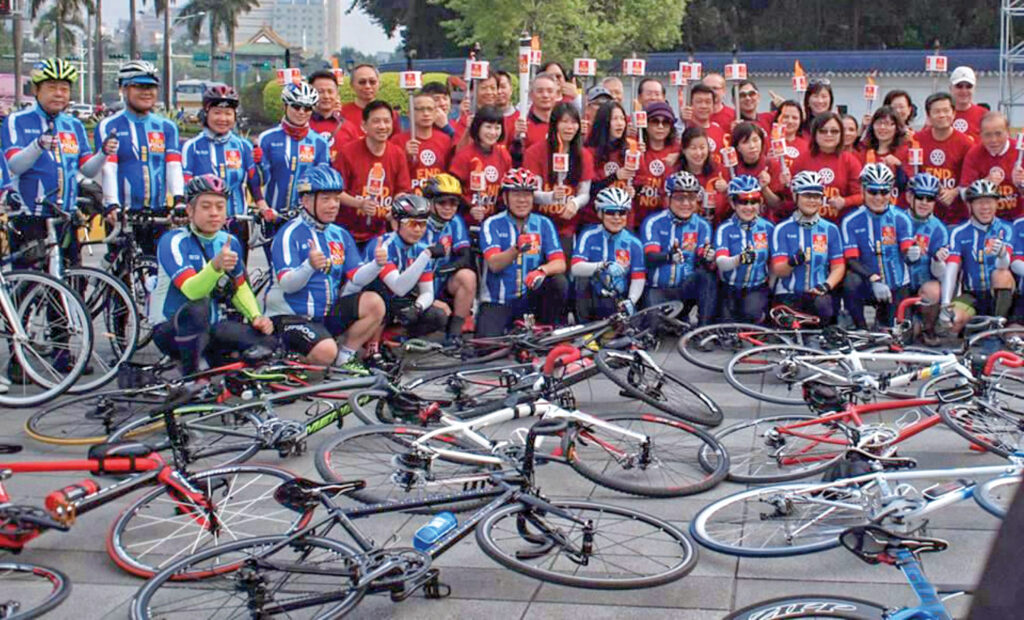
Srikanth added that on request from PRIP Gary, and the Taiwanese Rotarians, the flame will now be housed at the ‘Light Up Rotary House’ museum in Yilan, Taiwan. “The museum preserves the history and humanitarian milestones of Rotary and the flame is widely regarded as a major milestone. Of course, we have other torches that will continue the journey of the flame!”
Asked for how long, he smiles and says: “Looks like till polio is eliminated totally.”
But this passionate Rotarian is now fully charged up about working in an area which is very close to his heart — sanitation; “because when you can’t provide decent sanitation facilities, all kinds of health problems, including polio, arise.”
Years ago, he had poured all his efforts and attention into making a village near Chennai totally free of open defecation, and that had got him a lot of international attention and acclaim. IIM Ahmedabad too had taken this up as a case study.
He has now taken over the chairmanship of WASH-RAG, RI’s Water, Sanitation and Hygiene Action Group. He says proudly: “I am the first Asian to be given this responsibility and I have huge plans for it.” Having identified 150 ambassadors across the world, he hopes that Rotary will make a huge leap forward in this area.
Water is life and clean water means health, says Srikanth. “Sanitation has done more to increase human longevity than any surgery or drug. Yet, shockingly, over 2.5 billion people lack access to safe water and over 3 billion don’t have access to safely managed sanitation. The consequences are devastating — illness, disability and death, with children being the most vulnerable.”
WASH-RAG (https://www.wash-rag.org) supports and facilitates sustainable WASH initiatives undertaken by over 40,000 Rotary clubs worldwide and works closely with TRF. “Our network includes experienced technical professionals, project advisors, grant reviewers, and dedicated WASH-RAG ambassadors across Rotary districts worldwide, and they can interact with and guide clubs.”
For those Rotarians who are proud of their clubs doing water and sanitation projects, Srikanth shares a disturbing number; he estimates that “at present our failure rate in WASH projects is 50 per cent.” He says that many clubs start water and sanitation project with a lot of passion and fanfare, but within two to five years, they are not effective at all. Due to this tendency to “do projects and not sustained long-term programmes,” he estimates that Rotary loses each year as much as $25 million!
“I believe Rotary should stop this ‘projects’ business; I think building a school here or a water tank there will not really make an impact. Instead of these isolated efforts by clubs, we need to take up sustained programmes at district levels. Yes, we need to make the transition from projects to programmes, and I have ambitious plans to do just that going forward.”
His plan is to encourage districts to take up long-term sustainable programmes which have the support and commitment of the DG, the DGE and the DGN; “what we need is a huge emphasis on sustainability and a determined attempt to scale up our activities. We are also planning a major initiative where three selected Rotary districts from around the world will become a living laboratory to achieve the equivalent of SDG 6 — or access to clean water and sanitation for all.”
Doing all this, says Srikanth enthusiastically, will make “Rotary a preeminent player in WASH-RAG in the world.” But of course, he adds, all this will require a lot of hard work and above all, the willingness of the clubs to work together.”