
The lack of access to education that lakhs of children of migrant labourers in India battle with is a grim reality, made grimmer by the fact that these children miss out on a life altering basic right, that too in metros and the bigger cities where quality educational institutions are located.
These children stay for long periods in mega cities where long duration projects abound, and face language related challenges in getting into local government schools. “Most migrant workers come to cities like Bengaluru from Northern and North Eastern parts of India such as West Bengal, Assam, Bihar as also Nepal. Their mother tongues are different and hence they cannot join local government schools in Bengaluru, where the medium of instruction is Kannada. Such children always need at least one year of bridging to prepare them for regular mainstream schools,” says PDG of RI District 3192 H Rajendra Rai, who is a trustee of the Samridhdhi Trust, an NGO engaged in the education of underprivileged children, particularly of migrant workers.
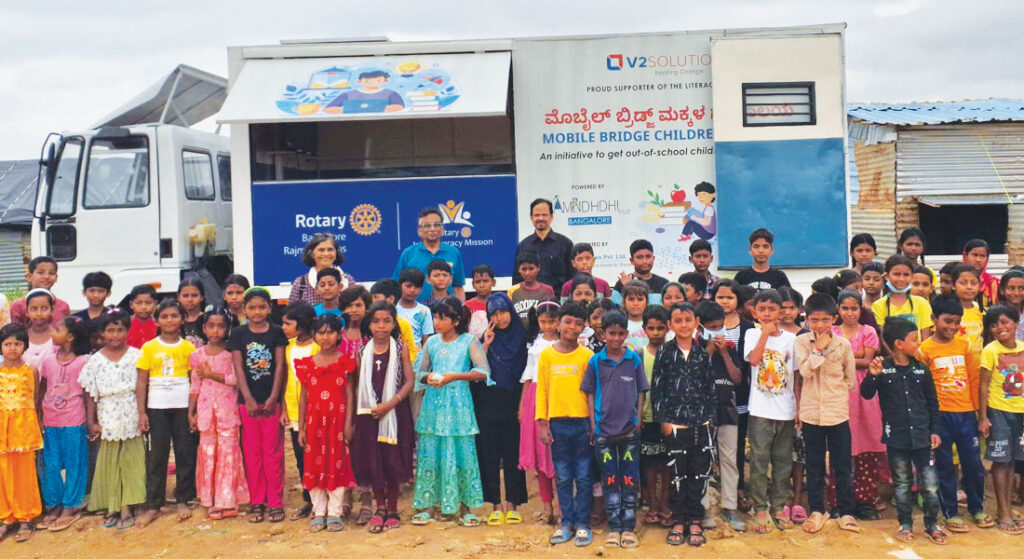
As the NGO was looking at the opportunity to set up one more ‘mobile bridge school’ for children of migrant workers living in temporary shanties or makeshift dwellings on the outskirts of Bengaluru city, towards the end of 2025 Rai approached RC Bangalore Rajmahal Vilas’s then president Deepa Sasidharan and IPP R K Hegde for a possible partnership to set up such a mobile bridge school. “The board of the club immediately agreed to sponsor this worthy project, and past president of the club Kirti Mehta, who has done many projects for the club, coordinated with me and got such a mobile school built in a Leyland vehicle,” he says.
of the mobile school.
The basic idea, explains Mehta, was to take education to the doorstep of such children. With CSR funding of around ₹10 lakh from the IT solutions provider V2 Solution, “an advocate of literacy and a recurring benefactor of our club projects,” and another couple of lakh rupees raised by club members, the mobile school was put together in a repurposed and custom-built Leyland vehicle. This was done with the assistance of KHT Agency belonging to past president of RC Bangalore Orchards Kirit Morzaria to suit all the requirements of a mobile school.
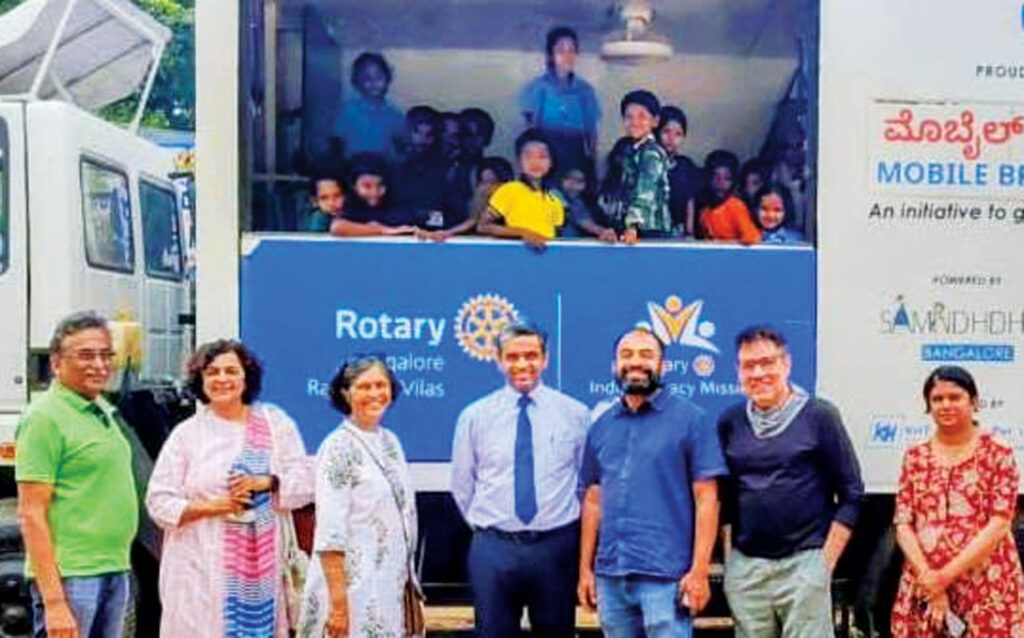
The experience of the Samridhdhi Trust, which already runs bridge schools to provide some schooling to out-of-school children and prepare them for admission to regular schools, has come in handy, particularly in providing teachers who teach the children coming to its mobile schools.
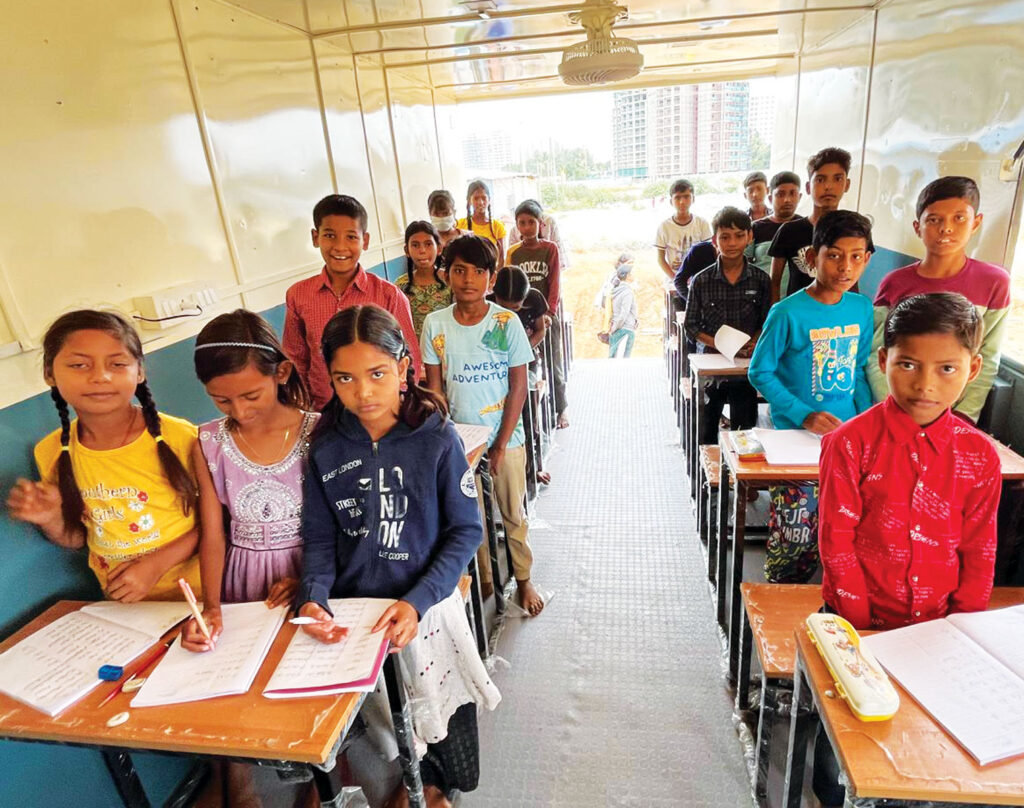
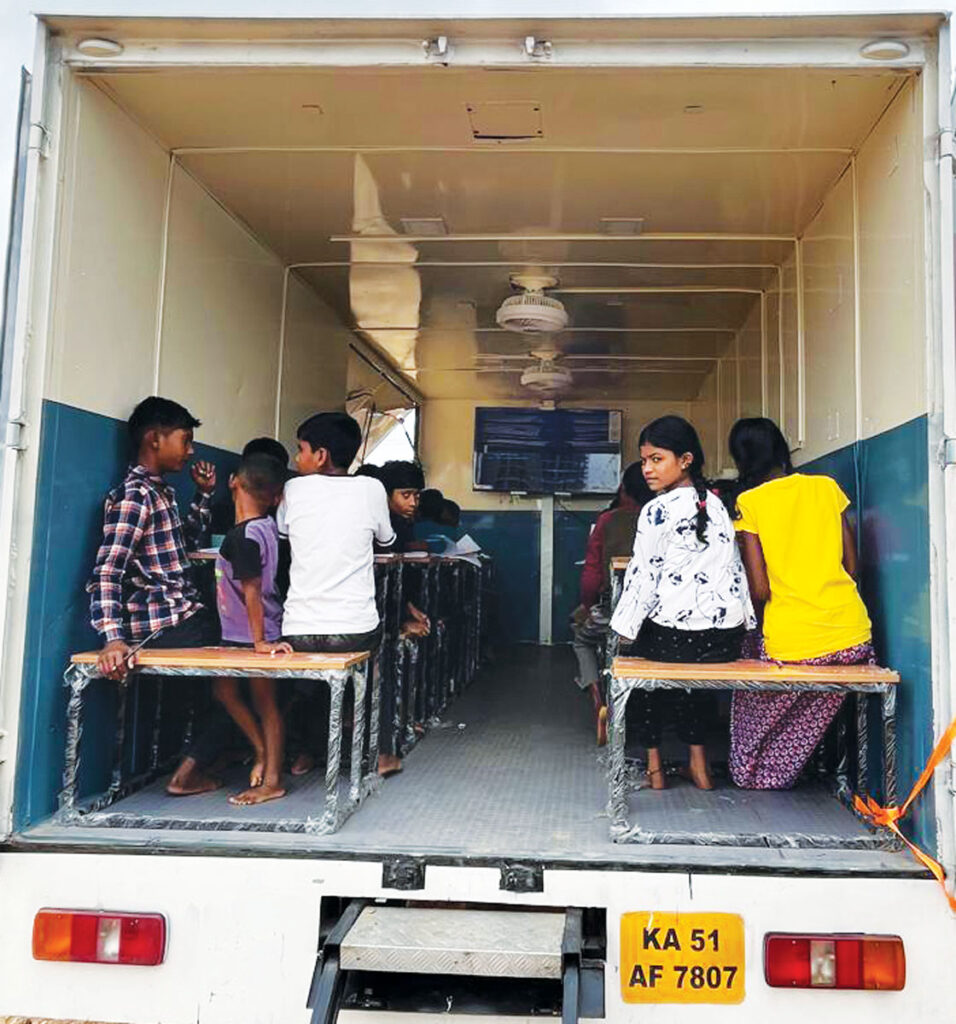
The vehicle was fitted with 12 fixed desks and can accommodate 24 children at a time and it supplements the other two bridge schools operating in temporary structures run by the Samridhdhi Trust. The bus also has a 32 inch-TV monitor loaded with software to teach core subjects such as Science, Mathematics, Social Studies and English grammar to children from Class 5 to 10. While the parked mobile school is equipped to get power from the local power points, in case local power supply is not easy to access, it also has a back-up power supply though a solar panel mounted on the top of the bus.
What is heartening is that four ‘classroom libraries’ with books for all age groups are available in the bus so the children can pick up books of their choice and read them while they are in the bus.
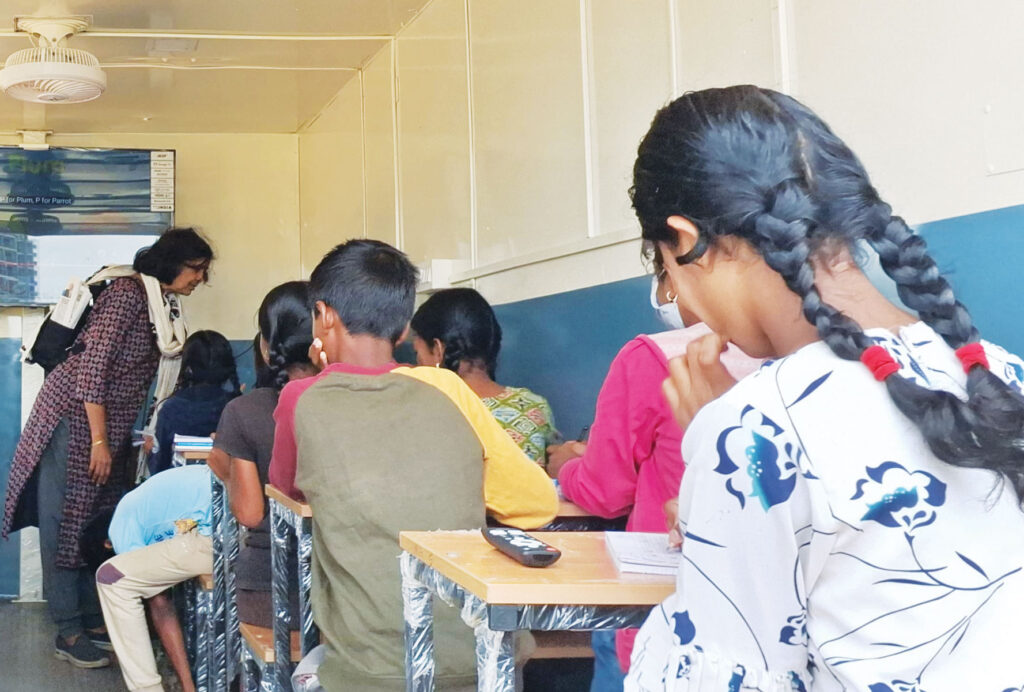
We did the required wiring and have put in lights and fans for the children along with a display board. Luckily Samridhdhi Trust has experienced teachers and they have also been picking up children from slums whose parents go out to work or simply loitering and whiling away their time. Many of them are school dropouts so they have to be schooled to a certain level before they can be put back in a mainstream school.”
Mehta adds that the children of migrant workers sit in the mobile school for a few hours in the morning. While some study for two hours and go away, others, who are more interested, spend more time. These children bring their own food and in between studies take a meal break. Special care is taken to see that as these are mostly non-Kannada speaking children, a functional knowledge in the local language is given to the children so that they can integrate better in the local regular schools. “They are made to repeat Kannada words regularly, so that they can speak the language with some confidence.”
Originally the idea was to take this mobile school to three or four different locations, as quite often Samridhdhi teachers were conducting classes for slum or migrant children in open air spaces, exposing them to the vagaries of the weather. But now that the NGO has got some space from schools, the Rotary bus doen’t need to move around much.
Under this model after 10 months of training the child is helped to get admitted to a regular school. Even after that under the Samridhdhi model, these children are tutored for a few extra hours each evening by these bridge school teachers till they get a proper grounding in the regular schools.
Asked if the parents are grateful to Rotary for educating their children, and are cooperative in sending their wards to the mobile school, Mehta says, “Actually we rarely see the parents because Samridhdhi people handle the interaction with parents. But I can tell you the children are very happy to come to our school and enjoy the lessons, and we are told that those who have gone to regular schools in the past have done very well. They have passed out of high school and some have even gone on to become engineers and other professionals.”
PDG Rai says that Samridhdhi, where he is a trustee, provides bridging classes to about 100 children every year, “before sending them back to regular low-cost English medium schools with the Trust bearing half the cost and the parents picking up the other half.”
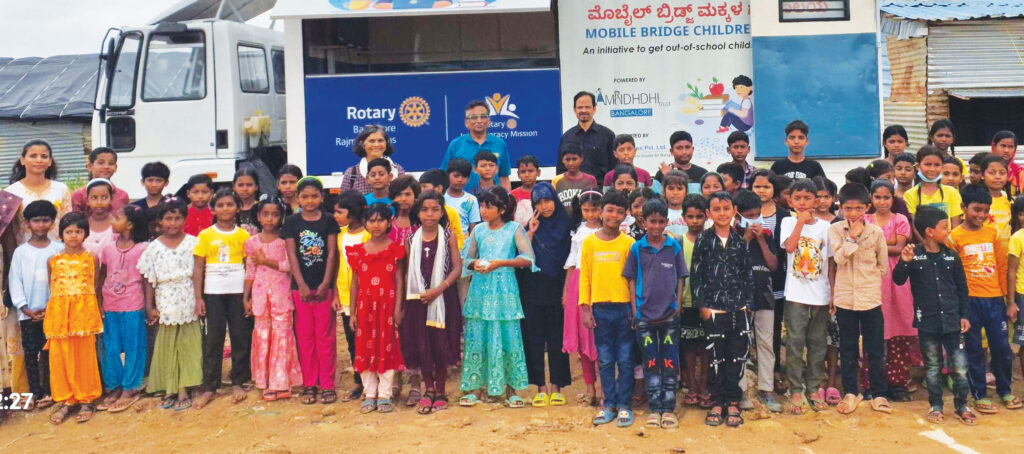
On one such visit to a mobile school sponsored by RC Bangalore Rajmahal Vilas, he found “29 happy children in the school and all of them were enjoying their lessons. Their joy and the smiling faces were indeed a very satisfying experience for all of us.”
On the future plans of the club, Kirti Mehta says that as Samridhdhi expands its base, it is looking up to Rotary for more support. Right now, they have the students, but there is a shortage of teachers Once they find the teachers and approach the club for more support, the Rotarians are ready to put together another bridge school, but this time around, as their partner has managed to get some fixed space from schools to station the bridge school, “we are thinking of doing the next bridge school in a container. We will get a container, refurbish and fit it with the required tables, chairs and other facilities and put it in a fixed place.” There will be saving in cost as well, as a bus requires registration, insurance, maintenance, road taxes and a driver!
We are told that those who have gone to regular schools in the past have done very well. Some have even gone on to become engineers and other professionals.
But containers don’t come cheap either; so it will cost the club another ₹10 to ₹12 lakh. But he is confident that the club will be able to raise the money, more so because they have been offered a fixed space by one of the builders.
At the end of the day, as Mehta puts it, the “children are really happy. Instead of whiling away their time indulging in wasteful or undesirable activities, they are learning something and preparing to get into a school.” And the community definitely needs such bridge schools. Apart from migrant workers who come for construction work, in a bustling city like Bengaluru, many other people also come looking for work, such as in the security services space. “There too, when the parents find work in Bengaluru, their children, who were earlier going to school, tend to drop out. They find it very difficult to get admission in a school here. This bridge school will help them get into a regular school at some point, and we will be happy to act as the bridge!”