



Many things at Booth 635, set up by Neeraj Bhatnagar, a member of RC Delhi South East, RID 3011, at the 2026 Taipei convention, caught Ma Yun’s attention. Incoming president of four-year-old RC Taipei Twin-Star, RID 3482, the “beginner Rotarian,” as Yun calls herself, found herself intrigued by the work of RC Delhi South East. The environmental initiatives, community projects and “especially rotariansforautism.com,” an initiative that grew from a request from RC Madras, RID 3234, two years ago to conduct awareness sessions and seminars on autism in Delhi. Bhatnagar then expanded the idea into a platform that brought together five Rotary clubs from Chennai, Sri Lanka and Australia. Today it has developed into a Rotary-led AI ecosystem for autism, mental health and inclusion.
He saw the Taipei convention as an opportunity to take the initiative to a larger Rotary audience. “We wanted people to know what our club is doing and see how they could become part of it,” he says. In 2023, he attended the RI Convention in Melbourne, Australia, as an ESRAG (Environmental Sustainability Rotary Action Group) volunteer. Next year at the Singapore convention, he put up two stalls at a cost of ₹5 lakh. One featured onemillionmindfulactions.com, “encouraging convention-goers to take small environmental actions, even something as simple as watering their houseplants and record the action with a photograph.” The second featured an energy-consultation stall showcasing green technology developed by his club member Ajay Gupta that converts solid waste into green coal for use in power plants. At the Taipei convention, he hosted a breakout session on Climate Belongs To All (www.climatebelongstoall.com – a global Rotary platform supported by 54 Rotary districts bringing together clubs and members to engage on climate action). The session featured eight speakers from across the world and 400 Rotarians attended it.
He noticed that the conversations at the convention had changed over the years. “People were not just looking at projects; they were discussing them and asking how they could participate.”
Yun wanted to understand how she could participate in different Rotary initiatives. She asked Bhatnagar about the projects, the club and ways in which Rotarians from different countries could work together. “Neeraj has the experience of attending five conventions and being part of 14 Rotary Action Groups (RAGs). His knowledge about Rotary is remarkable,” says Ma Yun. After the Taipei convention, Ma Yun joined climatebelongstoall.com and joined three RAGs.
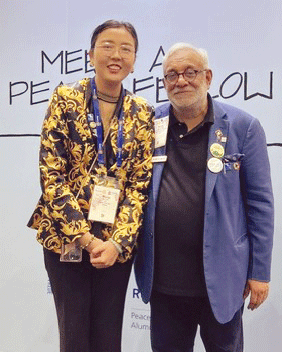
When Bhatnagar was packing to leave the convention, Ma Yun walked him all the way to the main gate. “Hundreds of people meet you at a convention, but very few people walk you to the gate. There was something genuine about it,” says Bhatnagar.
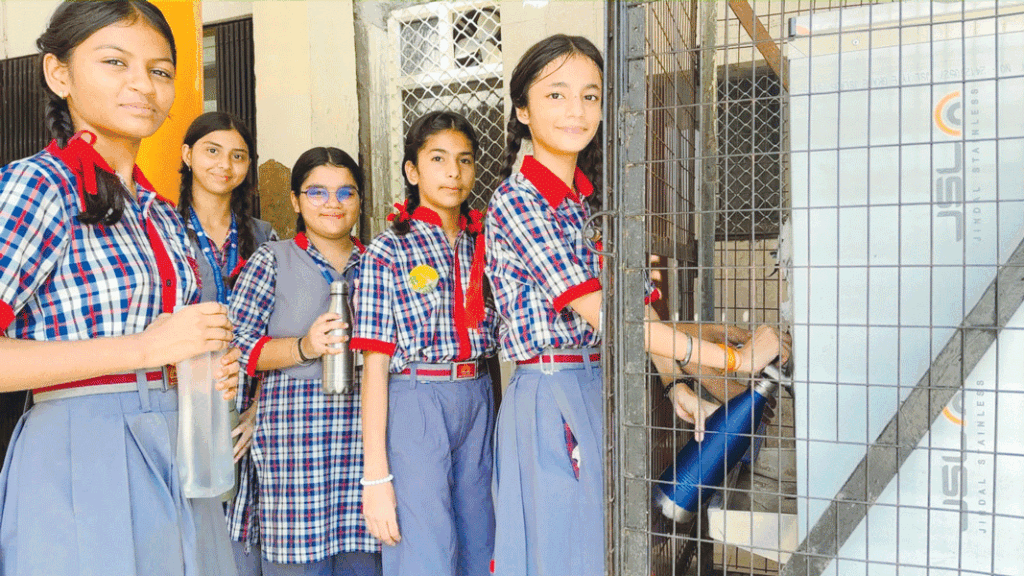
In July, Mamta Shekhar, principal of PM Shri Kendriya Vidyalaya, Faridabad, approached RC Delhi South East with a request for two drinking water coolers. The school has more than 1,100 students, and they were having difficulty accessing clean drinking water. The club had earlier worked with the school on a water-conservation project and had also helped set up a medical room.
This time, Bhatnagar saw “an opportunity to bring his new friendship with Ma Yun into the picture.” The two had continued to discuss Rotary initiatives after Taipei, and the school project offered a simple way to turn those conversations into collaboration. “I knew the water cooler project would happen anyway. But I thought, why not make it an international collaboration?” he says. He prepared a flyer for the project and suggested that the name of RC Taipei Twin-Star also be included. It was not a global grant project; there was no request for a financial contribution; RC Delhi South East would bear the entire ₹1.5 lakh cost of installing the two coolers.
The two clubs therefore did not share the cost, “We shared the project. For me, collaboration is not about who puts in how much money. It is about creating a sense of ownership together,” he says. The result was two 150 LPH drinking water coolers, providing four taps for the students, teachers and staff, and an international collaboration without money.
Bhatnagar wanted to demonstrate that an Indian Rotary club could include a foreign Rotary club in a service project simply as a gesture of partnership and friendship. He also hoped it would encourage a more inclusive approach to international collaboration and create a stronger identity for Indian Rotary clubs. “Ma Yun has promised to replicate the gesture,” he says and adds that “1,100 students now have access to clean drinking water and both our clubs have an international collaboration. One built not on a financial transaction, but on a friendship that continued after the convention ended.”