

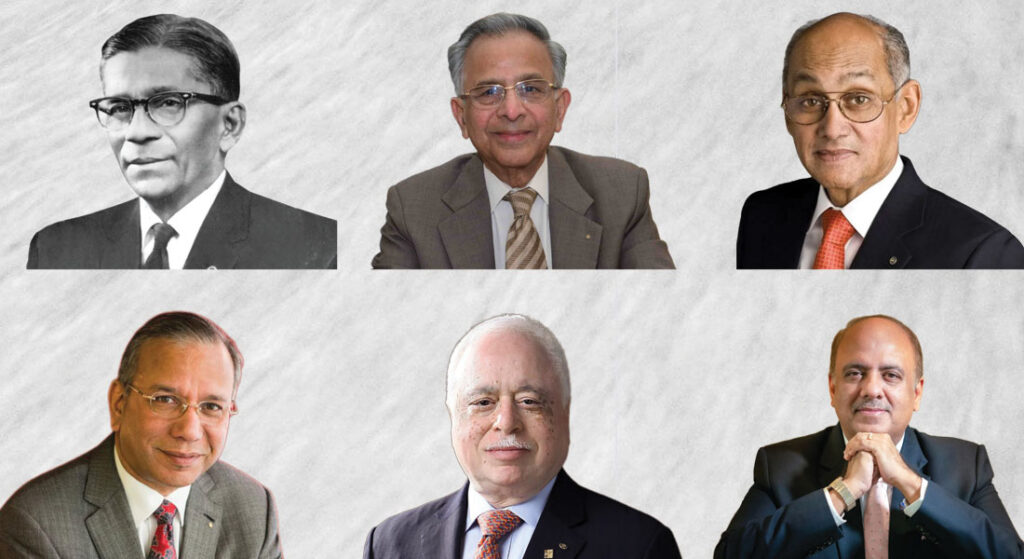
What four decades in Rotary have taught me about the people who lead it.
I have been in Rotary for four decades. In that time I have watched a long line of RI presidents arrive, serve and step away. Some I observed from across a crowded hall. Some I came to know across a dinner table. What follows is simply what I have seen.
They give without counting
The first thing anyone notices is the investing. Time, energy and money, given freely. They have not ever shied away from investing in everything related to Rotary.
Watch where they are and you will understand them. They travel constantly during their year in office. What is less understood is that they travelled long before it, often for years, and often at their own cost. The presidency does not begin with the chain of office. It begins much earlier, in the quiet accumulation of journeys that nobody records.
They see the opening, and they know whom to call
They are not dreamers. They are doers and organisers.
They have a particular eye. They can walk into a community and see quickly where a contribution can be made. They know exactly how to execute and whom to tap for resources.
That second half is the rarer skill. Anyone can hold a plan. Very few can pick up a telephone and know with certainty which three people will make it happen.
They listen, and they can tell the difference
They also listen well. That sounds like a modest virtue. It is not.
Any room is full of ideas. Some are good. Many are merely loud. The ability to sit through both and quietly separate one from the other is what marks these leaders stand out. They do not mistake enthusiasm for usefulness.
Reputation is built slowly
None of this can be bought. They have built their reputations over decades, by showing up, keeping promises and being authentic.
There is no shortcut hidden in that sentence. Do those three things for 30 years and people will trust you with anything. Fail at one of them and no title will repair the damage.
Now the part we speak of less
They have had to pay a price for their involvement in Rotary. I want to be honest about this, because admiration without honesty is only flattery.
The career dims
Many have struggled to hold their professional lives and their Rotary lives in balance. Rotary usually wins. Slowly the business, or the practice, or the career takes second place. It does not collapse. It dims. The person who might have built something larger elsewhere built Rotary instead.
The friendships thin
Some have lost friendships. Not through any quarrel, but through expectation. People they had counted as friends wanted something, a position or a favour or a recognition, and did not receive it. The friendship did not survive the disappointment. That is a lonely thing to discover late in life.
The body pays as well
Then there is the travelling itself. One RI president was so jet-lagged that he walked into a cupboard instead of the bathroom.
I tell that story because it makes people laugh, and then, a moment later, it makes them think. Behind the laugh is a man whose body no longer knew what hour it was. Years of broken sleep, unfamiliar food, shifting time zones, and constant adjustments leave a mark on the health. None of it comes free.
The matchless contribution
There is one more account to settle, and it is by far the largest. Behind every president I have described stands a spouse. Their contribution is matchless. I use that word carefully and I mean it precisely.
They have put their own lives on the line. Their own bodies. Their own aspirations. Careers set aside at the height of them. Ambitions quietly folded away and never spoken of again. Health spent on the same punishing itineraries, in the same aircraft, at the same functions, smiling at the same late hour when the body wanted nothing but sleep.
And they did all of it so that two things could win. Their spouse, and Rotary.
The rest of the family has contributed in no small measure either. Children who grew up with a parent who was often elsewhere. Households run single-handed for months at a stretch. Family occasions marked without the one person everybody wanted in the room.
Inside those families the relationships have stretched, and they have frayed. I have watched it happen. But in the families, I have known most closely they have never broken. That is not luck. It is the result of a patience and a generosity that nobody ever honours from a podium.
We should be honest about the arithmetic. The chain of office is worn by one person. The price is paid by a whole household.
They outgrow the room
Something else happens along the way. They have grown so much that they have outgrown their own clubs and districts.
This is often mistaken for arrogance. I do not believe it is. Someone who has sat in 50 countries and heard 50 ways of solving the same problem simply carries a wider frame. He is not looking down on anyone. He is looking from further back. But it is easily misread, and it can be lonely.
What carries them through
What sustains them is temperament. They are resilient, never say die, and resourceful. Setbacks do not settle on them for long.
They also come to understand power: how it moves, where it rests, how it can be used. The good ones turn that understanding outward, towards Rotary’s work, rather than inward towards themselves.
The lesson they all learn
The last thing I have observed is the most important of all.
They suspend judgement on cultures and learn to embrace different thoughts. They stop assuming that their own way is the standard way, and start treating difference as information rather than as error.
And eventually they arrive at a single sentence that changes how they lead. It is not my idea or your idea but the best idea. That is easy to say and very hard to live. It asks you to let go of authorship, and to be genuinely pleased when somebody else turns out to be right.
The travelling, the giving, and the price quietly paid by them and by the families who carried them, all in service of one thing: finding the best idea, wherever it happens to come from, and then having the grace to get out of its way.
These reflections are my own, drawn from four decades of observation within Rotary. No individual or family is named, and no anecdote is attributed by design.
The writer is a former member of RI Strategic Planning Committee (2011–15), and a mentor to CEOs