
To discover the 2027 Rotary International Convention host city, start by getting lost.
In just a few steps we’ve travelled through 2,000 years of Barcelona’s history… the ruins of a Roman temple; a medieval church sheltering the relics of the city’s martyred patron saint, and a mosaic-covered modernist concert hall. Every corner we turn there are more quaint buildings, more quiet courtyards filled with greenery, and fountains and artwork.
I know I’m jet-lagged, but that’s not why my mind is spinning. Albert Torras, a journalist who moonlights as a tour guide and who has joined me for the afternoon, reassures me. “The best thing to do in Barcelona is to get lost here in the centre,” he says.
I landed in Barcelona a few hours ago to experience for myself the charms that draw so many people to this city, which will host the 2027 RI Convention, June 26–30. Torras, a member of RC Barcelona Alba, and Montse Moral of RC Sant Cugat del Vallès had met me at the Gran Hotel Havana after I regrouped from my flight. The historic luxury hotel, built in 1882, is the home base of the Rotary Club of Barcelona and my home for the next few days.
Barcelona is a very old town, has a lot of history, but it’s also very modern.
As we walked toward the city’s Gothic Quarter, Torras regaled me with the history of Barcelona and its region, Catalonia. Romans founded the city at the end of the 1st century BC, calling it Barcino. In the mid-12th century, Catalonia became part of the Crown of Aragon, which went on to conquer parts of the Western Mediterranean, including Valencia, Sicily, Sardinia, Naples and Athens. “It was the most important country in the Mediterranean from 12–14th centuries,” Torras says.
There’s more to say, but that brings us to where we’re standing right now, at the entry to the Gothic Quarter. The neighborhood was built up around the time that Barcelona was a Mediterranean powerhouse. As we wander around, we pass the ornate Barcelona Cathedral, dedicated to St Eulalia, martyred at the age of 13 during the 4th century persecution of Christians throughout the Roman Empire. And speaking of the Romans, the cathedral is inside the original Roman city. Torras points out the large stone blocks at the base of nearby structures. These are the original Roman walls; the smaller bricks farther up were placed later.
We continue down a narrow street next to the church, and the atmosphere is more subdued. We see the old royal palace with its crown-shaped tower and pass the Archives of the Crown of Aragon, which holds several UNESCO-recognised documents.
To explain those, it’s time for more of that history lesson. In 1469, Ferdinand II of Aragon married Isabella of nearby Castile, setting the stage for the unification of Spain. In 1492, they sponsored Christopher Columbus’ voyages to the New World, launching the country into its role as a global power. Historical documents related to Columbus’ expeditions are housed at the Aragon archives.
The Catalan merchants who found their fortunes in the Americas are responsible for the architecture that Barcelona might be best known for — that of the Modernisme movement.
I get my first taste of the Catalan Modernist architecture just outside the Gothic Quarter in the Palau de la Música Catalana, perhaps the building that stands out most in my postflight brain fog. The UNESCO World Heritage Site is adorned with mosaic pillars with floral motifs and busts of famous composers. If you don’t have time for a tour of the inside, go around the corner and grab a coffee from the first-floor café, where you can admire the ceramic flowers and stained glass incorporating the natural themes typical of the movement.
My Rotary friends promise me a lot more Modernisme the next day, but for now, it’s starting to rain, forcing us inside for a coffee break. As the rain slows, the city practically glows. I say goodbye to Torras and head out with Moral to walk down La Rambla, Barcelona’s famous pedestrian boulevard. The street is known for its vibrant atmosphere, but it’s quiet this evening as the weather keeps the crowds away.
We turn into Plaça Reial, and Moral spreads her arms wide. “Enjoy,” she says. I can see why: The square is closed to vehicular traffic and filled with palm trees, giving it the feeling of an oasis in the city. It’s lined with classical-style buildings that are home to restaurants and nightclubs.
Moral suggests a selfie by the fountain in the centre, but before we can snap our photo, she’s stopped by a group of young people who ask her to take their picture. They’re working for an international employer here in Barcelona, coming from Portugal, Brazil, Germany, and elsewhere. Moral happily obliges. “Barcelona is a very old town, has a lot of history, but it’s also very modern,” she says. “It has a lot of young people. It’s innovating all the time.”
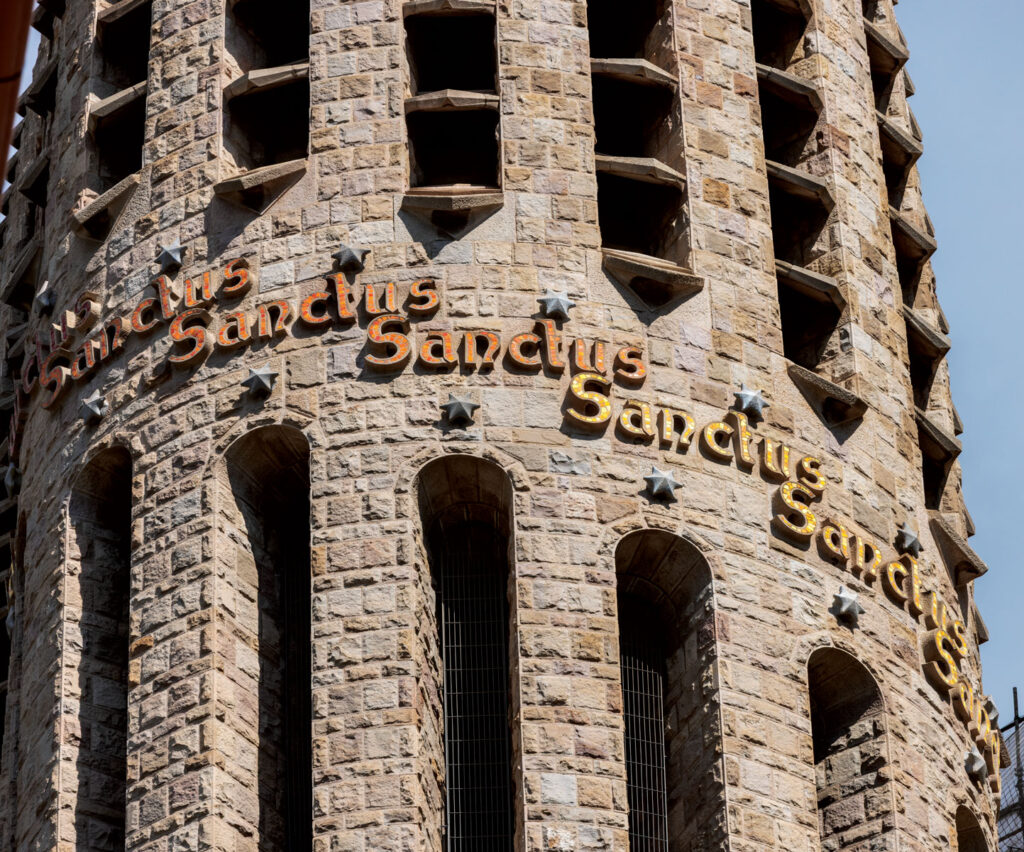
Antoni Gaudí is practically synonymous with Barcelona. I only had a few hours to see a sampling of the architect’s fantastical works, but you could easily dedicate all of your spare time in the city to viewing his masterpieces. Which you might need to do. Because no matter how long I observed his stunning creations, I could not find the language to describe the whimsical fairytale buildings and park that Gaudí designed. “You can stay there one hour looking at things and realise there are things you have not seen before,” says Aleix Martorell, a member of the Rotaract Club del Vallès, as we take in Gaudí’s architectural wonder, the Sagrada Família Basilica, the tallest church in the world.
Gaudí began work on the basilica in 1883, and it’s been under construction ever since. On June 10 this year, the 100th anniversary of Gaudí’s death, Pope Leo XIV blessed the church’s recently completed spire, the tallest of the 14 that adorn the church. Want to step inside and view the basilica’s giant tree-like columns and a ceiling that mimics a forest canopy? Best to prebook tickets, which I intend to do when I return for the convention next June.
As we walk around the enormous building, I chat with Tomàs Masucci of the Rotaract Club of Barcelona-Diagonal, whose parents met as Rotaractors. The 20-year-old has been a Rotaractor for two years, and he lives about a 15-minute walk from the basilica.
“It’s very important to know the city,” he advises. “Walk around the streets, know how the people live here. We have buildings you can’t find in other parts of the world, like the Sagrada Família, like other Modernisme buildings. It’s a thing we only have here in Catalonia.”
During the 19th century, Barcelona saw booming industry and growing wealth, while the rest of Spain fell on harder times. The conditions gave birth to a growing regional pride among Catalans still evident today, and Modernisme was an expression of this. Rich patrons hired Catalan architects to design even more extravagant buildings. Though the artistic movement began to fizzle in the early 1900s, today you can find hundreds of properties in the city with modernist elements, nine of which are on the UNESCO World Heritage List.
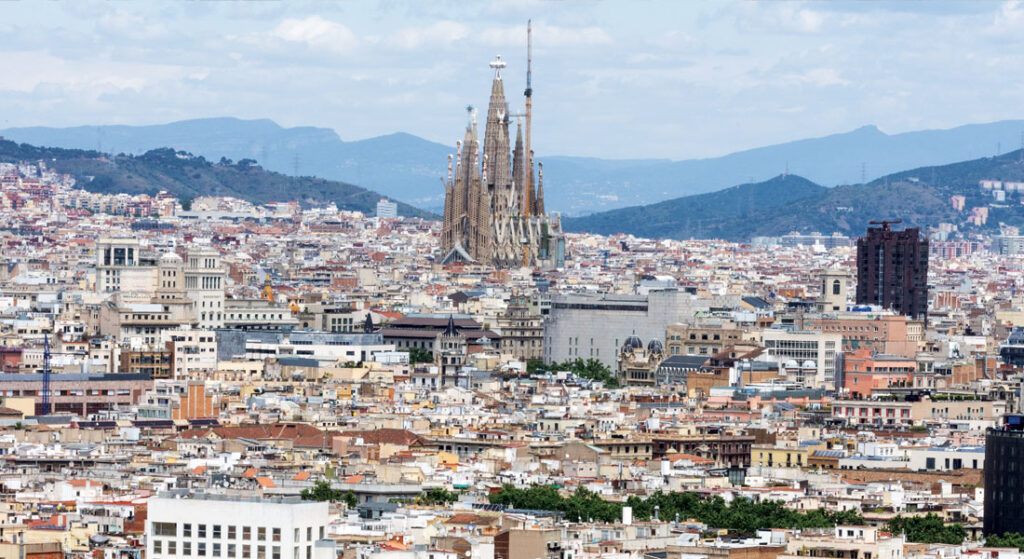
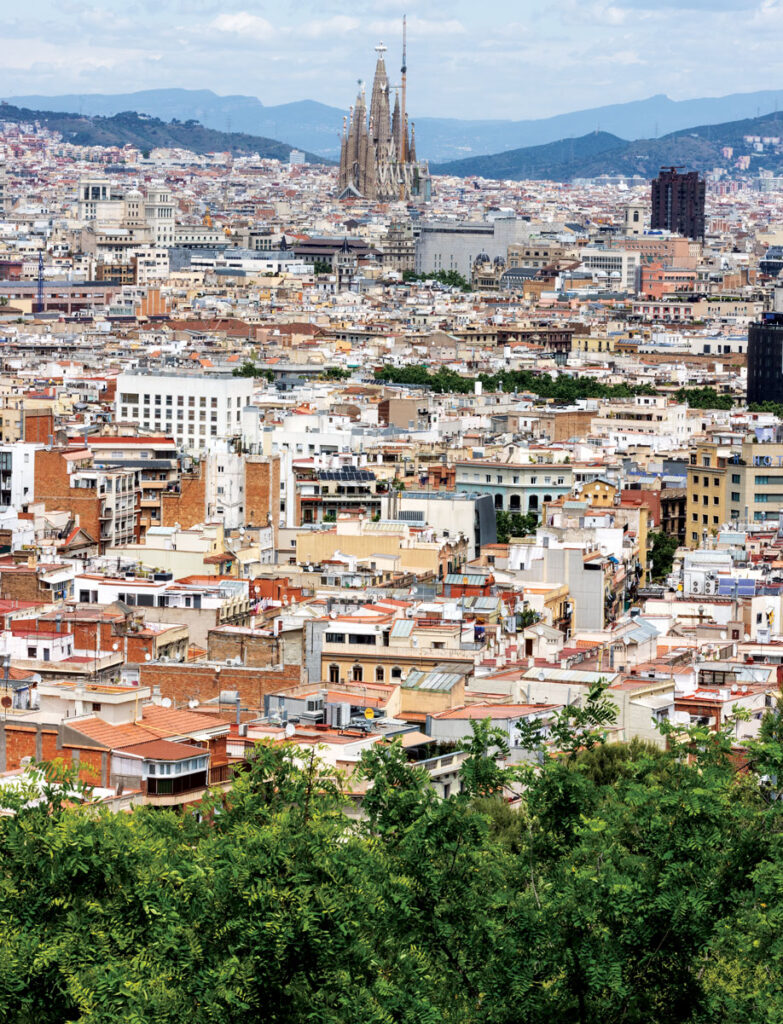
Gaudí’s Sagrada Família is otherworldly as it rises out of the patchwork of buildings below.
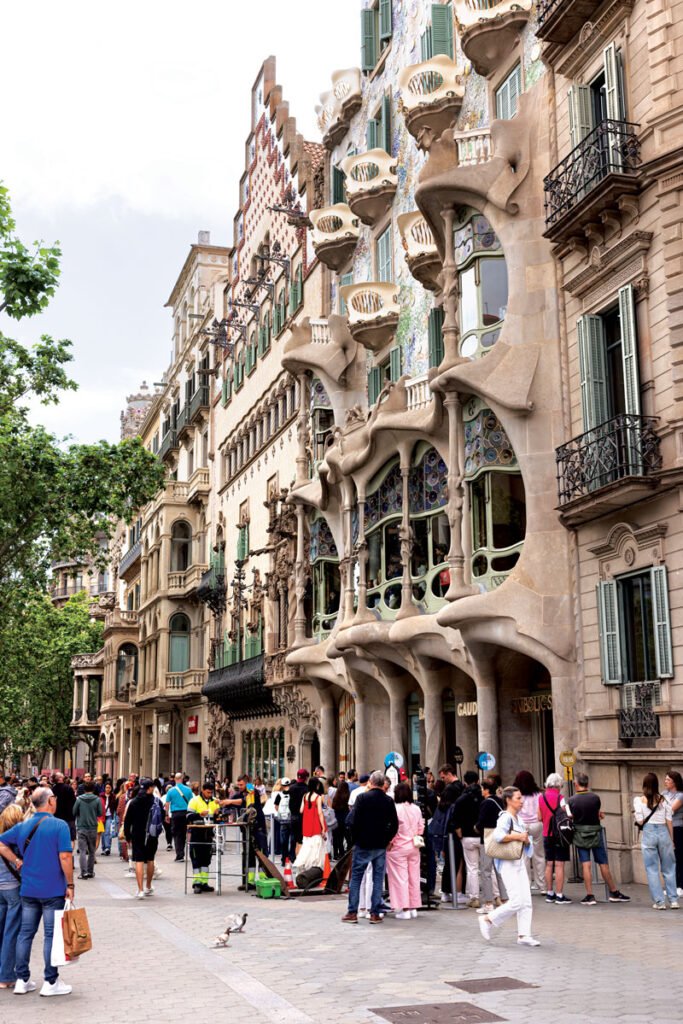
We head over to the elegant Passeig de Gràcia, the epicentre of Modernisme in the early 20th century. Here you will find two more Gaudí-designed buildings only a few blocks apart: the undulating Casa Milá and the magical Casa Batlló with its roof scaled like a dragon’s back. While you’re strolling, check out the street’s ornate lampposts with their mosaic-tiled benches and the decorative sidewalk tiles called panot. And when you’ve had your fill of architecture, Passeig de Gràcia offers an array of luxury shops, including Cartier, Prada and Chanel.
After a full morning of sightseeing, I’m famished. Luckily, two new Rotary friends are about to show me what the Mediterranean way of life is all about.
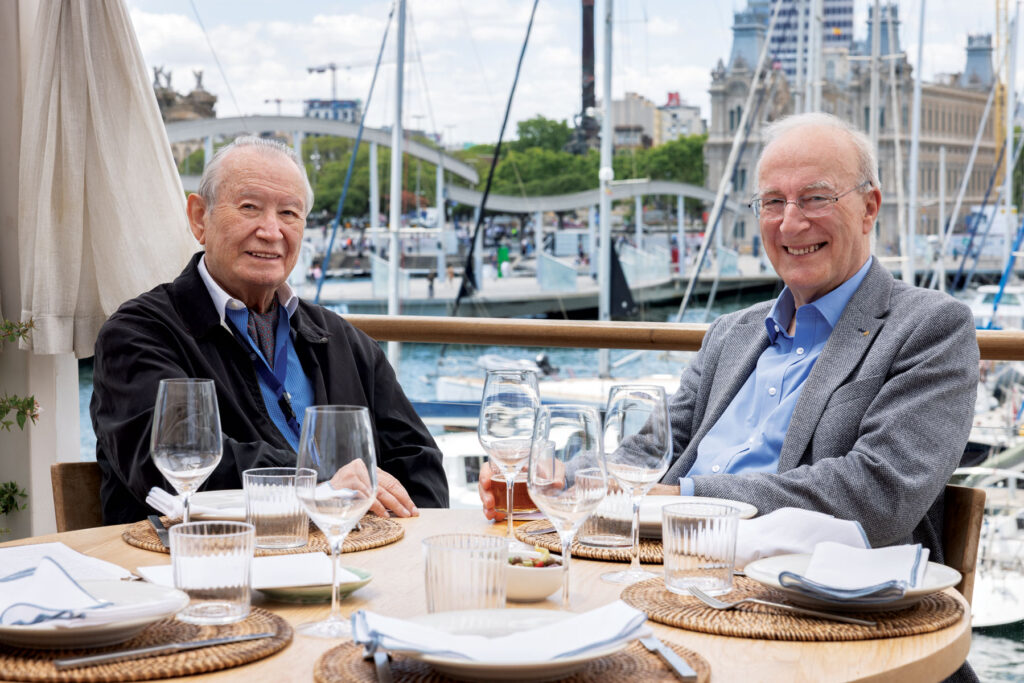
Sergio Aragón and Julio Sorjús are sitting on the terrace of the Reial Club Marítim de Barcelona, beers in hand and a small dish of multicoloured olives on the table. Flags on the many sailboats in the century-old yacht club’s marina waft in the gentle breeze. Cable cars soar above the sea, and in the distance, people amble across the Rambla de Mar, a wavy wooden bridge that extends Barcelona’s famous pedestrian street across the water to historic Port Vell.
I take a seat on the terrace, and Aragón explains that although Barcelona is a coastal city, it lived for most of its existence with its back to the sea. The city had developed within the Gothic Quarter I’d seen earlier and later extended as the old walls were knocked down in the 19th century (the name for this newer part of the city, ‘L’Eixample,’ means ‘expansion’ in Catalan). But the waterfront was used for heavy industry, and locals rarely visited.
All that changed with the 1992 Barcelona Olympics. “There was a great transformation in the city, and one of the things that transformed was the waterfront,” says Aragón, chair of the convention’s Host Organisation Committee. “All this area was restructured in order to make it much more attractive.” Today, Port Olímpic is home to hotels, shopping, restaurants, nightlife and beaches. “It’s fun to just walk and spend the day there,” he says.
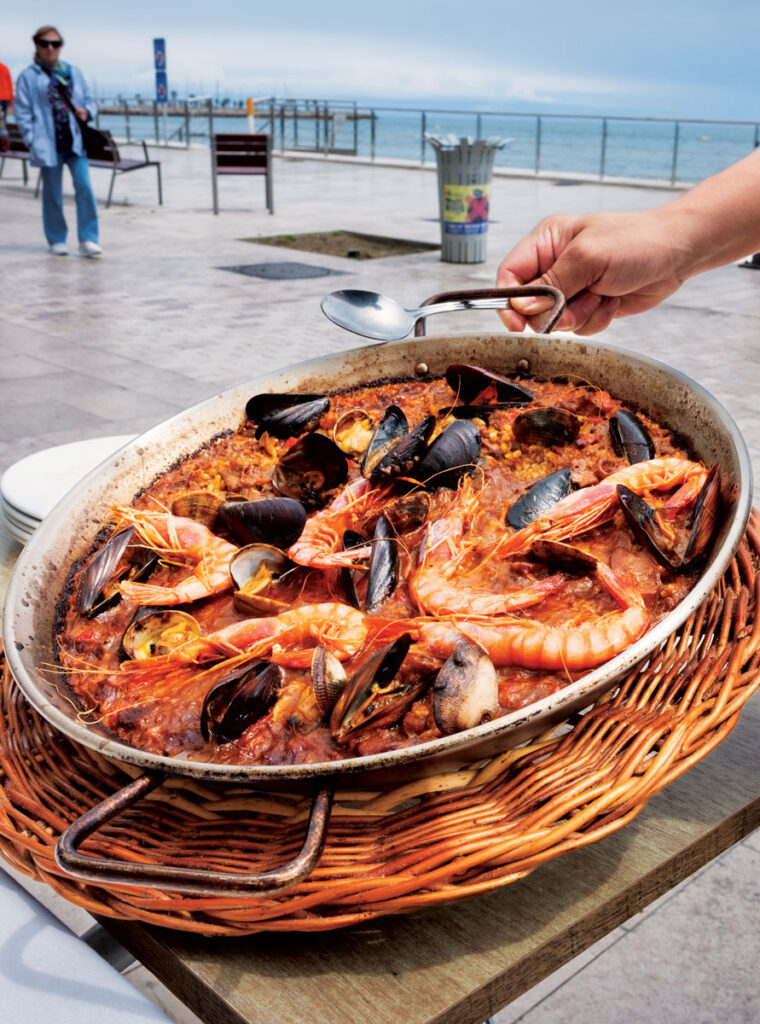
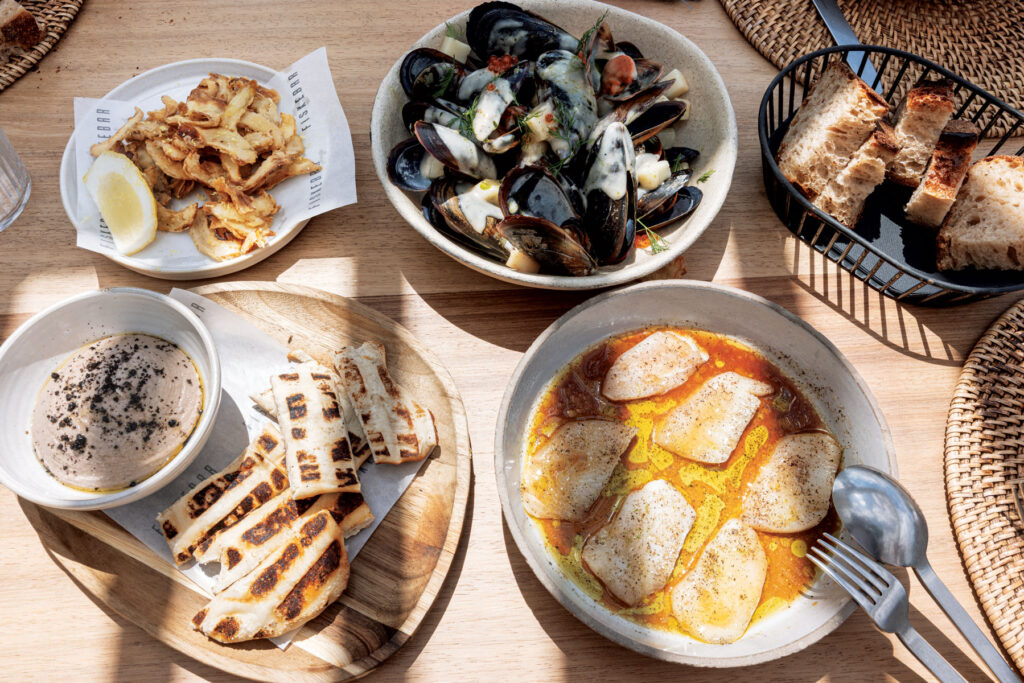
As we chat, waiters whisk out tapas, the small, shareable plates that Spain is famous for: fried artichokes, calamari, mussels, a smoky eggplant dip, a lemony fish crudo. We drift from our conversation about the city to talk about everything from wild boars to coffee culture. (“I don’t mean to exaggerate,” Aragón says, “but the two places in the world you can get the best coffee are Italy and Spain.”) Sorjús, a past RI director and the HOC chair in 2002 (the last time the Rotary Convention was in Barcelona), quizzes me about Santiago Calatrava, the Spanish architect responsible for the most famous landmark in my hometown of Milwaukee: a breathtaking pavilion added to the city’s art museum. As we talk, I pause occasionally for a taste of food followed by a contented sigh. So good.
It’s all this — the food, the culture, the friendliness — that Barcelona Rotary members will share with convention attendees come June, says Aragón. “Barcelona is a very attractive city,” he adds. “It’s a cosmopolitan city. It’s friendly, it’s easygoing. The Mediterranean atmosphere and the surroundings make it a very attractive place.”
Aragón attended his first Rotary convention in Portland, Oregon, in 1990. He was drawn to the opportunity to see the magnitude of Rotary and the ease with which you can make connections. “You start friendships which then last many, many years,” he says.
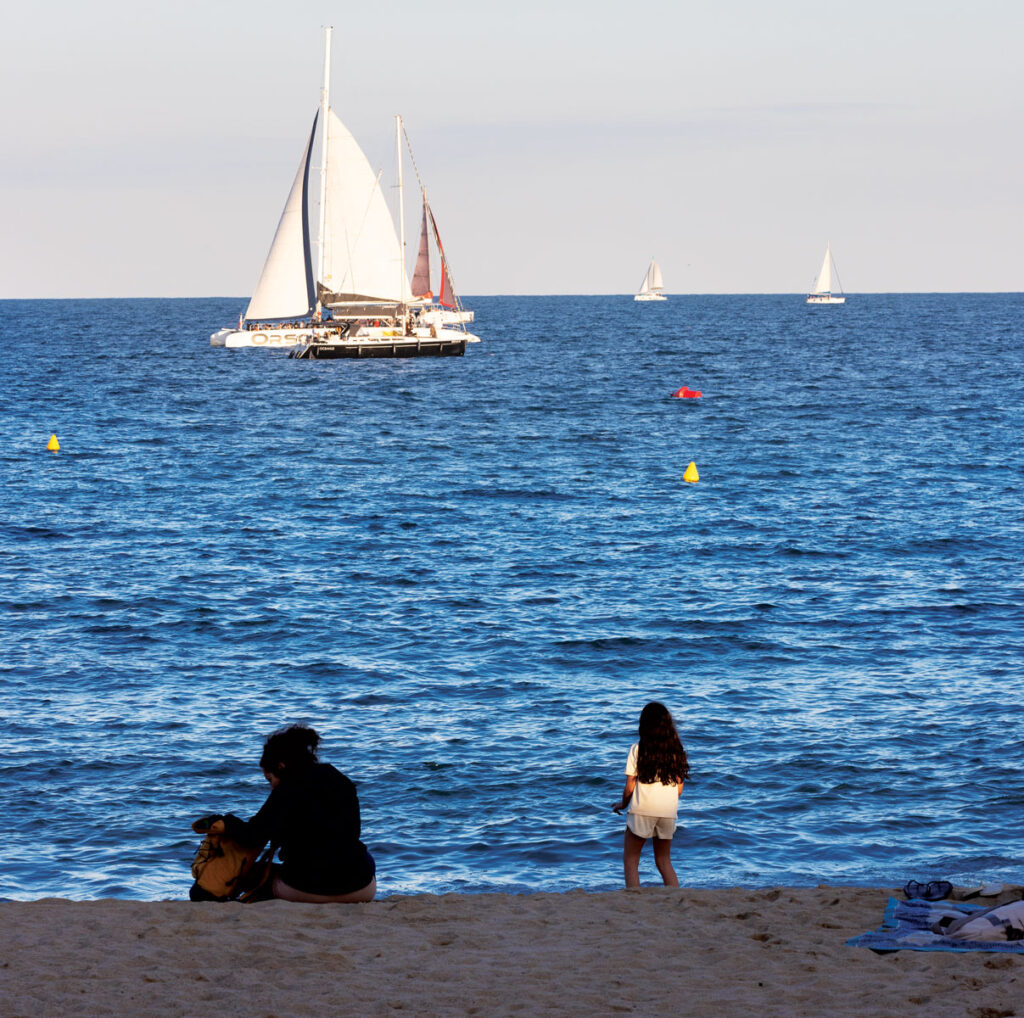
The meal has left me stuffed and sleepy. After I’ve had a chance to indulge in another Spanish tradition — the afternoon siesta — I head back to the waterfront for an evening stroll on the promenade along Barceloneta Beach. Palm trees flank the path, and those people who aren’t admiring the view from a blanket on the beach are hitting a volleyball or engaging in a pickup game of soccer.
Hundreds of runners fly past, waving flags and blasting music on boomboxes they carry on their backs. I stand and watch, tempted to join them, swept away by the energy of the city.
In Spain, bullfighting is a legally protected part of the country’s cultural heritage, though one that faces growing opposition. While the last bullfight in Barcelona took place in 2011, you can experience a part of that history with a visit to Las Arenas de Barcelona, only a few stops on the Barcelona Metro from the convention site. The bullring opened in 1900 and saw its last fight in 1977, standing empty for years before being restored as a shopping centre. Today, you will find dozens of shops, a cinema, and places to indulge in food and drinks.
“Maybe we don’t like nowadays the bullring, the bulls, and all of that,” says Laia Marín, a member of the Rotary Club of Barcelona and an architect who worked on the restoration project, “but it was our culture and our history.”
While bullfighting is in Barcelona’s past, Marín says that they are working to bring other traditions to the Rotary convention come June. “We are planning a very cultural convention, where, if Rotarians come here, it’s easy to get the experience of the Catalan culture,” she says.
Marín, who joined the Rotary Club of Barcelona in 2013 after spending time as a Rotaractor, went to her first Rotary convention in 2019 when it was held in Hamburg, Germany. There, she enjoyed learning about everything going on in Rotary beyond her club. “When you are in an international convention,” she says, “you see what is working.”
Marín takes me up to the arena’s rooftop, where you will find 360-degree panoramas of the city, along with restaurants where you can linger and savour the sights. It is, explains Marín, a favourite place to bring visiting Rotarians for dinner. “You can see the sunset, you can see Montjuïc, all of that,” she says.
That’s where we’re headed next: Montjuïc, or ‘Jewish Mountain,’ so named for a Jewish cemetery that stood on the hill in the medieval era. There’s also a massive forested urban park that was developed as the site of the 1929 International Exhibition and later renovated for the 1992 Olympics. Today, as you wind through its paths, you’ll find sports venues, museums, gardens, and Montjuïc Castle.
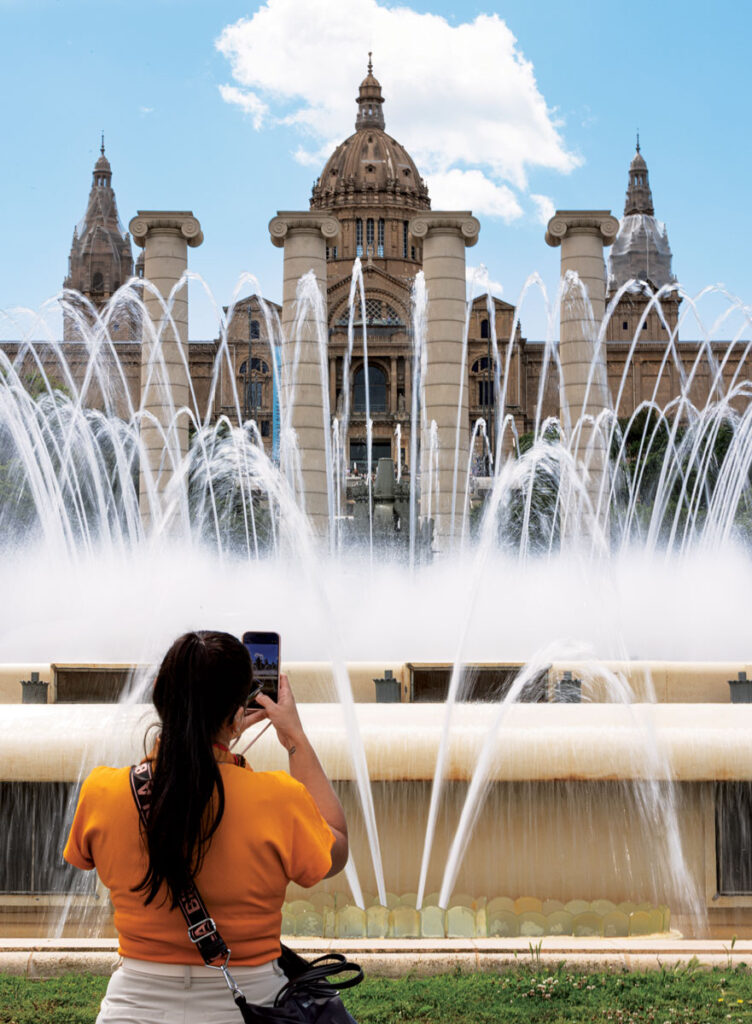
From Las Arenas, we walk from the roundabout at Plaça Espanya and along a street lined with fountains until we reach Font Màgica de Montjuïc, an enormous ‘magic fountain’ where you can see choreographed light shows on select evenings (check online for the current schedule). Even during the day, the mist and shade trees make a nice respite from the summer sun.
We hop on an escalator that takes us up past a series of waterfalls to the terrace of the Museu Nacional d’Art de Catalunya. You can join the crowds sitting on the steps in front of the art museum, originally the 1929 exhibition’s National Palace, for sweeping views of the city.
It’s here that I realise just how massive Gaudí’s Sagrada Família really is. It’s otherworldly as it rises out of the patchwork of buildings below. The church was built to be slightly shorter than Montjuïc, and none of Barcelona’s other buildings are taller than the church.
We continue meandering through the park until we reach the springboard diving pools from the Barcelona Olympics; at the time, the site was immortalised in numerous photos of Olympians diving here with the skyline in the background. Today, the space has been converted into an open-air restaurant, Salts Montjuïc, and from our table, we enjoy yet more spectacular views of this magnificent city.
Albert Torras, my Gothic Quarter tour guide, joins us, looking dapper in preparation for the opening of a photography exhibit he helped organise. We’re here to partake in another Spanish tradition, la hora del vermut: the pre-meal ‘vermouth hour’. While my experience drinking vermouth, a fortified wine, is limited to a cocktail mixer, in Spain it’s served as its own drink — on the rocks, white or red — as an aperitif along with something to nibble on. “It’s typically before lunch, or before dinner, or when you wake up,” Torras jokes. “When you want.”
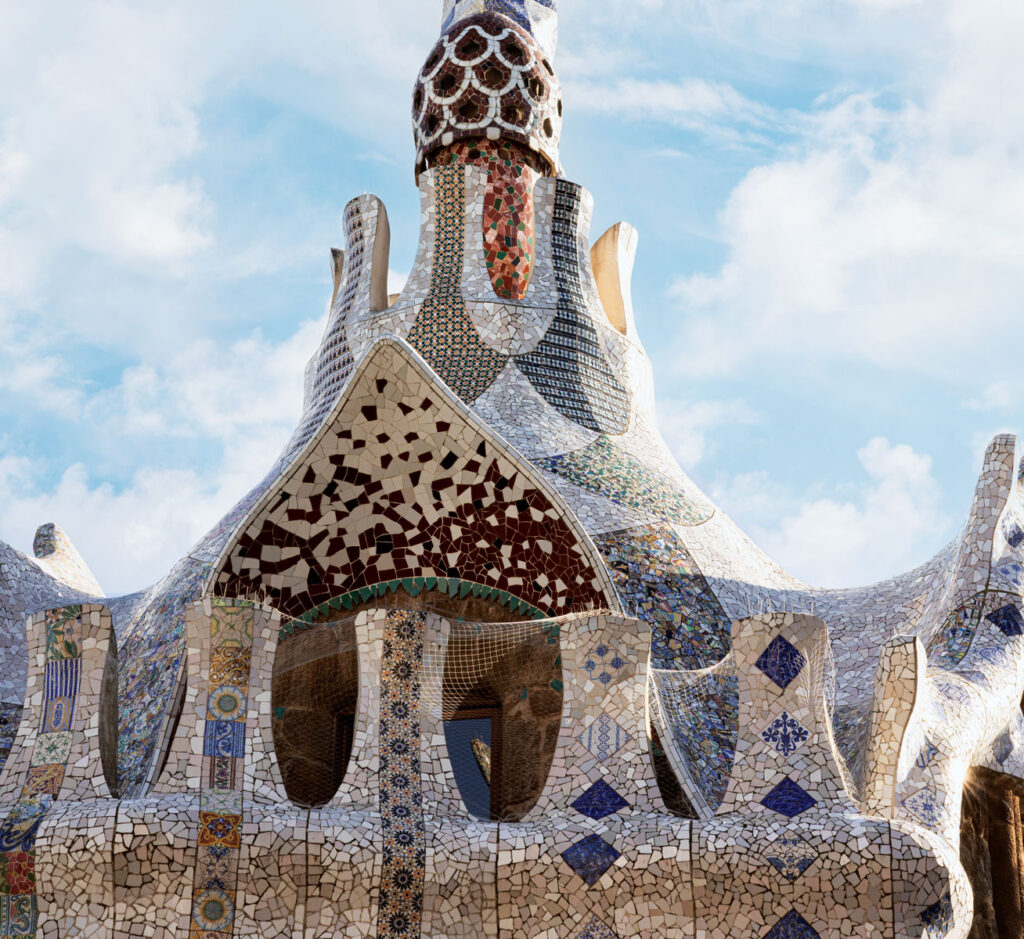
I pause to catch my breath at my hotel before meeting back up with Aleix Martorell, one of my Rotaract friends from the previous day. This time, we’re heading for Park Güell, a Gaudí-designed public space with more panoramic views of the city. Eusebi Güell, a longtime patron of Gaudí’s, commissioned the artist to design a housing development for wealthy families. The venture proved to be unviable, however, and only two of the envisioned 60 houses were built. Gaudí lived in the show house with his father and niece, and after Güell died, the city purchased the park.
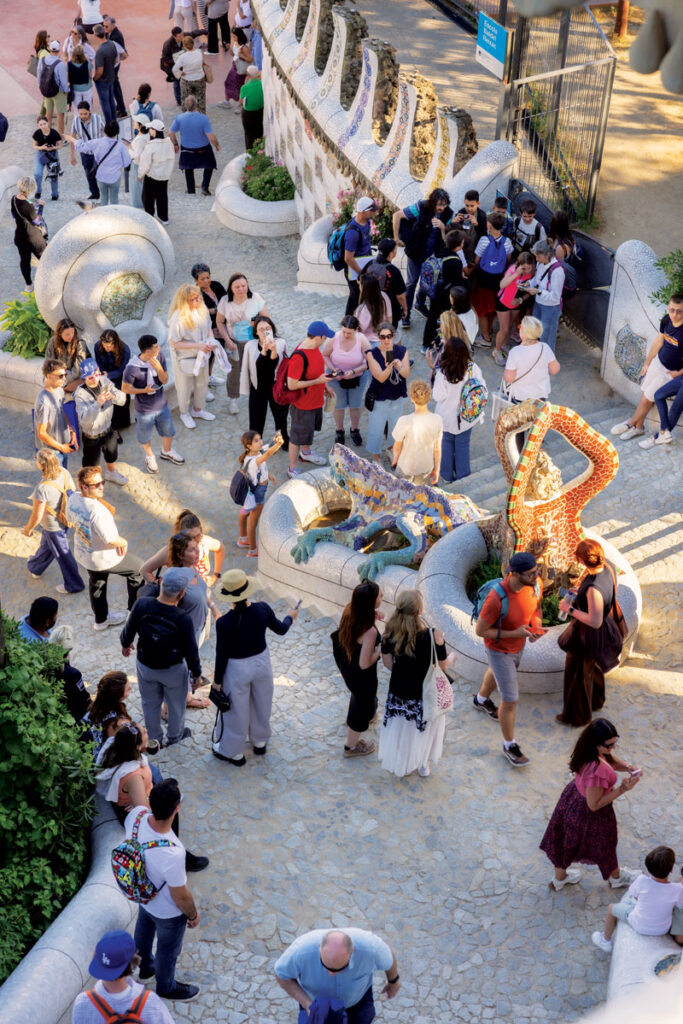
That’s lucky for us, because what remains looks like it could come straight out of a Disney movie. The most photographed landmark in the park is a mosaic salamander known as El Drac (“the dragon” in Catalan), halfway up a double staircase at the main entrance. But my favourite part, on the terrace above, is a colorful mosaic-tiled bench in the shape of a sea serpent that snakes along the plaza’s edge. Gaudí popularised this style of mosaic, made of broken ceramics or glass, known as trencadís (and the inspiration for the logo of the 2027 Rotary Convention).
As I ooh and ahh at every turn (fairytale-like stone viaducts! houses that look like they belong in Candy Land!), I ask Martorell how people in Barcelona feel about Gaudí: Do they like all of this, or are they sick of being known for him? He assures me that the art is a welcome part of the city’s identity. “People are very proud,” he says.
Dusk begins to fall, and we head to the rooftop bar Tope, ostensibly for sunset photos of the cityscape and the neighbouring pickle-shaped Torre Glòries, a skyscraper that lights up at night. Music thumps and a string of lights illuminates the tables. It’s time for a toast, to another day in Barcelona, to a city that’s both fantastic and fantastical.
Photography by Monika Lozinska