
RID 3141 under Motwani’s leadership shines a candle
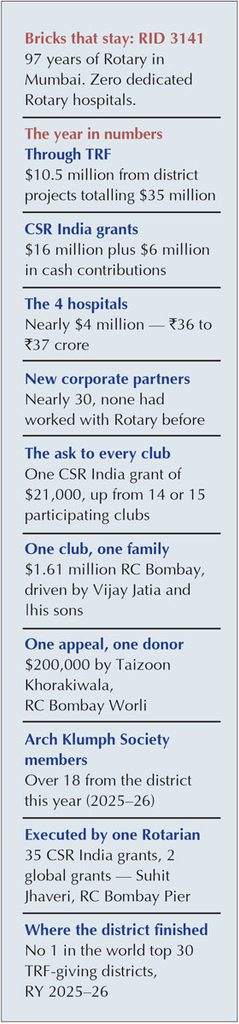
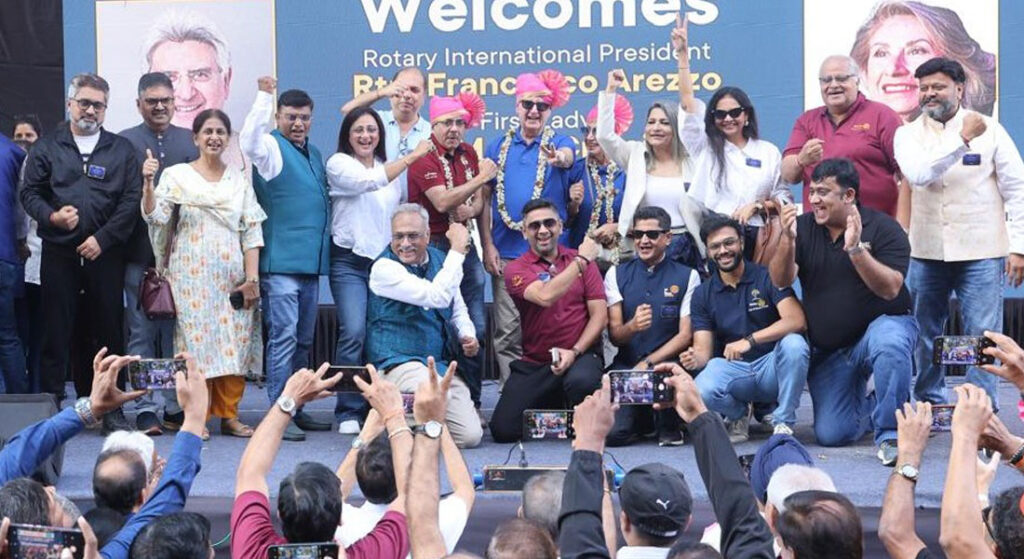
IPDG Manish Motwani’s RI District 3141 helped India to emerge second globally in TRF-giving with a contribution of $45 million, making this (2025–26) a Rotary year India will remember with pride. His district built four dedicated Rotary hospitals, routed $10.5 million through TRF, and finished first among the world’s top 30 TRF-giving districts.
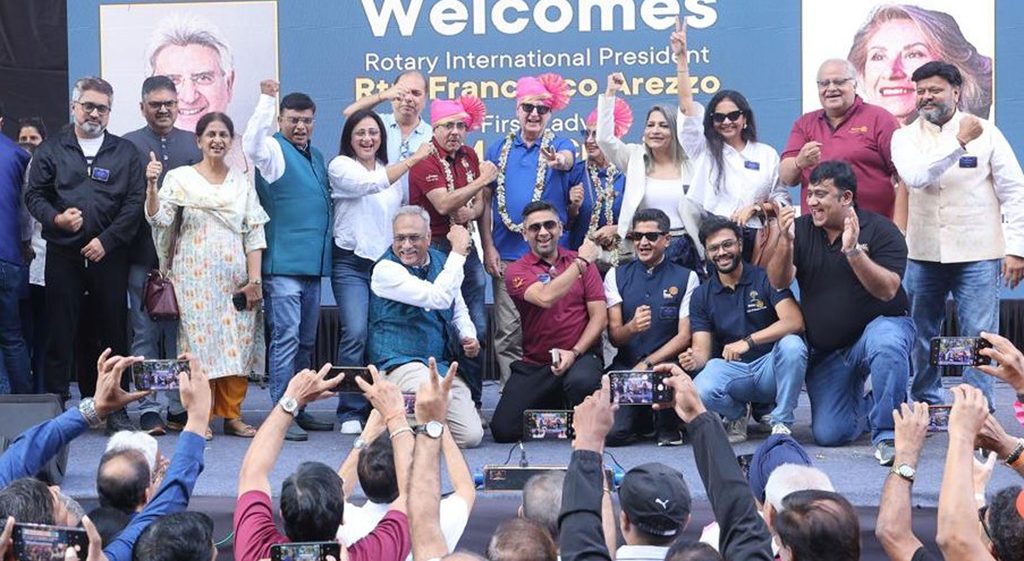
This became possible with RC Bombay Pier president Noopur Desai, Kushal Desai and Sunnil Mehra, who backed two hospitals and cardiac path labs. Motwani says that Suhit Jhaveri “operated like a one-man machine,” executing 35 CSR India grants and two GGs. PDG Sandip Agarwalla and Vijay Jatia of RC Bombay, under president Bimal Mehta, followed; Jatia and his sons crossed $1.61 million as AKS members.
He was able to achieve this feat, he adds, by “convincing our clubs to break out of their comfort zones.” Only 14 or 15 clubs had ever touched a CSR India grant. Armed with templates such as pink autos, vocational centres, school renovations and gaushalas, clubs were coaxed higher. “You don’t need to put money out of your own pocket. You just need the passion to ask.”
What kept him going was not strategy, but his partner Dr Mahek Motwani, his “constant sounding board.” The moments that mattered were first- timers crossing the line, his home club, RC Mulund Hill View under Kashmira Ganatra, completing two grants.
CSR India grants brought $16 million, plus $6 million in cash, one appeal alone drew $200,000 from Taizoon Khorakiwala of RC Bombay Worli. Four flagship projects — two heart hospitals, a cancer hospital, an eye hospital, raised nearly $4 million.
Motwani admits that his “guiding star was RI director K P Nagesh, who was clear in his vision, followed by TRF trustee Bharat Pandya, who believed and backed the model early, and his inner core team of K K Choudhary, Kishor Parekh, Saurabh Sonawala, Kanderp, Deepak Choudhary, Ravi Jaswani, Bhagwan Patil and Monica Grover.
But RC Bombay itself, under Bimal Mehta, became a throbbing engine. Nikunj Jhaveri moved the logistics and Yogesh Zaveri kept the pledges flowing. Meena Choudhary anchored the details while Tehmina and Kanderp Khandwala worked at the ground level. Bina and Paresh Dattani, Bharat and Neelima Jhunjhunwala, and Smita Parekh didn’t just give, they turned pledges into permanent hospitals. Across Mumbai, other clubs caught the current, RC Bombay Worli under Dr Paula Goel, RC Bombay Bayview under Sonali Shah with Urvi Mody and Vidya Moorjani, RC Mumbai Royales under Deepika Sharda, RC Queen’s Necklace under Apoorva Shah with Sanjiv Mehta, RC Bombay Queen City where Sonal Agarwal backed CSR grants, RC Bombay Central where Fanny and Ashit Mehta gave further.
Motwani, who is a bariatric surgeon at Aastha Bariatrics, smiles and adds: I carry that operating-room discipline into everything, Rotary included.”
RID 3000 led by Karthik tops the world in membership
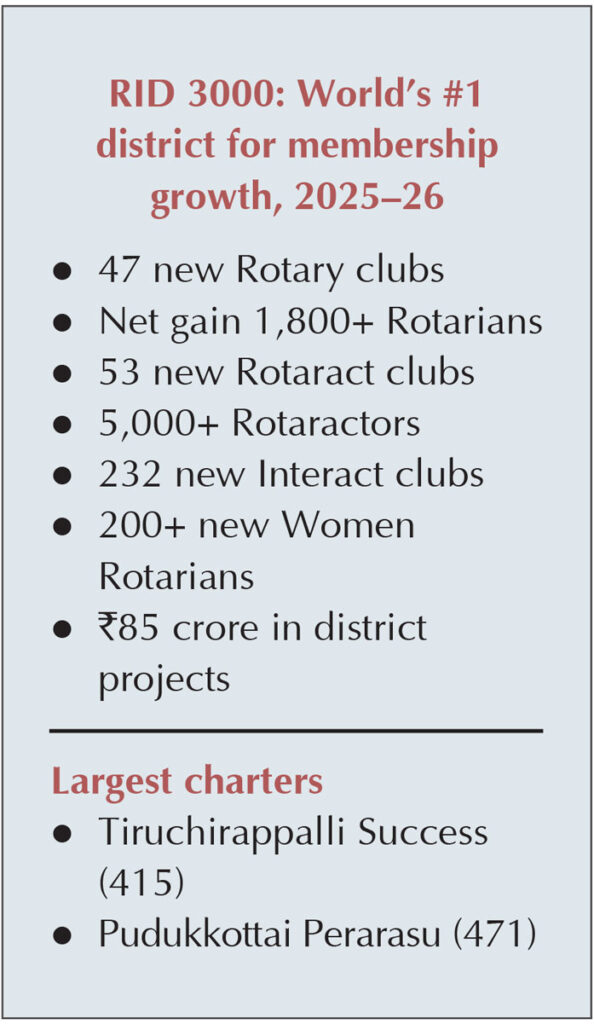
Forty-seven new Rotary clubs, 53 Rotaract clubs, 232 Interact clubs, a net gain of over 1,800 Rotarians and more than 5,000 Rotaractors in a single Rotary year. With all this, RID 3000 led by DG J Karthik, was named the world’s no 1 district for membership growth in 2025–26.
A third-generation Rotarian, Karthik traces the first spark to a Rotary News feature on RC Chennai Icons, which had been chartered with 225 members. He shared the idea with Rtn Vijayalayan, and together they aimed higher, chartering RC Tiruchirappalli Success with 415 members. “That challenged the conventional idea of what was possible,” says Karthik.
Explaining how the district achieved the global feat, he says, “We did not impose 1:2:3 (one new club, two Rotaracts, three Interacts from every existing club) as a mandate. We reframed it. We made the clubs architects, not assembly lines.” The emphasis was on breaking a large target into manageable steps. “When you look at a target of 50 or 100 new clubs, it can seem overwhelming. If every existing Rotary club sponsored one or two new clubs, the overall target became much more achievable.”
The approach also helped clubs that had lost momentum. RC Trichy Dynamic, for instance, had 24 members, but had dwindled to 12 active members. Those 12 members went on to sponsor a new club. “What changed was their mindset,” Karthik says. “Sometimes, a club begins to thrive not when it first adds members, but when it regains the confidence to lead.”
The district did not attempt to create an entirely new formula. “One Disha idea stayed with me — PRIP Shekhar Mehta’s ‘Each One, Bring One.’” It became central to the district’s membership approach.
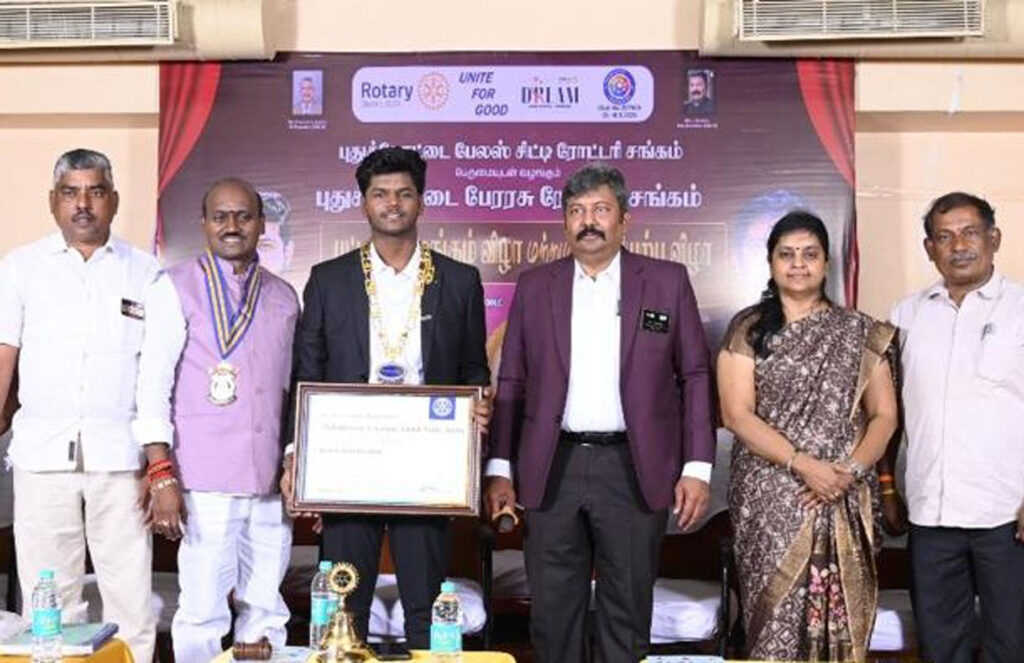
The effort was also a collective one. Guided by RI directors K P Nagesh and M Muruganandam, the strategy took shape under district learning facilitator PDG P Gopalakrishnan, with membership chairman Shanmugavel and his team, regional coordinators and assistant governors. Karthik says the scale became possible because no single person was expected to carry the responsibility. Initiatives like ‘DREAM Dozen+’, ‘RAG Analysis’ and ‘1 AG — 1 new club — 25 new members’ turned ambitions into specific action. Women’s membership grew by over 200. Murugaraj led RC Pudukkottai Perarasu to charter 471 members.
But Karthik identifies retention as the biggest challenge. “The responsibility does not end with bringing people into Rotary; we also have to give them reasons to stay engaged.” The district ran projects worth ₹85 crore, organised a ‘Business RYLA’ and several orientation programmes.
For his successor, he has a simple message: “Build something the next person wants to build on, not something they feel they have to beat.”
The writer is a past president of RC Hiranandani Estate, RID 3141