

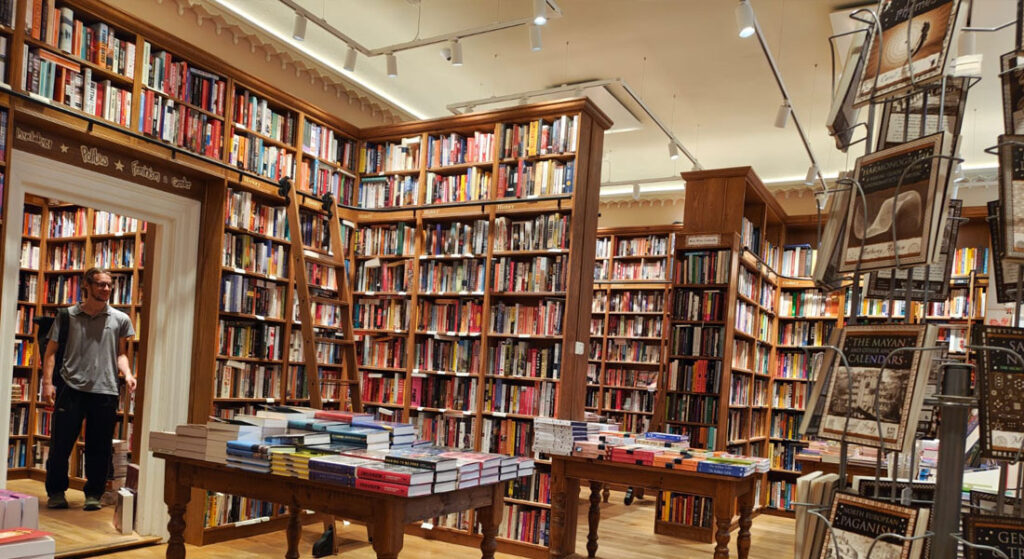
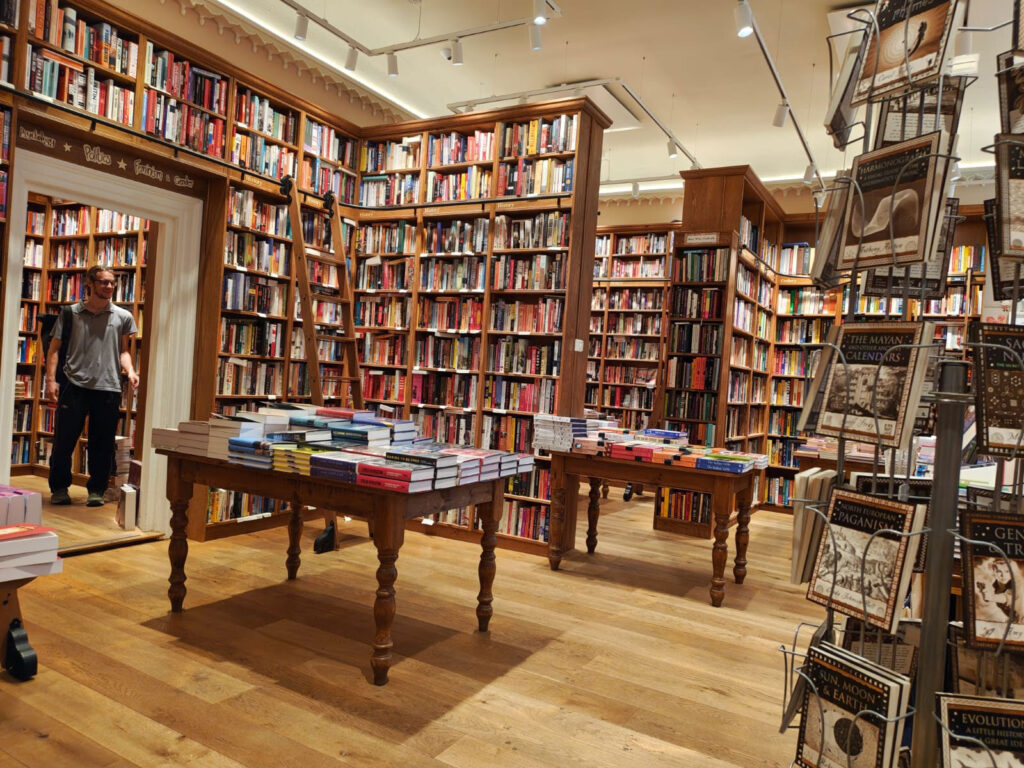
Such joy scanning the shelves and buying books from the most amazing bookshop ever… in a city named for Roman baths!

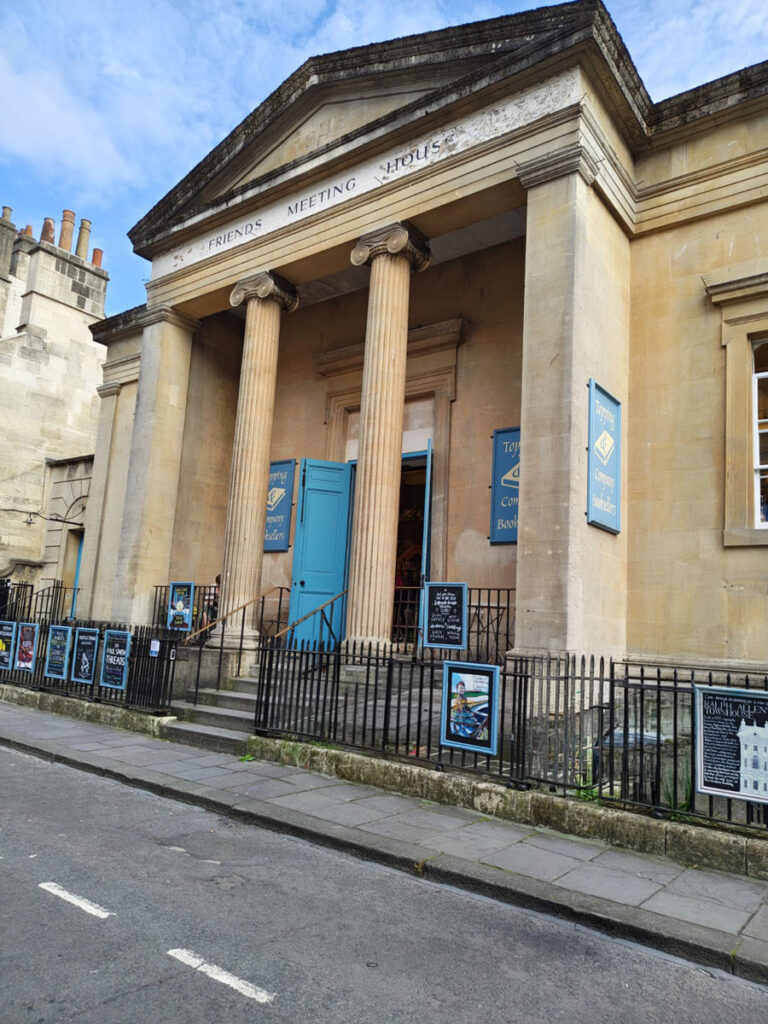
Imagine exploring room after room after room and browsing shelves stacked ceiling-high with books, books and more books, all minutely categorised, wooden ladders leaning against them, tables overflowing with titles, and chairs to sink into to salivate over your cache. This was the highlight of a recent visit to the English city of Bath famous for Roman hot springs and Georgian architecture. Topping and Company Booksellers is one of several bookstores there. It boasts some 80,000 titles — yes, 80,000 — and gets a steady stream of visitors from all over the world. It hosts authors and events at the store and elsewhere practically every day; Arundhati Roy and Elif Shafak, for instance, were there. Interestingly, just a short distance away, Waterstones had prominently displayed Roy’s Mother Mary Comes to Me.
Across short forages over two days, we managed to fish out some wonderful titles from Topping. (Oh, if only there were no weight restrictions on air travel!) A British Childhood: How Our Children Live Now is a reflection on schooling in the UK by the 2024–2026 Children’s Laureate Frank Cottrell-Boyce who, apart from being a novelist, is also a screenwriter and, along with Danny Boyle of Slumdog Millionaire-fame (based on Q&A by Vikas Swarup), had co-created the 2012 London Olympics opening ceremony. As Laureate, he travelled around the UK meeting children in schools, libraries, institutions, prisons, and saw first-hand the precarious circumstances in which many children are forced to grow up. The book captures reflections on his own childhood and the childhood of young people today, and offers insights into the gaps and loopholes and failures of systems and communities in the care (or lack) of a nation’s most vulnerable population.
Although Boyce’s observations are about the situation in the UK, much of what he writes could quite easily apply to children and circumstances in other parts of the world. For instance, we often hear parents complain of having to tell or read the same story to their child ad nauseum. Boyce points out that in the early years of a child’s life, “it’s not about cultural capital or a rich vocabulary. It’s about making a space for a profound emotional connection.” As the blurb from the Guardian review says, “(Boyce’s) clarion call about the loss of delight and safety in children’s lives is also a reminder of the sheer magic of reading.” Reading this book compelled me to buy (from Topping) and read Millions, his debut novel which went on to win many awards and was also made into a film. It centres around a bag of pounds (GBP) landing in the lap of two small boys and the fallout of this weird happenstance! Millions may be a book for children, but it guarantees a delicious and thought-provoking adult read.
Another book that we fished out from this labyrinthine bookstore was The History Trees: Extraordinary Tales of Trees Through Time by Colin Slater. The book features the stories of some 60 trees from all over the world that have withstood the seasons over hundreds, even thousands of years. Trees are solid, except when their trunks are hollow, which is a rarity. So, then, what do you have to say about the Boab Prison Tree of Australia? In Wyndham, Western Australia, when “a sharp-eyed policeman in the 1890s spotted a hollow baobab on the road from the gold mines into town, he immediately thought of a good use for it. An officer cut a hatch into the trunk and for the next few decades, the tree served as a holding cell for prisoners on their way to the Wyndham courthouse”! Apparently this 1076 square foot space could hold some 30 people! This one is believed to be more than 1,500 years old.
In comparison, the Tree of Life in Bahrain is a toddler, at only some 442 years as determined by dendrochronology (tree ring dating). What’s interesting, though, is that it is one of two curiosities in this arid archipelago of some 50 natural and 30 artificial islands that are 90 per cent desert. The other is Bahrain’s very first oil well, now in disuse, and indicative of the fact that Bahrain will sooner than later exhaust its oil resources. The tree, with long roots and the ability to survive in dry conditions, is believed to have been planted in 1482 when the Portuguese briefly ruled over the region.
Leif Kullman and Lisa Öberg were conducting a census of trees on Fullufjället mountain in Sweden when they came across a particular Norway spruce, a pretty unprepossessing-type tree. They found that its trunk was a few hundred years old but its root system, determined through a process called vegetative cloning, was much older. Radiocarbon dating revealed that its root system was born from a seed that had germinated 9,565 years ago! They named the tree Tjikko, after their beloved pet dog. And so, Old Tjikko it is.
In this context, we cannot miss mentioning Thimmamma Marrimanu, the world’s widest banyan tree, still standing near the Horsely Hills of Anantapur district in Andhra Pradesh, India. Estimated to be 550–650 years old, it spans an area of over seven-and-a-half acres and is held up by over 4,000 aerial roots. This process of sending down aerial roots and re- rooting is called layering. Old Tjikko too layers itself, a little differently, though. When snow falls, its lower branches are pressed so far down that they root themselves. The stories of each and every tree in the book is a fascinating reminder to protect and nurture trees, not decimate them in the name of so-called security and development.
One other book from Topping is The Correspondent by Virginia Evans, winner of the 2026 Women’s Prize for Fiction. It is often believed that prize-winning fiction can be difficult to read. The Correspondent overturns that perception. I don’t think I’ve ever read an about-300 pages-long book this easily or finished it so quickly and felt thoroughly satiated. Its epistolary — told through letters — style is not unique; there have been many popular novels written in this style. The protagonist is a retired, crusty, clever, unyielding lawyer in her seventies; for many this could be a non-starter. She has been a letter-writer since childhood and through her steady correspondence with family, friends, authors, doctor, suitors, the gardening club and many others, the concerns and cares of her world and her life in particular stand revealed in all their detail. Things she observes, comments on, advises about, reflects upon, keeps secret… everything. All this while she is slowly losing her vision even as she gains not one but two suitors.
As we read what she has to say, as also the responses she receives from those she corresponds with, including someone sending her hate mail consequent to a harsh sentencing, we gradually understand what the secret is that Sybil Van Antwerp has been hiding for decades. It is shocking, unforgivable even. I must confess to having been moved to tears by the end of the novel which, don’t fear, also has several moments of irony and amusement as well. Tender, clever, sharp, clear… the writing is all of this and more as it completely wraps up the reader in the emotional embrace of its warm storytelling. Don’t be misled by the bland title of the book, read it.
Pictures by Sandhya Rao
The columnist is a children’s writer and senior journalist