

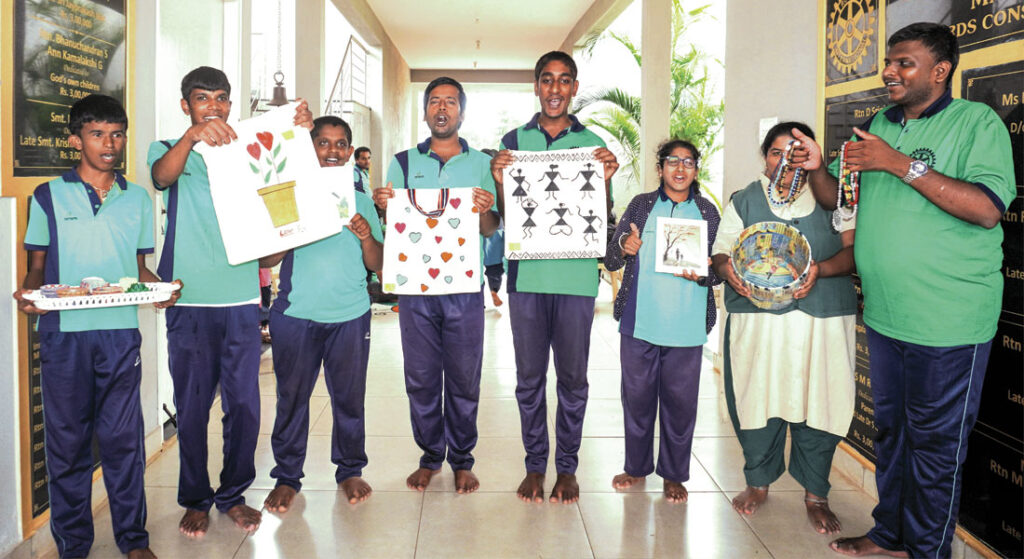
The welcome at Rotary Maanasa Kuteera in Mysuru is warm and spontaneous. As I enter, the children greet me with enthusiastic applause. Moments later, 17-year-old Rajan, a student with ADHD, sings a soulful Kannada song. He astonishes me further by telling me, in a matter of seconds, the day of the week I was born after I mentioned my date of birth. It was a remarkable display that challenged many assumptions about children with intellectual and developmental disabilities.
Established and managed by the Rotary Club of Mysore Mid-town, RID 3181, Rotary Maanasa Kuteera is a special school where nearly 100 children with intellectual and developmental disabilities receive education, therapy, vocational training and, above all, confidence.
For the 45-year-old club, which has around 83 members, the school represents its commitment to creating projects with lasting social impact. “Each president strives to leave behind a landmark project that serves the community. Maanasa Kuteera is not just another project for us; it is something very close to our hearts,” says club president Rakesh Babu K L.
The idea took shape in 2012–13 after club members repeatedly visited special schools across Mysuru while organising Bandaviya, an annual sports meet for 600–800 children with special needs. What they saw disturbed them. Many schools functioned from cramped rented buildings or temporary structures because landlords were reluctant to lease premises to institutions serving children with disabilities. Those that did find space struggled to pay the rent.
Parents cannot leave a child with special needs alone. By caring for them from morning till evening, we give the parents an opportunity to earn a livelihood.
— S Raghavendra
founder-chairman, Rotary Maanasa Kuteera
Determined to change this, the club secured a one-acre site from the Mysuru Urban Development Authority after nearly eight years of persistence. The land alone cost ₹45 lakh, while the school building required another ₹1.6 crore. “Every rupee came from our Rotarians and philanthropists who believed in the cause. It is truly a project built by our members,” recalls founder-chairman S Raghavendra, a past president of the club.
The spacious campus, operational for the past three years, houses 12 classrooms, a kitchen and therapy spaces. Two school buses pick up children from homes within a 10–15km radius; they are served nutritious meals at school and are dropped back home in the evening, allowing many parents to work during the day.
“Our objective was not only to educate the children but also to support their families. Many parents, particularly from economically weaker sections, cannot leave a child with special needs alone. By caring for them from morning till evening, we give the parents an opportunity to earn a livelihood,” says Raghavendra.
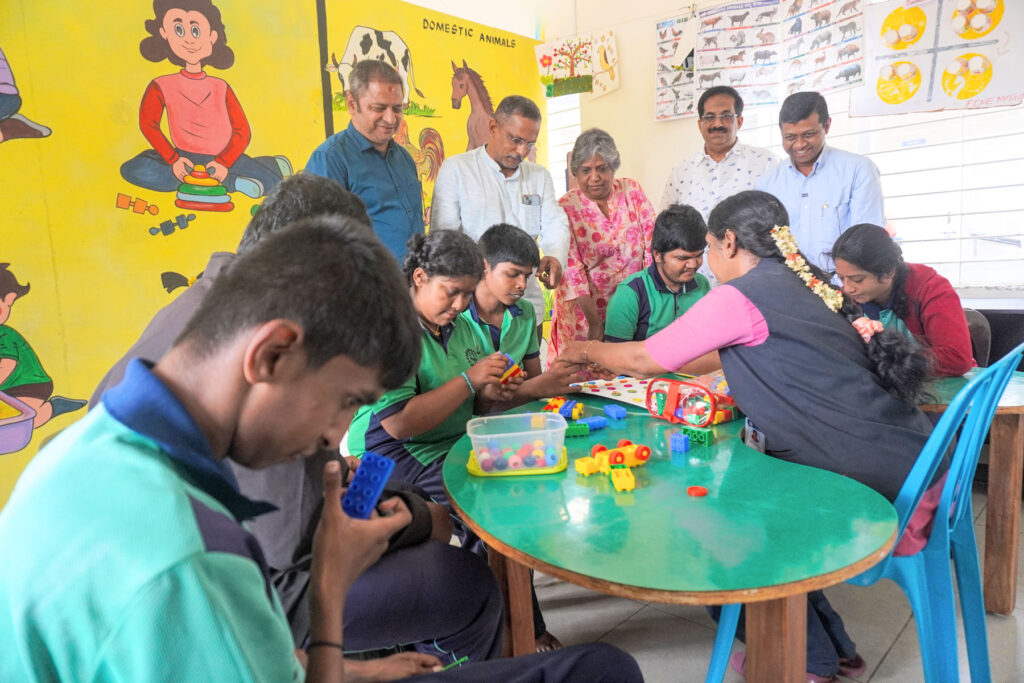
The school admits children with intellectual and developmental disabilities, including those with Down’s syndrome, cerebral palsy and autism, charging only a nominal fee from families that can afford it. Those who cannot pay are not turned away.
Learning here is tailored to each child’s abilities. After admission, teachers observe every child for about 10 days before preparing an individual learning plan. Progress is reviewed every three months and goals are revised according to each student’s development.
“We don’t rely only on what parents tell us. We assess every child, understand their strengths and challenges, and then decide the most suitable learning goals,” explains special educator Bhavani.
Besides English, Kannada, mathematics and general knowledge, the curriculum emphasises practical life skills. Students learn to recognise money, calculate change, understand time, identify vegetables and groceries, and build communication skills needed for independent living.
Vocational training forms another important pillar of the programme. Depending on their aptitude, students make greeting cards, jewellery, paper bags, candles, soaps, cloth paintings, crochet products and embroidered items. Their colourful creations reflect both patience and creativity. I found the painted cloth bags particularly attractive and could not resist buying a few.
Around 15 trained teachers, supported by caregivers, ensure every child receives individual attention. Yoga, games, music and dance are part of the daily routine, helping improve physical fitness, coordination and confidence. The children have consistently excelled in cultural competitions, held at the prestigious Dasara celebrations in Mysuru, and in inter-school events.
Club members sponsor meals on birthdays and wedding anniversaries, provide uniforms, maintain the infrastructure and regularly monitor the school’s functioning. Parent orientation and counselling sessions have also been introduced to help families better understand and support their children.
The club now plans to construct an additional vocational training block where older students can learn income-generating skills such as paper plate making and other small-scale enterprises. The long-term vision also includes a teacher training institute for special educators, addressing the shortage of trained professionals in this field.
The school’s work has already attracted attention beyond Mysuru. During this year’s Bandaviya sports event, RID 3192 DG Ravishankar Dakoju was deeply moved by the participation and enthusiasm of the children. Inspired by what he witnessed, he announced plans to replicate the event in Bengaluru as a state-level programme, with Rotary Mysore Midtown serving as knowledge partner.
While Maanasa Kuteera remains its signature initiative, the club’s service extends further. It runs an affordable school for nearly 700 children, supports government school students with digital learning devices, and has recently built a visitors’ shelter for families accompanying patients at the Princess Krishnajammanni Super Speciality Hospital in the city.
Pictures by Jaishree